
Golf Match Betting Tips: How Head-to-Head and Three-Ball Markets Work
 Available in US
There’s something deeply satisfying about simplifying a 156-player field into a direct contest between two golfers. Head-to-head matchup betting does exactly that — and when you approach it analytically, it’s one of the most accessible markets in professional golf for finding genuine edge. I’ve been tracking H2H results systematically for several years, and the market is definitely not as efficiently priced as the outright winner market. Here’s why, and what to do about it.
Head-to-Head vs Three-Ball: Key Differences
Head-to-head matchups are priced on a player-versus-player basis, typically settling on 72-hole stroke totals. Three-ball betting involves three players who are grouped together for one or more rounds, with the winner being whoever scores lowest in that specific pairing. Both markets reduce the complexity of backing an outright winner, but they operate differently in practice.
H2H matchups are usually created by bookmakers for the full tournament — four rounds, one winner determined by cumulative stroke total. Three-ball markets typically settle on a single round or, in some formats, a specific pairing across 36 holes. Three-ball settlement is faster, more volatile, and more dependent on single-round performance rather than week-long form. That volatility means three-ball prices are often less sharp, because bookmakers have less data to work with when pricing individual round outcomes.
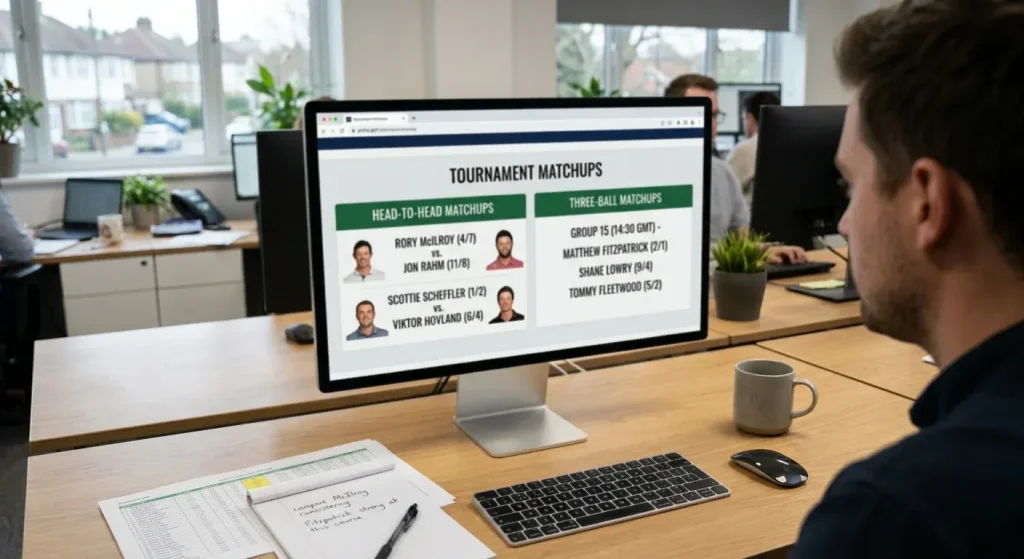
Online real event betting grew to £596 million in a single quarter — a market growing at 5% year-on-year. Within that, match betting markets are growing faster than outrights as punters discover the reduced complexity and more manageable odds. The increased attention from casual bettors also means the market is being priced more carefully than it was three or four years ago, so the edges are narrower than they were — but they’re still there.
Reading Matchup Form and Head-to-Head History
The most common mistake in H2H betting is treating it like a single-variable problem. “Player A is ranked 15th, Player B is ranked 80th — back Player A.” That logic misses all the texture that makes matchup betting interesting and potentially profitable.
Course fit matters enormously in H2H markets. A mid-ranked ball-striker who’s won twice on this course type might be a genuine threat against a higher-ranked player whose game doesn’t translate to this particular track. World ranking reflects overall tour performance, not specific course suitability. Strokes Gained data filtered by course type — specifically looking at SG performance on courses with similar characteristics to the venue in question — gives you a far more reliable head-to-head assessment than raw ranking.
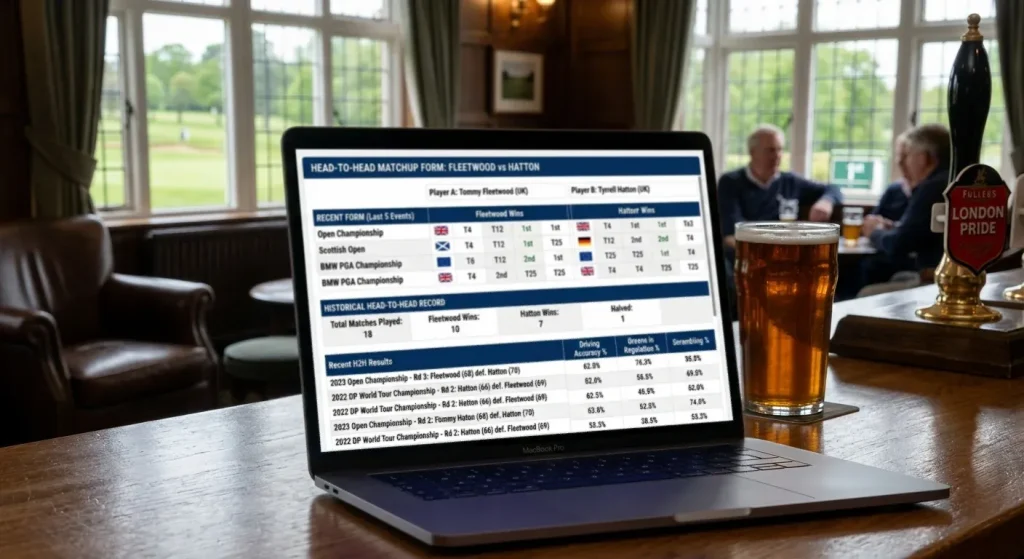
Recent form over the last six starts is the primary window I use for H2H assessment. A player in genuinely strong form — top-20 finishes, positive SG across all four categories, making cuts comfortably — is likely to outperform their ranking in any given week. A highly ranked player returning from injury or showing declining SG numbers is vulnerable to lower-ranked opponents who are peaking right now.
Actual head-to-head history between two players can be informative but requires careful interpretation. Sample sizes are usually small — these players may have only been directly grouped together five or six times across a career. That’s not enough data to draw conclusions about relative ability. What the history can tell you is how the players respond to playing in the same group — some players are genuinely affected by playing alongside specific personalities or styles. But use this as a supplementary data point, not a primary one.
DataGolf provides over 2.1 million records including form splits and course-type performance. Filtering for the last 24 months of performance on similar course profiles gives you the most reliable head-to-head dataset for any specific matchup.
Where Tee Time Groups Create Matchup Edges
This is the angle most casual H2H bettors ignore entirely, and it’s where some of the sharpest edges in the matchup market live. When the morning wave has a significant weather advantage over the afternoon wave on a links or coastal course, any player in the favourable wave has an inherent edge over a comparable opponent drawing the afternoon tee time.
For three-ball markets specifically, the groupings are published on Tuesday or Wednesday morning. A player grouped with two big hitters on a course that rewards driving distance will face a different psychological environment to one grouped with two shorter but accurate ball-strikers. Some players demonstrably play better when they’re the longest hitter in the group; others prefer not to be the shortest. This is qualitative data, but it’s real and it affects scoring.
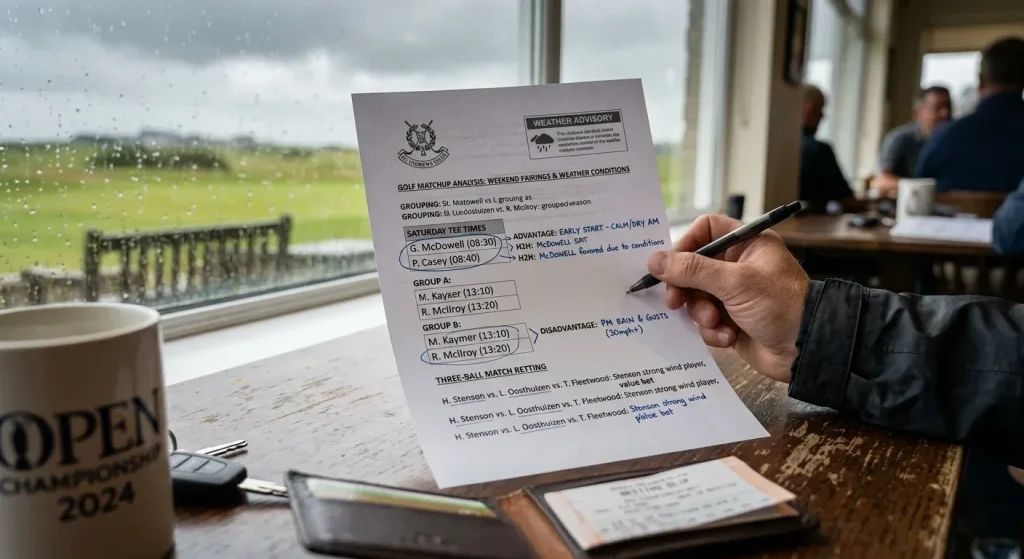
Looking at how a player has performed in their specific tee-time slot over the last five appearances at a venue — if that data is available — can reveal meaningful patterns. A player who’s consistently outscored their morning-wave groups at this course, and is again in the morning wave against an afternoon-wave opponent, has a structural tee-time edge in addition to whatever form-based assessment suggests.
Dead Heats in Match Betting: What Happens
H2H markets typically offer three options: Player A wins, Player B wins, or a tie. Most bookmakers price the tie as a separate outcome and return stakes if the market you backed isn’t a void but the exact match-result market doesn’t account for ties by default — this varies by operator and market.
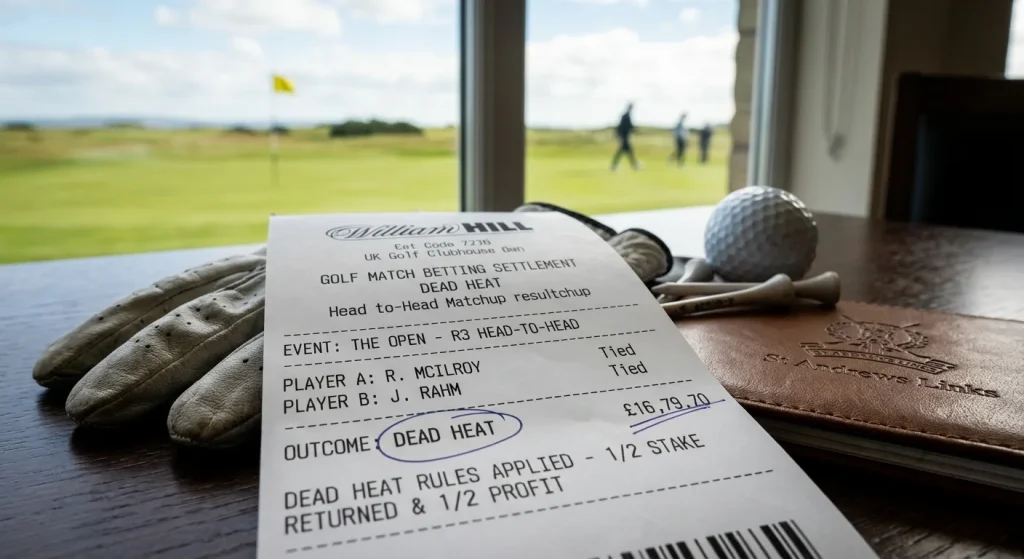
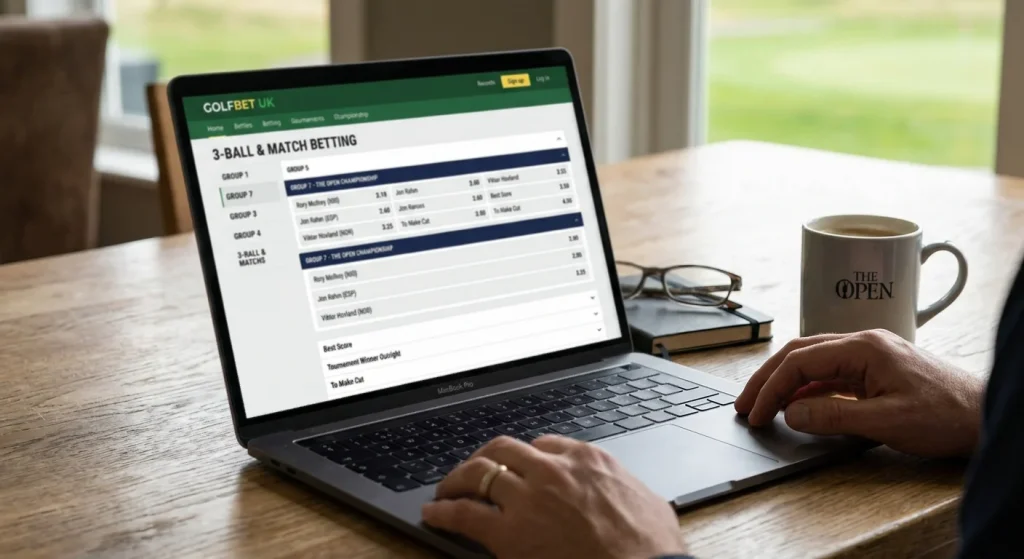
Three-ball markets are more complex, because three players can score identically or any two of the three can tie. Check the specific settlement rules for any three-ball market before placing — particularly how ties are handled when they involve two of the three players. The standard approach is similar to the dead heat formula applied in outright markets: the winning payout is split proportionally between tied players. A complete explanation of how dead heat calculations work in practice is available in the guide to dead heat rules in golf betting.
Frequently Asked Questions
What happens to a head-to-head golf bet if one player withdraws?
If one player withdraws before completing any holes in the round(s) that the bet covers, most bookmakers will void the bet and return your stake. If the player withdraws after completing at least a specified number of holes, settlement rules vary by operator. Always check the withdrawal rules for H2H markets in the bookmaker's golf betting terms before placing.
Is three-ball or head-to-head betting better value in golf?
It depends on your analytical edge. Three-ball markets settle faster, are harder to price accurately, and show more variance — which creates more frequent mispricings. H2H markets over 72 holes give your edge more time to express itself and are less vulnerable to single-round luck. If you have strong short-term form analysis, three-ball can be very effective. For players with longer-term course-fit analysis, H2H over the full tournament is usually more appropriate.
How do I research a golf head-to-head bet?
Start with Strokes Gained performance on comparable course types for both players over the last 24 months. Overlay recent form — last six starts, cut rate, top-20 rate. Check tee times and any weather forecast differential. Consider course history and whether each player's game profile matches the demands of the specific venue. Only place where a clear analytical edge separates the two players, not just a marginal difference.
Articles
Golf Betting for Beginners UK
The first time I placed a golf bet, I picked a player because I'd heard his name on television, found…
Golf Betting Value Bets Explained
The word "value" gets thrown around in betting circles so often it's almost lost meaning. Every tipster claims to find…
UK Gambling Regulation 2025-2026
The UK's regulatory framework for gambling is undergoing its most significant evolution in two decades, and most golf bettors haven't…
Golf Betting Exchange Tips UK
The first time I laid a player on a betting exchange and watched them make a quadruple bogey on the…
