
DP World Tour Betting Tips: Finding Value on Europe’s Premier Golf Tour
 Available in US
The most reliable source of value I have found in golf betting over nine years is not the Masters or the Players Championship. It is a mid-June DP World Tour event with a 132-player field, limited television coverage outside Sky Sports and a set of market prices that were clearly modelled from general player rankings rather than any serious analysis of the specific competitive context. These overlooked tournaments are where the market is thinnest, where the bookmakers’ pricing teams are allocating the least scrutiny, and where a punter who does their research properly can find odds that dramatically understate a well-suited player’s genuine finishing probability.
The DP World Tour — formerly the European Tour, rebranded in 2022 — operates Europe’s premier professional circuit. It runs a full calendar of approximately 45 to 50 events annually, spanning European venues, the Middle East, Africa, Asia and beyond, and produces its own schedule alongside the PGA Tour rather than as a secondary circuit. Understanding how to bet it is different from the PGA Tour, the data available is different, and the edges available are meaningfully more exploitable if you know where to look.

Why DP World Tour Offers Better Betting Value Than PGA Tour
Several years ago I tested a simple hypothesis: does the same research methodology produce better ROI on DP World Tour events than PGA Tour events? The answer was unambiguous, and the reason is not complicated. The PGA Tour is the most watched, most analysed and most bet golf circuit in the world. Its markets are tighter, the bookmakers allocate more analytical resource to them, and the concentration of sharp bettors per event is higher. Finding genuine mispricing in a Masters or US Open outright market requires competing with some of the best golf bettors in the world. Finding mispricing in a DP World Tour Rolex Series event at a course that receives four minutes of coverage on a Tuesday preview segment requires competing with far fewer sophisticated counterparties.
Paul Williams at Golf Betting System, who has covered the DP World Tour for more than 17 years, summarised the market dynamic accurately when he noted that access to the right each-way terms in today’s golf betting market is the essential foundation for any serious punter — and those terms are often more consistently available on European events than on PGA Tour marquee weeks when promotional competition between bookmakers operates differently. The underlying principle extends beyond each-way terms: less money flowing through a market means wider bid-ask spreads, more pricing errors, and greater opportunity for a well-researched bettor to find the kind of odds that represent genuine positive expected value rather than marginal advantage.
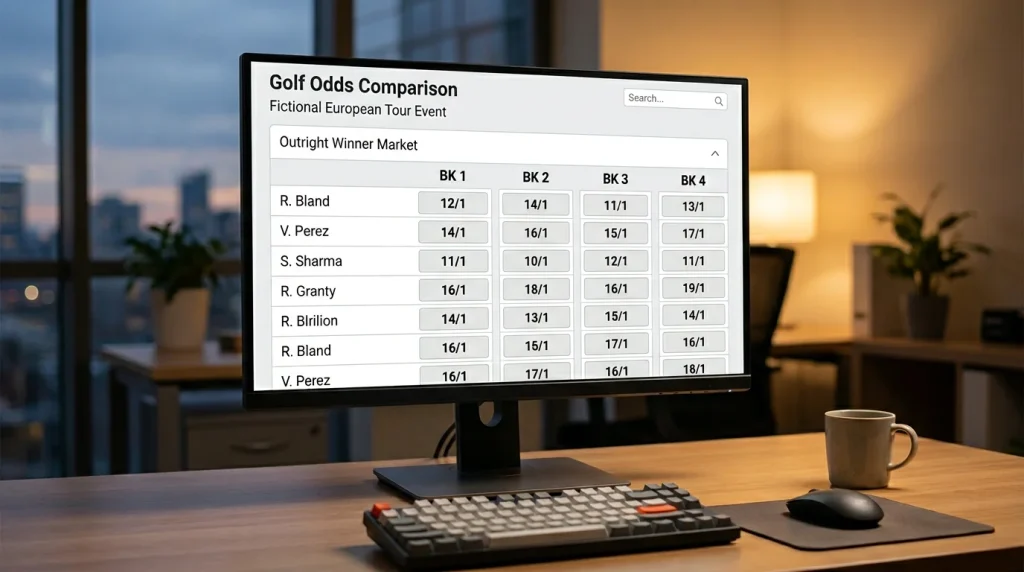
There is also a specific information asymmetry on the DP World Tour that does not exist on the PGA Tour. The PGA Tour’s ShotLink system tracks every shot with laser precision and makes the data publicly available, creating a near-level playing field in terms of performance data access. The DP World Tour’s equivalent tracking is less comprehensive and less consistently applied across all venues, which means that a bettor who does qualitative course research and player form analysis can sometimes arrive at conclusions not captured in the publicly available statistical data. That edge is not available on PGA Tour events where every approach shot is already catalogued.
The scale of the UK online gambling market provides some context for how much analytical resource is concentrated on the PGA Tour relative to the DP World Tour. Online sports betting accounts for the majority of UK gambling activity, and golf betting’s growing share of that market — with online real event betting rising 5% in the final quarter of the 2024-25 season alone — means the PGA Tour’s flagship events are attracting increasingly sophisticated betting money. The DP World Tour runs in this market’s shadow, which is exactly where an analytical edge can be maintained. The punters who allocate the same research quality to both circuits, and who bet selectively on the European events where the market is thinnest, are consistently the ones generating positive long-term returns on their golf betting.
Reading the DP World Tour Season Calendar
The DP World Tour’s season structure is more complex than the PGA Tour’s because it integrates multiple regional swings and has evolved significantly since the co-sanctioning agreements with the PGA Tour that began in earnest around 2022. Understanding the calendar is not just useful background — it is directly relevant to when and where the betting value concentrates during the year.
The season broadly divides into several phases. The early season from January through February features a heavy concentration of events in the Middle East — in Dubai, Abu Dhabi and elsewhere — that attract strong international fields because players prioritise World Golf Ranking points and Race to Dubai points during this period. These events represent competitive strength equivalent to mid-tier PGA Tour events, with many of the world’s top 50 players competing. Field depth here is higher than in the equivalent period on the PGA Tour, which means the each-way maths at longer prices can be more favourable.
The UK and Irish summer swing — spanning roughly May through July — brings the DP World Tour to home soil with events in England, Scotland, Ireland and Wales. These are the tournaments that attract the greatest UK punter interest and where the golf tourism data reinforces just how significant a live audience these events draw. The Open Championship itself pulls enormous betting volumes, but the supporting UK events in the weeks either side operate in a market with strong domestic interest and competitive fields that include the top European players competing at familiar venues.

The autumn swing and season finale in November — the DP World Tour Championship in Dubai — is where the Race to Dubai concludes and where many of the tour’s top players are motivated by prize money, ranking points and season-end bonuses to perform at their highest level. End-of-season motivation produces some of the most competitive and predictable fields of the year, where players with clear mathematical incentives to win are demonstrably more focused than they might be in a mid-season event with nothing specific at stake.
The competitive insight from all of this calendar analysis is straightforward: summer events during the UK swing, mid-season events with smaller fields and lower world ranking depth, and co-sanctioned events where many top PGA Tour players skip in favour of competing on their home circuit — these are the segments where field strength is weakest and where a well-researched player at 25/1 to 40/1 has the most realistic probability of contending. The concentration of smart money is lowest and the field itself is most navigable. This is where I allocate the greatest proportion of my DP World Tour research time.
There is one additional calendar insight worth noting: the DP World Tour’s co-sanctioning agreements with the PGA Tour mean that certain events count for ranking points and prize money on both circuits. When a major PGA Tour event runs concurrently with a mid-tier DP World Tour event, the European circuit’s field for that week is depleted of its American-based members. For bettors who track DP World Tour developments closely, these “split week” periods often produce fields where a strong European-based player — who has chosen not to travel to the USA for the concurrent PGA event — faces a significantly reduced competitive field at the European event. These situations can generate exceptional each-way value on mid-ranked European players whose odds have not been adjusted for the reduced field quality.
Course Profiles: Key DP World Tour Venues and What They Reward
The DP World Tour’s course rotation is far more varied than the PGA Tour’s, which tends to return to a consistent set of well-established parkland and links venues year after year. The European circuit plays desert courses in the UAE, links-adjacent tracks in Scotland, parkland venues in Germany, Spain and Italy, and everything in between. Each demands a different player profile, and applying a generic selection framework across all of them will consistently produce underperformance compared to using course-specific profiling.
The desert courses in the Middle East — typically firm, fast, bermuda grass fairways with tight bermuda roughs and receptive but grainy putting surfaces — reward players with precise iron play from firm fairway lies and the ability to read grain on the greens. Distance is less of an advantage here than on the long PGA Tour venues because the firm fairways add roll to every drive, somewhat equalising the distance gap between long and short hitters. Short game excellence around grainy greens becomes disproportionately important, as does the ability to hit penetrating iron shots that hold their line in the crosswinds common to elevated desert venues.

The UK links and links-adjacent courses — including the Scottish venues that host the Scottish Open and Genesis Scottish Open each summer, and the Irish Rolex Series events — reward very different attributes. Ball-flight control off the tee, the ability to execute low-running iron shots, and strong scrambling on awkward ground above and below the flag are the primary differentiators. Distance advantage is amplified or eliminated depending on wind direction, making SG: Off the Tee a more variable predictor than on calm, protected parkland venues. The player who consistently performs on these courses has creative imagination with the short game and the ability to play “ugly golf” — saving par from awkward positions rather than relying on the kind of pure iron approach play that dominates at Augusta or TPC courses.
Continental European parkland venues — those in Germany, Italy, France and Spain — tend to sit somewhere between the two extremes described above. They are typically tighter off the tee than the open fairways of a links course, more demanding around the greens than a typical US parkland, and often feature European ryegrass or bentgrass surfaces that favour a high ball-flight approach rather than the run-up game required on firmer turf. Accurate driving combined with reliable SG:APP performance is the profile I consistently look for at these events, with SG: Around the Green as a secondary differentiator on courses where the roughs around the green reward a clean wedge game.
Understanding these contrasts means your SG filtering criteria should change from week to week depending on where the tour is playing. The player who leads the DP World Tour in SG:OTT and SG:APP on parkland courses may be a marginal proposition at a Scottish links event in a west coast wind. Applying the right category weighting to the right venue type is the core competency that separates disciplined DP World Tour betting from generic form-chasing.
One practical tool for building these venue profiles is the DP World Tour’s own shot tracking data, available through the tour’s official statistics section. While less granular than PGA Tour ShotLink, it provides scoring average breakdowns, driving accuracy and distance figures, and greens in regulation data by venue that allow you to identify the statistical fingerprint of recent winners at each course. Players who fit the winner profile are those whose game characteristics — measured objectively over recent starts — match the attributes that the course has historically rewarded. That alignment is what genuine course fit looks like when you strip away the narrative.
Each-Way Betting on DP World Tour: Terms and Opportunities
Each-way value on the DP World Tour operates under the same structural logic as PGA Tour betting but with some meaningful differences in how bookmakers apply their terms, particularly for smaller events with field sizes below 100 players.
The standard each-way market for most DP World Tour events is five places at one quarter of the win odds, identical to the PGA Tour baseline. However, the promotional extension of terms — to six, eight or ten places — is less consistent on the European circuit than on PGA Tour marquee events. Bookmakers tend to extend terms most reliably on the Rolex Series events (the DP World Tour’s equivalent of elevated PGA Tour events) and on the season-ending DP World Tour Championship. For mid-tier events with smaller purses, you are more likely to find that standard five-place terms apply, and that only one or two operators are offering extensions at all.

This is both a constraint and an opportunity. On the weeks when a major bookmaker does offer extended terms on a DP World Tour event that the market has not heavily bet, the value available from those terms in combination with a well-researched player profile can be exceptional. One leading UK operator’s analysis of its each-way extensions across the 2025 season showed that 563 additional places were offered above the standard market across the full Major, PGA Tour and DP World Tour schedule — a figure that underscores how significant the cumulative value of extended terms becomes across an entire year of betting. The key is identifying which DP World Tour events attract the term extensions and timing your selections to take advantage of them when they are available. For a full breakdown of how to evaluate and compare each-way terms across bookmakers and event types, the each-way golf betting guide covers the methodological detail.
The field size consideration is particularly relevant for DP World Tour events. Standard each-way terms for fields of fewer than 12 players may be reduced to two or three places, but most DP World Tour events start with fields of 120 or more, making this a non-issue for the majority of the calendar. The events where field size genuinely affects terms are the small invitational events and team formats that operate as separate competitions from the main stroke play schedule.
The Race to Dubai Outright: Betting the Season-Long Market
The Race to Dubai is the DP World Tour’s season-long order of merit — the ranking of players by prize money earned throughout the year, which determines the champion and the qualification criteria for the season-ending Championship. It is also a betting market that offers a genuinely different kind of opportunity from the week-to-week outright markets that most punters focus on.
The season-long outright operates across approximately ten months of competitive golf. Prices are published at the start of the season, typically in January, and updated throughout the year as the competition develops. The opening prices — set before a single event has been played — reflect general player quality assessments and recent form coming out of the previous season. They are not built from any event-specific form analysis, which means they can be significantly wrong about players who are coming into form, have made technical improvements over the winter, or are specifically motivated by the Race to Dubai as a competitive target for the current season.

The best entry points for Race to Dubai outright bets are typically in the first four to six weeks of the season, before the early Middle East results have begun to compress prices on the obvious early leaders. A player who finishes 4th in the season-opening event and 2nd in week two will see their Race to Dubai price shorten dramatically — backing them at the opening price before their strong early form becomes obvious is where the value concentration is highest. This requires doing early-season form analysis that most casual punters do not bother with, which is precisely why the early-season prices are often generous.
Hedging strategies become relevant once a player you have backed outright builds a meaningful Race to Dubai lead. If they have moved from 25/1 to 6/1 by mid-season and hold a 500-point lead in the standings, the option to lay them at shorter odds or back their leading rival at extended prices offers a risk management tool that outright markets for single tournaments do not provide. The season-long duration also means you have extended opportunities to cut losses if a player you have backed suffers an injury or severe loss of form in the early weeks — selling back an early-season position at reduced odds limits your downside in a way that is not available in a standard tournament outright where your bet runs for four days or not at all.
Frequently Asked Questions
Is DP World Tour harder to bet on than PGA Tour?
In some respects, yes — the data available for European players who compete primarily on the DP World Tour is less granular than PGA Tour ShotLink data, and the course variety is greater. But from a market efficiency standpoint, DP World Tour events are often easier to find value in because fewer sophisticated bettors analyse them in depth. The bookmakers' margins tend to be wider on European events, and the pricing errors are more frequent on smaller DP World Tour events than on flagship PGA Tour weeks.
When does the DP World Tour season typically start and finish?
The DP World Tour season currently runs from approximately January through November. It opens with Middle East events in January and February, moves through a European spring and summer swing from April to August, and concludes with the Race to Dubai finale in November. The schedule overlaps significantly with the PGA Tour, with many co-sanctioned events where both circuits' points are available.
Which bookmakers offer the best coverage of DP World Tour events?
Coverage varies significantly between bookmakers. The leading UK operators all cover the flagship Rolex Series events, but depth of coverage for mid-tier DP World Tour events differs. Look for bookmakers that publish early each-way terms on European events and maintain competitive outright markets throughout the week rather than only opening markets close to the first round. Having multiple accounts is particularly important for DP World Tour betting given the variation in which firms offer the best terms on any given event.
What is the Race to Dubai and can I bet on it outright?
The Race to Dubai is the DP World Tour's season-long order of merit, determining the tour champion based on prize money accumulated across the year. Yes, it is available as a betting market at most major UK bookmakers, typically opening in January with outright winner prices and available for in-running bets throughout the season. The best value tends to be in the opening weeks before early-season results have compressed prices on the obvious contenders.
Articles
Golf Course Form Guide
The laziest analysis in golf betting is "he's won here before." The most sophisticated analysis acknowledges that course history matters…
Masters Betting Tips
Augusta National is the most predictable Major venue in golf — if you're looking at the right metrics. That sounds…
Golf Betting Free Bets UK
Free bets are how UK bookmakers compete for new customers — and for good reason. A well-structured offer can genuinely…
Golf Course Form Guide
Monday morning, the tour schedule updates, and you have until Thursday morning to build a credible analytical case for the…
