
Golf Betting Value Bets Explained: How to Find Mispriced Odds Every Week
 Available in US
The word “value” gets thrown around in betting circles so often it’s almost lost meaning. Every tipster claims to find value. Every preview promises “value selections.” But ask most golf bettors to explain precisely what value means — in mathematical terms — and the conversation gets awkward very quickly. I spent my first two years backing horses I liked without once doing the calculation that would tell me whether the odds actually represented a positive expectation. Here’s what I wish someone had explained to me earlier.
What Value Betting Actually Means
Value betting is not about picking winners. That’s the fundamental misconception. Value is about finding bets where the probability implied by the odds is lower than your assessed probability of the event occurring. Those two things — picking winners and finding value — are related but entirely distinct.
Sports betting accounts for more than 57% of the UK online gambling market by gross yield. That’s a vast amount of money exchanging hands every week, and the bookmakers wouldn’t be growing if punters were systematically identifying value correctly. The market is efficient — but not perfectly efficient, and that gap is where profit lives.

Think of it like this. Imagine a coin you know is weighted 60/40 in favour of heads. A bookmaker offers you evens on heads — effectively implying a 50% probability. You should take that bet every single time, regardless of whether it lands heads or tails on any individual flip. The edge is in the process, not the outcome. Golf is exactly the same, just with 156 players instead of two sides of a coin.
The single most important principle: if you can consistently identify situations where your probability estimate is better than the bookmaker’s, you will make money over time. That’s value betting. It requires a method for estimating probability, the discipline to act only when the gap is real, and the patience to let the long run play out.
Calculating Implied Probability Step by Step
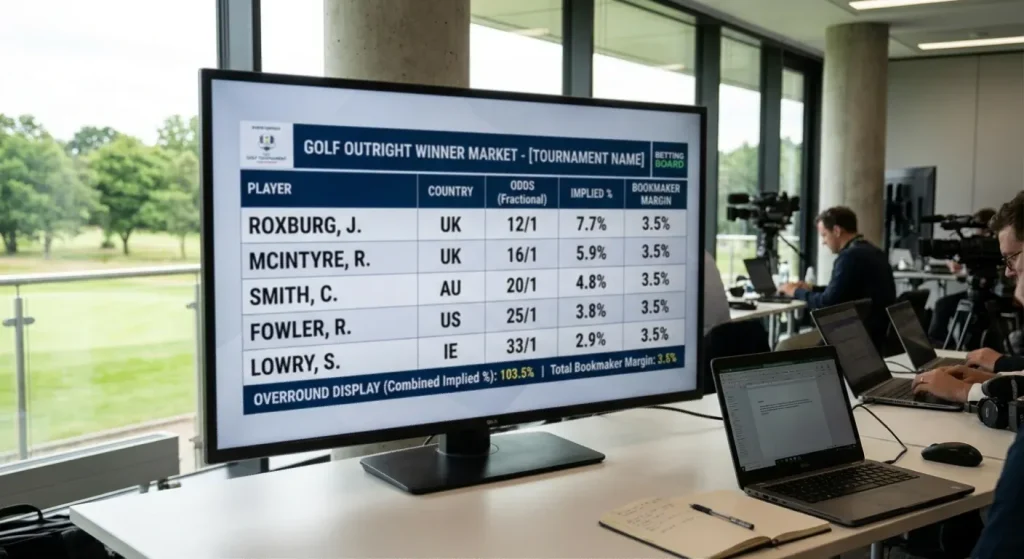
I remember the first time I ran this calculation on a golf outright market and actually looked at the numbers end to end. The bookmaker’s book added up to 130%. That 30% overround represents their edge — the margin baked into every price across the field. Understanding that single fact changes how you approach every bet you’ll ever place.
Converting fractional odds to implied probability is straightforward. Take any price — let’s use 20/1. The formula is: denominator divided by (denominator plus numerator). So 1 divided by (1 plus 20) gives you 1/21, which is approximately 4.76%. The bookmaker is implying this player has a 4.76% chance of winning.
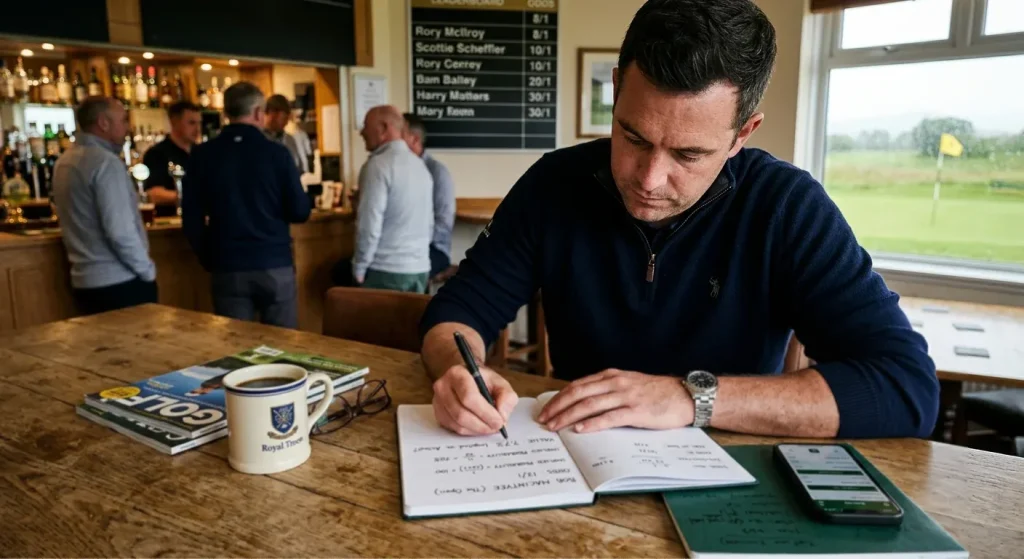
Now here’s where your analysis comes in. Using Strokes Gained data, recent form, course fit, and field strength, you’ve assessed this player at 7% — meaning you believe they’re roughly a 14/1 chance. The odds are 20/1. You’ve found value. The mathematical expectation on a £10 bet at 20/1 is positive: (0.07 x £200) minus (0.93 x £10) equals £14 minus £9.30, which is £4.70 expected profit per bet.
Run this same calculation in reverse to understand what a bookmaker’s price implies, and you can audit every selection you’re considering before you place it. If your honest assessment of a player’s winning probability is lower than the implied probability in the price — that’s not a value bet. Walk away. That discipline alone will save most punters significant money over a season.
For each-way bets, the calculation requires separate probability estimates for the win part and the place part. The place probability depends on the number of places paid and the fraction of the win price. It’s more complex but the same principle applies: does your assessed probability exceed the implied probability? Only bet when the answer is yes.
Where Golf Bookmakers Consistently Missprice
After nine years watching golf markets, there are predictable patterns in where bookmakers tend to leave value on the table. This isn’t a permanent edge — the market is smarter than it was five years ago — but the patterns persist because of the structural realities of how golf odds are priced.
The most consistent area is mid-range players in fields with a dominant favourite. When one or two players attract massive public money and media attention, the pricing of the 30/1-to-80/1 tier often gets depressed. Bookmakers shade the heavy favourites tighter to manage liability and implicitly inflate the mid-field prices. That’s where value hunting is most productive.
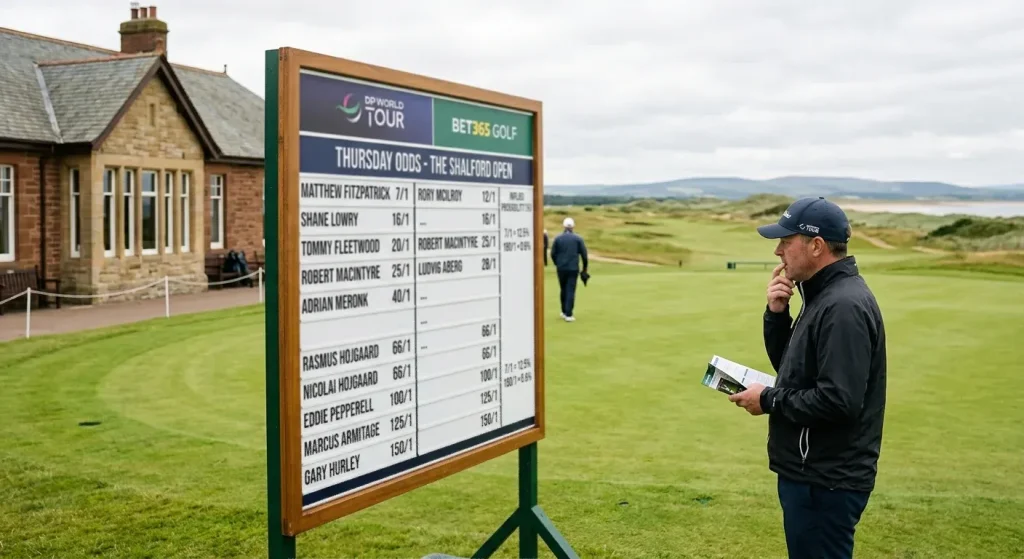
Week-to-week events on the DP World Tour are another reliable area. Lower media coverage means less smart money, which means wider bid-ask spreads and more frequent mispricings. The bookmaker doesn’t have the same volume of information flowing through to sharpen the prices as they do for a PGA Tour event broadcast to millions.
Early prices on Tuesday and Wednesday also tend to offer better value than day-of-event prices. As information accumulates — weather forecasts, practice round reports, injury updates — prices tighten. Getting on early when you have a strong view locks in the inefficiency before the market corrects. Online real event betting grew 5% in a single quarter to reach £596m — that volume creates a competitive market, but the arbitrage window is widest before the money rushes in.
Late withdrawals create short-term mispricings that disappear within minutes. If a field loses a major name on Thursday morning, the remaining players’ prices don’t always adjust proportionally or quickly enough. Having multiple accounts open and monitoring alerts gives you a window — though a narrow one — to exploit those recalculations.
Tracking Value Over a Season
Finding individual value bets is one thing. Knowing whether your value identification process actually works is another — and it requires keeping records that go beyond “did I win or lose?”
The metric to track is closing line value. The closing price — the final odds before an event starts — represents the market’s sharpest estimate of probability. If you’re consistently backing players at prices that are longer than the closing price, you’re beating the market. That’s as close to confirmed edge as you can get. If you’re consistently getting shorter prices than the closing line, you’re backing popular selections after the smart money has already moved the price.
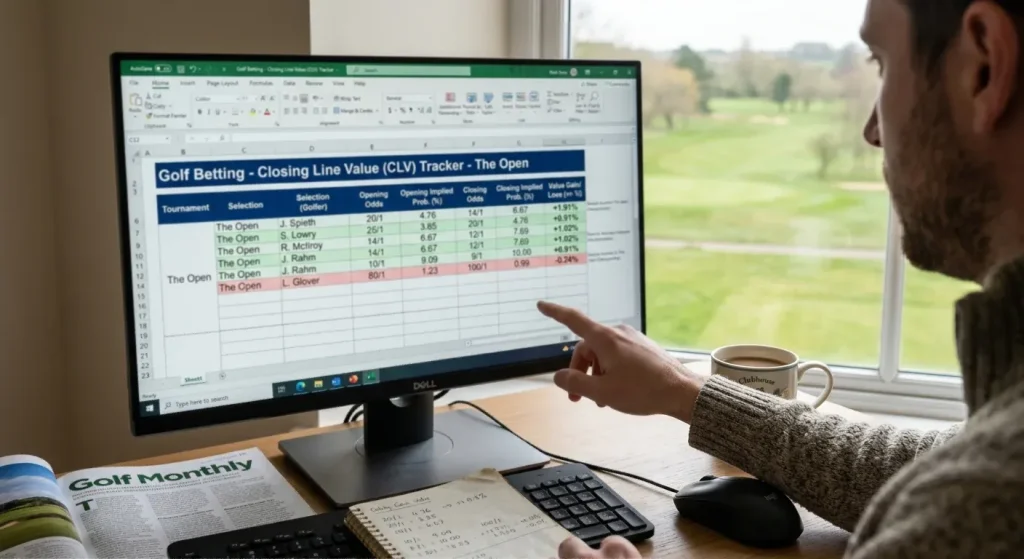
Keep a simple spreadsheet: date, tournament, player, your estimated probability, odds taken, closing odds, stake, result. After 100 bets, you’ll have a clear picture of whether your probability estimation is better or worse than the market’s. After 200 bets, the signal is reliable enough to draw real conclusions.
The honest reality: most punters who track their records this rigorously discover that their probability estimates are not systematically better than the market’s. That’s not a reason to quit — it’s a reason to refine the model. Combining your own qualitative judgment with tools like Strokes Gained data, which you can explore in more detail in the guide to Strokes Gained golf betting, is where genuine analytical edge gets built over time.
Frequently Asked Questions
What is implied probability in golf betting?
Implied probability is the chance of an outcome that a bookmaker's odds suggest. For a player priced at 9/1, the implied probability is 1 divided by (9+1) equals 10%. If you believe the player has a better than 10% chance of winning, you have a value bet. The bookmaker's full market will always sum to more than 100% — the excess is their margin.
How do I know if a golf bet offers genuine value?
Calculate the implied probability from the odds, then honestly assess the player's actual probability using form, course fit, Strokes Gained data, and field strength. If your assessed probability is higher than the implied probability, you have a value bet. The more reliable your probability estimation process, the more accurately you'll identify real value.
Does value betting work differently in golf compared to football?
The core principle is identical — back when your probability exceeds the implied probability. The key difference is field size. With 156 players, even a favourite might have only a 12-15% chance of winning, so all golf betting operates in the realm of longshots. This creates more frequent mispricings and more opportunities, but also means variance is higher and larger samples are needed to validate an edge.
Articles
Masters Betting Tips
Augusta National is the most predictable Major venue in golf — if you're looking at the right metrics. That sounds…
Best Golf Tipsters UK 2026
I've wasted money on tipster services that looked impressive until I asked one simple question: where's the verified proof? The…
Golf First Round Leader Tips
The FRL market is one of the most interesting bets in golf — and one of the most frequently misunderstood.…
UK Gambling Regulation 2025-2026
The UK's regulatory framework for gambling is undergoing its most significant evolution in two decades, and most golf bettors haven't…
