
Free Golf Betting Tips: The Complete UK Punter's Guide for 2026
 Available in US
Sharp picks. Real stats. Your weekly edge.
Start Reading
Most golf betting sites give you tips. This one gives you the reasoning behind the tips — the analytical framework that tells you why a certain player represents value at a certain price on a certain course, not just a list of names to back before Thursday. After nine years of tracking picks, testing staking systems and building performance models around Strokes Gained data, the difference between a profitable season and a frustrating one almost never comes down to luck. It comes down to methodology.
The UK sports betting market generated over £3.3 billion in Gross Gambling Yield in the first quarter of the 2025–2026 financial year alone. A significant slice of that — 56.6% of all online gambling — comes from sports wagering. Golf has been one of the fastest-growing verticals within that figure, partly because the markets are deep, the tournaments are weekly

What you'll find in this guide is different from the standard tipster fare. You'll get a clear breakdown of how each-way betting actually works in practice, with real numbers rather than vague reassurances. You'll get a grounding in Strokes Gained — the statistical methodology that serious analysts use to separate genuine contenders from narrative-driven picks. You'll get a system for reading tournament form before a single shot is played. And you'll get a bankroll framework that keeps you in the game long enough for an edge to compound. The weekly picks are here too, updated each time a new tournament cycle begins — but this page is built to be useful even when the leaderboard is blank.
What Every UK Golf Bettor Needs to Know Right Now
- Each-way terms vary enormously between bookmakers — the standard market offers 5 places at 1/4 odds, but leading operators in 2026 are regularly extending to 8–12 places. That difference is worth more than any single tip.
- Strokes Gained Approach is the single most predictive metric for identifying tournament contenders. It was developed at Columbia University in 2011, and every credible analyst now uses it — yet most tipster sites never mention who created it or how it works.
- 8% of UK adults bet online on sports in any given four-week period, according to Gambling Commission data. Golf punters represent a knowledgeable subset of that group — and the market inefficiencies that remain are found through research, not instinct.
- The regulated market is under pressure from illegal operators: unlicensed betting stakes in the UK grew from £5 billion in 2019 to £16.6 billion in 2025. Sticking with UKGC-licensed bookmakers isn't just safer — it's the only way to access the protections that actually matter.
- Bankroll discipline beats system-hunting every time. A verified tipster track record of 30% ROI over 2,000+ bets means nothing if you're staking 20% of your bank on a single longshot.
Why Golf Betting Rewards Patience, Not Luck
The first time I had a 33/1 shot finish second and collect an each-way return that covered three losing weeks in one go, I understood why serious punters treat golf differently from every other sport. That wasn't luck. That was a player whose approach-play numbers pointed toward contention on a course where approach play is everything — and a bookmaker offering 10 places at 1/5 odds instead of the standard 5 at 1/4. The combination of those two facts, and only those two facts, made the bet worth placing.
Golf rewards patience for a structural reason: the size of the field. In a 156-player PGA Tour event, even the pre-tournament favourite rarely wins more than once every six starts. The implied probability of backing a 14/1 shot to win is around 6.7%, but their implied probability of making the top 10 might be closer to 30–35%. That gap between win probability and place probability is where golf betting value lives — and it's a gap that doesn't exist in the same way in football or horse racing.
UK Sports Betting Share
56.6% of all UK online gambling is sports wagering — the single largest segment of the market.
Online Bettors Monthly
Around 290 million online bets on real events are placed in the UK every month — and the golf market grows faster than traditional verticals like racing.
Active Sports Bettors
8% of UK adults placed an online sports or racing bet in the four weeks preceding the most recent Gambling Commission survey — a figure that has held steady, suggesting a stable and engaged punter base.
The growth in golf betting isn't accidental. The Gambling Commission's own chief executive noted in a speech at ICE 2025 that operators are "showing a widening out of the sports offering in particular, with sports beyond the traditional horseracing and football growing." Golf is specifically part of that trend — and the consequence for bettors is that market depth is improving year on year. More bookmakers offering more markets with more competitive odds is, bluntly, good for the serious punter.
Golf betting's core advantage over other sports markets is the combination of large fields, long tournament duration and weekly frequency. Unlike a football fixture with two or three realistic outcomes, a golf tournament presents 156 starting prices — and among those, there are always several players whose odds don't fully reflect their statistical profile. That's the gap systematic analysis is designed to find.
Where most casual bettors go wrong is treating golf like a lottery: picking names they recognise from TV coverage, chasing last week's winner, or loading up on the low-priced favourite because it "feels" safe. The players who actually make money from golf betting — verified tipster services with 7-year track records, P&L histories stretching back to 2018 — do none of that. They pick on price. They evaluate statistical fit. They wait for the right market conditions. And then they move.
That's the discipline this guide is designed to build. Not a shortcut. A framework.
How Each-Way Betting Works in Golf — With Real Numbers
Here's something I learned the hard way in my early punting days: not all each-way bets are equal. Two bookmakers can both offer "each-way golf betting" on the same tournament, and one of them might be worth roughly twice as much as the other. The difference is in the terms — specifically, how many places are paid and at what fraction of the win odds. Getting this wrong is one of the most expensive habits a golf bettor can have.
The industry standard for golf each-way betting has traditionally been 5 places at 1/4 the win odds. That means if you back a player each-way at 20/1 for a £10 total stake (£5 win, £5 place), and they finish in the top 5, your place return is 20 multiplied by 1/4, which is 5/1. Your £5 place bet returns £25 plus your £5 stake back — a total of £30 from the place portion alone.
That's the baseline. But in the current market, it's increasingly not the best you can do.
Standard vs Enhanced Each-Way Terms in 2026
The industry default is 5 places at 1/4 the odds. Leading bookmakers now regularly offer 8, 10 or 12 places on major PGA Tour and DP World Tour events — sometimes at the same 1/4 fraction, sometimes at 1/5. Understanding which combination offers better value requires doing the maths, not just counting the number of places.

The maths of enhanced each-way terms matters enormously, and here's a concrete example to show why. One of the major operators offered 563 additional each-way places above the market standard across all Majors, PGA Tour and DP World Tour events in 2025 — that's not a promotional gimmick, that's a structural commitment to the golf market that changes the value calculation for every single bet placed through them.
Each-Way Return Calculation: Standard vs Enhanced Terms
Scenario: You back a player at 20/1 each-way for a £10 total stake (£5 win, £5 place). The player finishes 7th.
Standard terms (5 places, 1/4 odds): Player finishes outside the 5 paid places. Your win bet loses. Your place bet loses. Total return: £0. Total loss: £10.
Enhanced terms (8 places, 1/5 odds): Player finishes 7th — within the 8 paid places. Place odds: 20/1 x 1/5 = 4/1. Your £5 place bet returns £20 plus £5 stake = £25 total. After losing the £5 win bet, your net return on the £10 stake is £25 — a profit of £15.
The difference: Identical bet, identical result, identical player selection. One set of terms returns £15 profit. The other returns a £10 loss. This is why bookmaker selection is not a secondary consideration — it's a primary one.
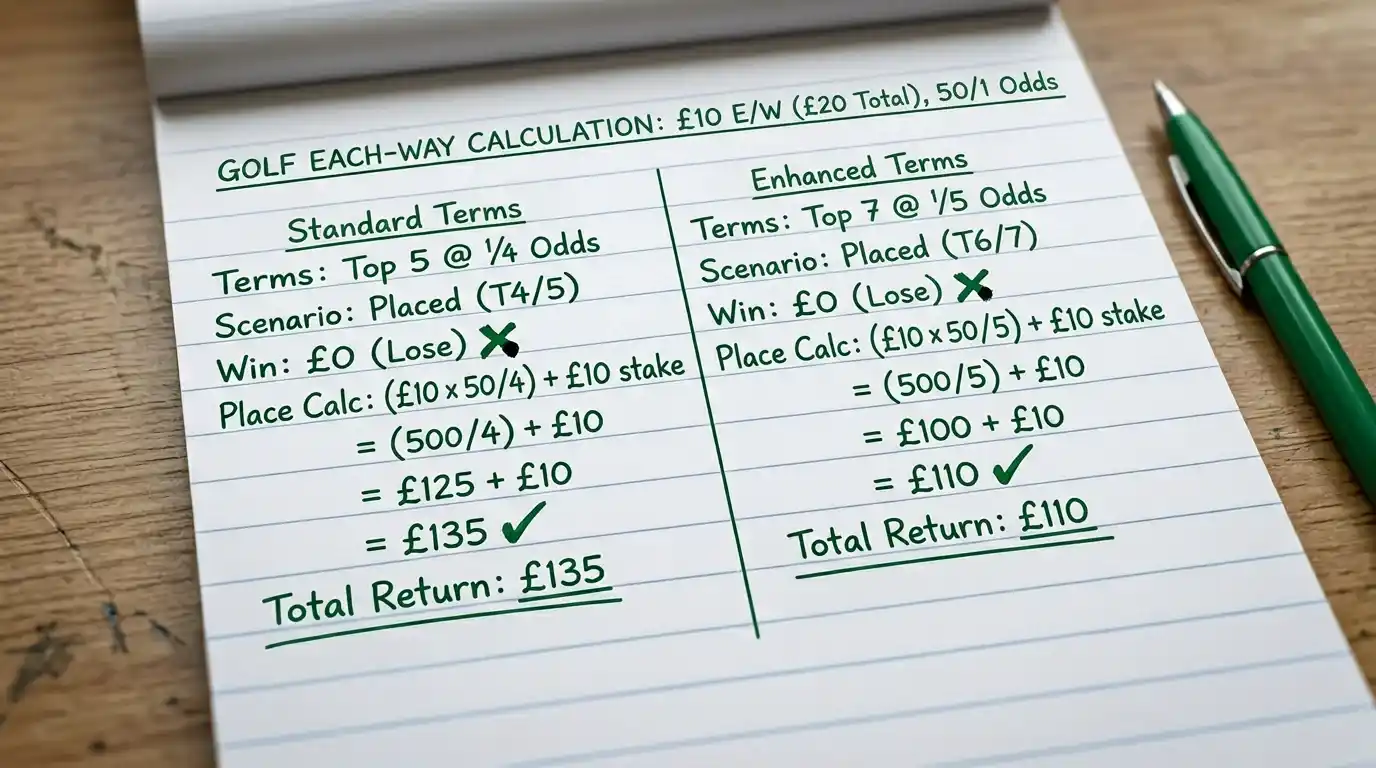
A worked comparison by one analytics resource put it this way: an each-way bet at 20/1 with 8 places paid at 1/5 odds is roughly equivalent in expected value to a win-only bet at 26/1. That's a meaningful implied odds upgrade, and it explains why experienced golf bettors maintain accounts with multiple licensed operators specifically to access the best each-way terms available each week.
There's a deeper point here too, which is about what "each-way value" actually means. A player offered at 33/1 in a 156-player field might have a statistical top-10 probability of 22% based on their Strokes Gained profile. If the place terms cover 10 places, and those 10 places represent roughly the top 6.4% of the field, then the implied probability you need to beat with that selection is much lower than 22%. That's positive expected value — and it's the kind of calculation that separates structured betting from guessing.
For a full breakdown of how to calculate each-way returns in different scenarios, including dead heat adjustments and what happens when a player withdraws mid-tournament, see the dedicated guide to each-way golf betting tips.
Understanding Strokes Gained: Your Statistical Edge
The most important analytical tool in modern golf betting wasn't invented by a bookmaker, a tipster service, or a data company. It was developed by a finance professor named Mark Broadie at Columbia University in 2011, using a dataset called ShotLink that tracks every single shot in professional golf — location, distance to hole, outcome, everything. Broadie published his methodology in an academic paper, the PGA Tour adopted it, and within a decade it had fundamentally changed how anyone serious about golf betting evaluates player performance. Most tipster sites mention "Strokes Gained" in passing. Almost none explain where it came from or why the academic origin matters.

Before SG, the best available statistics were things like putts per round, driving accuracy and greens in regulation. These numbers are what they sound like: raw counts. The problem is they don't account for context. A player who hits 14 greens in regulation from easy positions has actually underperformed a player who hit 11 greens from difficult ones. SG fixed this by comparing every shot to the expected score for a tour-average player from the same spot — and the result was a statistical framework that actually predicts future performance rather than just describing past results.
SG:OTT (Off the Tee) — measures value added or lost from tee shots, accounting for distance and accuracy relative to the tour average from each position.
SG:APP (Approach) — measures value added or lost on approach shots into greens. Widely considered the most predictive category for sustained tournament performance.
SG:ARG (Around the Green) — measures value added or lost on short-game shots from outside putting distance but not full approach distance.
SG:P (Putting) — measures value added or lost on the putting surface relative to the tour average from each specific distance.
Here's the critical point for betting purposes: not all four categories carry equal predictive weight. Approach play — SG:APP — is the single most stable and forward-looking metric in the entire dataset. The reasoning is intuitive once you hear it: approach play directly creates birdie opportunities by setting up short putts from quality positions. Players who consistently gain strokes on approach tend to outperform over time, even during stretches where their putting goes cold. Putting, by contrast, is relatively volatile from week to week — a player can rank first in SG:P one tournament and fortieth the next. Backing approach specialists means backing a more durable form of excellence.

This plays out specifically at Augusta National, where multiple statistical analyses have confirmed that SG:APP is the critical differentiator among Masters contenders. The players who score well there — year after year, regardless of their world ranking — are almost uniformly strong approach players. The finalists who accumulate +1.0 or better in SG:APP over recent starts are disproportionately represented in the final groups on Sunday. That's not coincidence. It's course architecture. Augusta rewards shots to specific sections of greens, and the players who control their approach distances with precision have a structural advantage at every hole on the property.
DataGolf maintains one of the most comprehensive SG databases available, with over 2.1 million records covering professional golfers across the PGA Tour, DP World Tour, and other major circuits. Free access to rolling SG averages is available through multiple tools, and the PGA Tour's own ShotLink system publishes weekly updates. Using these tools doesn't require a data science background — it requires knowing which numbers to look at and what they mean in the context of a specific course profile.
Strokes Gained was built by an academic, adopted by tour analysts, and is now the baseline for any serious betting research. If a tip doesn't come with at least a nod to SG metrics, it's based on narrative — and narrative doesn't beat closing line value over the long run.
For a full practical guide — including how to build a weekly shortlist using SG data, how to weight categories by course type, and where to access the best free tools — the dedicated article on Strokes Gained golf betting covers all of it in depth.
How to Read Golf Form Before You Bet
I've watched punters lose significant money backing players who won the same tournament two years running. The logic is seductive — "he loves this course" — but the form analysis behind it is paper-thin. Course history is one input among many, and in isolation it can actively mislead you. A player who won here three times in the mid-2010s may have done so on different greens, in different rough conditions, at a different stage of their career. The course is the same name. The relevant characteristics may have changed entirely.
Genuine form analysis starts with recent output — the last eight competitive starts, minimum — and works systematically through a set of specific metrics. For each player under consideration, I look at scoring average relative to field, cut percentage over the past 20 starts, GIR percentage (greens in regulation) as a proxy for ball-striking consistency, bogey avoidance rate on the specific type of course profile coming up, and then SG performance in the relevant categories for that venue.
DataGolf and the PGA Tour's statistics portal give you most of this for free. The DP World Tour's stats platform has improved significantly and covers most of the same ground for European events. The challenge isn't data availability — it's knowing how to weight the data you have. Recent form should be weighted more heavily than historical results for most players in most situations, with two exceptions: Augusta National and The Open Championship. Both courses have such specific demands that three-to-five-year course history from the current era of the player's career does carry meaningful signal, in a way that a generic parkland event doesn't.
Weather is also form analysis. A player with strong links credentials and a history of scoring well in wind is a structurally different bet for a coastal Scottish course in October than they are for a soft, calm parkland event in the same week. The conditions at the venue during that specific tournament modify the course profile — and therefore modify which statistical attributes matter most. Checking a seven-day forecast before placing any golf bet is not optional. It's part of the process.
My Pre-Bet Form Checklist
- Last 8 tournament results: scoring average relative to field, not just raw scores
- Cut percentage over last 20 starts: players who miss cuts frequently can't generate place returns
- SG:APP over the rolling 24-month period, filtered to comparable course types
- Course history from the current form era only: ignore results from more than 4–5 years ago unless the player profile hasn't significantly changed
- Tee time grouping: early waves on Thursday can have a meaningful advantage or disadvantage depending on whether conditions are expected to ease or worsen through the day
- Market movement: if a player's odds have shortened by 30% or more since early prices opened, there's usually data behind that movement worth investigating

The goal of form analysis isn't to find certainty — golf doesn't offer that. It's to build a shortlist of players whose statistical profile fits the course profile better than their odds reflect. From a 156-player field, a disciplined form process should reduce the universe to 12–20 genuine candidates. The value is then found among those 12–20 based on price. For a complete tournament research framework with the full methodology for building that shortlist, the golf course form guide goes through every step in detail.
The form process above applies to any professional golf event. But how you calibrate the research — how deep you go, which metrics carry the most weight — depends significantly on which tour you're betting. That calibration question is worth addressing directly.
PGA Tour vs DP World Tour: Where the Betting Value Lies
A question I get regularly is which tour to focus on. My honest answer: both, but for different reasons.
The PGA Tour is the better-covered market. It's where the biggest names play, where ShotLink data is most comprehensive, and where most major bookmakers allocate their pricing resource. That comprehensive coverage cuts both ways — more data means a more informed market, which means the bookmakers' opening odds on PGA Tour events are generally tighter. Inefficiencies still exist, but you need to dig harder to find them. The PGA Tour market had a total addressable size of $2.5 billion in 2024, projected to reach $3.8 billion by 2032 — that kind of commercial scale means significant analytical resource goes into pricing it accurately.
The DP World Tour is a different story. Smaller fields in some events, less media scrutiny, less smart money flowing into the markets — and the consequence is wider pricing inefficiencies. A player who finishes 8th in a DP World Tour event on a course that perfectly suits their game can offer significantly better value than their odds suggest, partly because the bookmakers simply spend less time modelling DP World Tour fields than PGA Tour fields. That's not a criticism of the bookmakers — it's rational resource allocation. And for bettors who are willing to do their own research, it's an opportunity.
| Factor | PGA Tour | DP World Tour |
|---|---|---|
| Field size (typical) | 132–156 players | 120–156 players |
| Market depth | Very high — most operators offer full range | Moderate — some operators limited to outrights only |
| Data availability | Excellent — ShotLink, DataGolf, official stats | Good — DP World Tour stats portal, DataGolf |
| Pricing efficiency | Higher — more analyst resource applied | Lower — pricing gaps appear more regularly |
| Each-way terms | Industry-leading on major events | Variable — generally standard, enhanced on top-tier events |
| Best use for punter | SG-driven value picks, major events | Course-fit specialists, weekly grind value |
The Open Championship, PGA Tour events and the Ryder Cup collectively attracted more than 980,000 live spectators in 2023

The practical implication is that your research process should be calibrated differently for each tour. For PGA Tour events, SG analysis is table stakes — everyone with a Bloomberg terminal is already looking at it. The edge comes from identifying which SG categories are most predictive for the specific course that week, and finding players whose numbers fit that profile at prices that don't reflect it. For DP World Tour events, basic SG screening combined with a solid understanding of the course profile and the field composition will frequently surface players who are genuinely underpriced.
The DP World Tour also offers something the PGA Tour can't: the Race to Dubai, a season-long accumulator market that opens at the start of the season and narrows as the year progresses. Backing a player at 40/1 to win the Race to Dubai in February and watching their odds shorten to 12/1 by September is a legitimate and repeatable betting approach — one that most casual punters never consider. The full breakdown of how to bet the DP World Tour is in the dedicated guide to DP World Tour betting tips.
Bankroll Management: The System That Separates Punters from Gamblers
The biggest misconception in golf betting is that bankroll management is boring admin. It's not. It's the only variable in this entire equation that you control completely. You can't control whether your 25/1 pick misses the cut by one shot. You can't control whether the market reprices a player the day before you were going to back them. You can absolutely control how much of your bank you stake on any given bet — and that decision, made consistently or inconsistently over 200 bets, is what separates a punter who builds sustainable profit from one who has a few good runs and nothing to show for them six months later.
The core principle is straightforward: flat staking at 1–2% of your total bankroll per bet. If your bank is £500, your stakes are £5--£10. If your bank grows to £700 through a profitable run, your stakes scale up accordingly. This approach feels conservative when you're winning and protective when you're losing — which is precisely how it should feel. The goal is to survive variance long enough for a genuine edge to emerge from the noise.
Do
- Set a fixed unit stake of 1–2% of your total bank and stick to it for a minimum of 100 bets before evaluating
- Track every bet: tournament, player, bet type, odds, stake, result — the full record. No record, no analysis.
- Scale stakes up only after a period of profitable betting has meaningfully grown your bank — not after a single big win
- Set a session loss limit and stop for the day when you hit it. "Just one more" is how P&L histories go negative
- Review your bets by bet type, not just by outcome — losing bets at good prices are fine; winning bets at poor prices are a problem
Don't
- Chase losses by increasing your stake size to "win back" what you've lost — this is how a manageable deficit becomes a serious one
- Stack multiple bets on the same tournament without accounting for correlation — if the market moves against one, it probably moves against all
- Treat a winning streak as evidence your system is infallible — variance works in both directions and a cold run always follows a hot one eventually
- Bet without having researched the event — placing a bet because "the deadline is about to close" is not a reason to bet
- Keep betting if you're genuinely unsure about the size of your current bank — check your balance before placing, not after

The gambling landscape is worth addressing honestly here. The Gambling Commission's most recent annual survey found that 2.7% of UK adults score 8 or higher on the Problem Gambling Severity Index — a meaningful figure representing real harm. The context for golf bettors is not meant to be alarmist, but the structural features of golf betting — long losing streaks, high variance, the psychological frustration of a 40/1 shot finishing 6th — create specific pressures that make discipline harder to maintain than it sounds on paper. Knowing that going in is part of bankroll management too.

Men place sports bets at roughly four times the rate of women in the UK — 15% of men vs 4% of women according to recent survey data. That demographic skew matters partly because it reflects the social context in which most golf betting happens: among friends who are also betting, in an environment where increasing stakes might feel normalised. The flat staking rule exists partly as a hedge against exactly that kind of social pressure.
The long-term numbers are clear. A verified tipster service with a 30% ROI over 2,000+ tracked bets — one of the best-performing records in the industry — still has weeks where nothing lands. The discipline of flat staking is what allows those winning tipsters to benefit from their edge over time. Ignoring it, even with a genuinely profitable selection process, is leaving money on the table.
Staking systems beyond flat betting — percentage staking, Kelly Criterion — have legitimate applications but add complexity that most punters don't need at the start. A complete treatment of staking plans, P&L tracking templates and the psychology of losing streaks is in the dedicated golf betting bankroll management guide.
Choosing the Right UK Bookmaker for Golf Betting
Bookmaker selection is a decision most punters make once and never revisit. That's a mistake. The difference between a bookmaker offering standard each-way terms and one offering extended terms on a specific tournament can represent a meaningful percentage of your annual P&L, and the landscape changes season by season as operators compete for golf betting volume.
The criteria that actually matter for golf bettors are these: the quality and consistency of each-way terms, the depth of markets beyond the outright winner (matchups, top-10 finishes, first round leaders), the reliability of the platform during live events, and the presence of a current UKGC licence. The last point isn't bureaucratic box-ticking — it's the legal framework that gives you access to dispute resolution, deposit limit tools and the consumer protections the Gambling Commission mandates.
Why the UKGC licence matters: A licensed operator is legally required to segregate customer funds, offer self-exclusion tools, participate in the GamStop scheme and resolve disputes through an approved Alternative Dispute Resolution provider. An unlicensed operator offers none of these protections — and you have no legal recourse if something goes wrong.

The growth of unlicensed betting is not a minor footnote. According to research from H2 Gambling Capital commissioned by the Betting and Gaming Council, illegal betting stakes in the UK grew from £5 billion in 2019 to £16.6 billion in 2025 — more than tripling in six years. The proportion of total online betting going through regulated channels dropped from 97% to 92% in the same period. As the BGC's chief executive put it: "What we are seeing is a harmful black market scaling up at pace. Illegal operators are becoming more sophisticated, more visible and more aggressive in how they reach UK customers." That trend has direct consequences for bettors who are attracted by slightly better odds on unlicensed platforms — the risk-adjusted value of betting licensed is significantly better than it appears from the headline prices.
For the golf-specific evaluation, each-way terms are the primary differentiator. Major operators have committed significant resource to the golf market: one leading bookmaker offered 563 additional each-way places above the industry standard across all major events in 2025 — a figure that translates directly into more place positions being paid, and more profitable each-way outcomes for bettors who were with that operator rather than one offering the baseline 5-place standard.
The practical recommendation is to maintain active accounts with at least three UKGC-licensed operators, specifically to access the best available each-way terms each week. Which operators those are depends on which tournaments are coming up, which operators are running enhanced terms promotions, and which platform handles the specific markets you want to use. The comparison work involved takes about 10 minutes before placing any given bet and consistently produces better outcomes than loyalty to a single bookmaker.
Responsible Gambling: Keeping Your Betting Sharp and Sustainable
This section exists because the data says it should. The Gambling Commission's Survey for Great Britain found that 2.7% of UK adults score at the problem gambling threshold on the Problem Gambling Severity Index — a figure the Commission's former chief executive, Andrew Rhodes, described as foundational to the evidence base that informs how the whole industry is regulated. That's not an abstract statistic. It represents a meaningful number of real people whose betting has moved from a recreational activity into something harmful.
Golf betting has specific risk features. Long losing streaks are structurally normal — even with a statistically sound approach, you can back 15 each-way selections in a row and see none of them place. The combination of that variance with the cognitive bias toward chasing losses is exactly the pattern the tools below are designed to interrupt.
The most important responsible gambling tools available to UK bettors are deposit limits, session time limits and self-exclusion via GamStop. All three are available free of charge through any UKGC-licensed operator. Deposit limits can be set immediately and cannot be increased without a mandatory cooling-off period — this asymmetry is intentional and genuinely useful.

The numbers around young people and gambling are also worth noting: 30% of UK teenagers aged 11–17 spent their own money on gambling in the 12 months to 2025, up from 27% the previous year. This isn't directly about golf betting, but it's part of the ecosystem any responsible punter should be aware of — particularly if you're sharing tips or discussing odds in social settings where younger people might be present.
If you're concerned about your own gambling behaviour, GamCare and BeGambleAware both offer free, confidential support. The key self-diagnostic questions are: are you betting with money you can't afford to lose? Are you betting to recover losses? Are you hiding your betting from people you're close to? A yes to any of those questions is a signal worth taking seriously — not as a judgment, but as useful information about where the activity has moved to.
Frequently Asked Questions
What is an each-way bet in golf and why does it suit high-odds markets?
An each-way bet is two bets in one: a win bet on a player to finish first, and a place bet on the same player to finish within a specified number of places. Each half of the bet carries the same stake, so a £10 each-way bet costs £20 total. The place portion is paid at a fraction of the win odds — typically 1/4 or 1/5 — on however many places the bookmaker has specified for that event.
Golf is particularly well suited to each-way betting because field sizes are large (typically 132–156 players), win odds are high even on genuine favourites, and the extended place terms available in the current market — 8 to 12 places on major events — mean a significant proportion of the field can collect a return. A player at 25/1 winning is rare; the same player finishing in the top 8 on a course that suits their game is considerably more achievable. Each-way betting structures your stake to profit from that more realistic outcome.
How does First Round Leader betting work in golf?
First Round Leader (FRL) is a market where you bet on which player will lead the tournament after 18 holes on Thursday. It's a single-round bet — it doesn't matter what happens in subsequent rounds. Most bookmakers also offer an each-way option on the FRL market, typically paying 2 or 3 places at reduced odds.
FRL markets are often considered among the more beatable in golf betting for a specific reason: tee time advantage. Players who tee off in the early morning wave on Thursday frequently benefit from softer, calmer course conditions compared to afternoon starters in the same round. If weather forecasts indicate conditions will deteriorate through the day, early starters are structurally advantaged — and the bookmakers don't always fully price that in. This is one reason why checking tee times and cross-referencing them with weather forecasts is a standard part of FRL analysis.
What is Strokes Gained and why does it matter for golf betting?
Strokes Gained is a statistical framework developed by Professor Mark Broadie at Columbia University in 2011, using the PGA Tour's ShotLink tracking system. It measures how much each shot a player hits adds to or costs their score relative to the tour average from that exact position on the course. Unlike traditional stats such as driving accuracy or putts per round, SG accounts for context — making it a genuinely predictive metric rather than a descriptive one.
There are four categories: SG:OTT (off the tee), SG:APP (approach), SG:ARG (around the green) and SG:P (putting). For betting purposes, SG:APP is the most important because it's the most stable over time — players who gain strokes on approach consistently outperform players who are temporarily hot with the putter. When assessing a player's suitability for a specific course, matching their SG profile to the course's demands is more reliable than any combination of traditional statistics.
What should I look for when choosing a bookmaker for golf betting?
The four factors that actually determine value for golf bettors are: each-way terms (how many places are paid and at what fraction), the range of markets available beyond the outright (matchups, FRL, top-10 finishes), the reliability and speed of the platform during live events, and the presence of a current UKGC licence.
The each-way terms comparison is the most impactful. The industry standard is 5 places at 1/4 odds, but leading operators regularly offer 8, 10 or 12 places on major events. The difference between standard and enhanced terms on a single each-way bet can flip a losing outcome into a profitable one — as the calculation example earlier in this guide demonstrates. Maintaining accounts with multiple UKGC-licensed operators and checking terms each week before placing is the most reliable way to consistently access best each-way value.
How do I read a golf form guide before placing a bet?
A useful form guide covers the last 8 competitive starts as a minimum, and looks at several specific metrics: scoring average relative to field (not raw scores, which are influenced by course difficulty), cut rate over the past 20 starts, SG:APP and SG:OTT averages over a rolling 24-month period filtered to comparable course types, and any direct course history from the past four years on that specific venue.
The goal is to identify players whose statistical profile fits the demands of the specific course that week, and whose odds don't fully reflect that fit. Weather should also be factored in: a seven-day forecast can meaningfully change which player attributes matter most for a given event. The full research methodology — including a tournament research template — is in the dedicated guide to reading golf course form.
How should I manage my bankroll when betting on golf?
The standard recommendation for golf betting is flat staking at 1–2% of your total bank per bet. At that level, a losing run of 20 consecutive bets — which is well within the normal variance for each-way selections at long odds — reduces your bank by 20–40%, which is painful but survivable. Staking 5–10% per bet turns the same losing run into a near-total wipeout before any recovery is possible.
Beyond the stake size, tracking every bet in a simple spreadsheet is non-negotiable if you want to understand your own results. The minimum meaningful sample for evaluating whether an approach is working is 100 bets. Below that figure, variance dominates and any conclusions you draw are statistically unreliable. A full staking plan guide with worked examples is available in the bankroll management article.
What is the difference between betting on PGA Tour and DP World Tour events?
The PGA Tour is the higher-profile, better-covered market. ShotLink data is comprehensive, bookmakers invest significant pricing resource, and the markets are generally efficient. Edges exist but require specific work to find — the broad SG narrative is already priced in on most contenders.
The DP World Tour offers different opportunities. Less media coverage means less smart money flowing into the markets, and pricing inefficiencies appear more regularly — particularly on players who are strong course-fit selections but who aren't prominent enough names to attract sharp bookmaker attention. Fields are sometimes smaller, which affects each-way value calculations. The DP World Tour also runs the Race to Dubai season-long market, which presents outright betting opportunities throughout the year. For a full breakdown of the DP World Tour betting landscape, the dedicated DP World Tour betting guide covers everything from the season calendar to venue profiles.
