
Each-Way Golf Betting Tips: How to Extract Maximum Value in 2026
 Available in US
Most punters stumble into each-way golf betting the same way I did years ago — they back a 40/1 shot, watch him finish third, and only then realise they actually made money. That happy accident introduces them to the most powerful structural edge in golf wagering. But there is a world of difference between accidentally landing an each-way return and systematically using each-way terms as a selection tool. The standard market — five places at a quarter of the odds — is just the starting point. In 2026, the gap between the best and worst each-way terms on offer across UK bookmakers is wide enough to change whether a bet has positive or negative expected value before a single shot is struck.

This guide is built around one core principle: the terms matter as much as the pick. I have spent years tracking each-way conditions across PGA Tour and DP World Tour events, and I can tell you that choosing the right market with the right bookmaker on a given week is often more impactful than agonising over which player to back. Here is everything you need to extract maximum each-way value in 2026.
What Makes Golf Perfect for Each-Way Betting
Try explaining golf betting to someone who only follows football, and the confusion is almost immediate. There is no 1X2 here. You are typically choosing one player from a starting field of 144 to 156 competitors, which means even elite favourites begin at odds of 8/1 to 12/1 on a standard PGA Tour week. That structure is precisely why each-way betting thrives in golf in a way it simply cannot in most other sports.
When a starting field has 156 players, the probability that any individual finishes inside the top five is genuinely small — even for the world number one. Bookmakers price accordingly, and the result is that place odds carry substantial, authentic value. Back a 25/1 player each-way at standard terms, and your place return at a quarter of the odds is 6.25/1. That is better value on the place part alone than you would get on a short-priced favourite to win in most football betting markets. Golf tournaments run across four days and produce continuous leaderboard movement, which means an each-way bet placed on Wednesday has four full rounds of opportunity to come into play — offering much greater exposure to profitable outcomes than a 90-minute match.
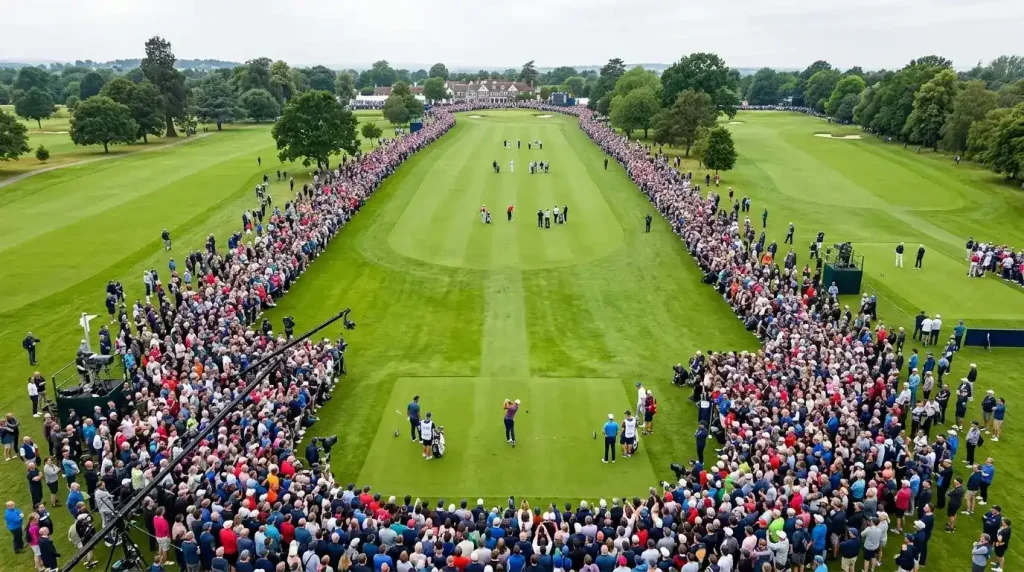
The sheer volume of competitive tournaments amplifies this further. The PGA Tour now operates a schedule of nearly 50 events, with DP World Tour events running in parallel on most weekends of the year. That creates a continuous stream of opportunities, week after week, to find fields where each-way conditions are generous and one or two players sit at prices that meaningfully underestimate their realistic finishing probability. Golf has a higher variance outcome than most professional sports — a single bad round can eliminate a world-class player from contention — which keeps bookmakers from pricing place markets too efficiently. That persistent inefficiency is your opportunity, and it replenishes itself every seven days.
One additional structural advantage worth noting: golf’s large fields mean that even the best players in the world miss cuts, withdraw, or have off-weeks with a frequency that keeps outright winner markets priced at value levels that simply do not exist in lower-variance sports. The place component of your bet does not require your selection to win — it only requires them to play consistently well across four days, which is a much higher-probability event than winning outright. This is the fundamental tension that makes each-way golf betting so compelling, and it is why I have oriented the majority of my weekly selections around this market structure for the better part of a decade.
Decoding Each-Way Terms: Places, Fractions and What They Mean
I once watched a punter argue with a bookmaker’s counter staff because he genuinely believed “each-way” meant his bet paid out whether the player won or lost, full stop. The confusion is entirely understandable when you are new to it, but the maths behind each-way terms is straightforward once you see it laid out precisely — and understanding it is what separates punters who extract value from those who simply get lucky.
An each-way bet is two equal bets placed simultaneously: one on the player to win outright, and one on the player to finish within a specified number of places. Both parts cost the same stake. A £5 each-way bet is actually £10 total outlay — £5 on the win part and £5 on the place part. If your player wins, both parts pay out. If they finish in a place without winning, only the place part pays. The critical variables are the number of places covered and the fraction of the win odds used to calculate the place return.
Standard terms in golf are five places at one quarter (1/4) of the win odds. Here is how the maths works on a concrete example. Suppose you back a player at 20/1 each-way at standard terms, staking £5 each-way (£10 total):
Win scenario: £5 at 20/1 returns £105 (£100 profit plus £5 stake back). Plus the place part: £5 at 1/4 of 20/1 = 5/1 returns £30 (£25 profit plus £5 stake back). Total return if the player wins: £135 from a £10 outlay — a profit of £125.
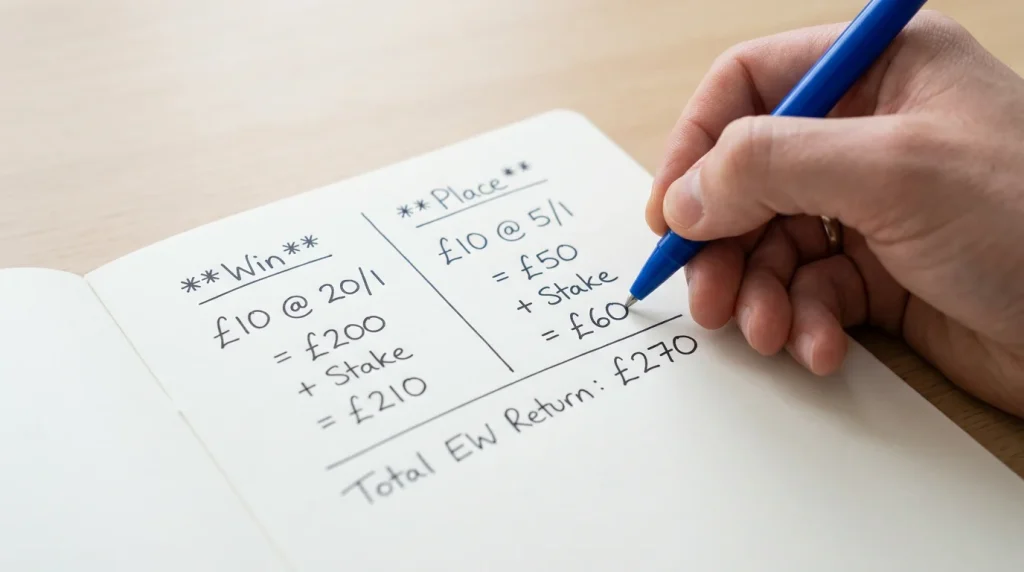
Place-only scenario (finishes 2nd to 5th): Only the place part pays. £5 at 5/1 returns £30 from a £10 outlay — a profit of £20.
Now apply the extended terms that have become widespread in 2026. Several major bookmakers now offer eight places at one fifth (1/5) of the win odds on the same tournament. At 20/1 each-way under those terms, with the same £10 outlay:
Place part at 1/5 of 20/1 = 4/1: £5 at 4/1 returns £25 (£20 profit plus £5 stake back). If the player finishes 6th, 7th or 8th — positions where standard terms pay nothing — total return is £25. Net profit: £15 from an outlay of £10.
The fraction shifts from 1/4 to 1/5, which reduces the payout per place slightly, but the extra places more than compensate — particularly at longer odds. A player finishing 7th is the difference between losing your entire £10 stake and recovering £25. One analysis of UK bookmaker terms found that a single leading operator offered 563 additional each-way places above the standard market across all Major, PGA Tour and DP World Tour events in 2025. Extended terms are equivalent to 5/1 on a 20/1 selection under eight-place conditions: as one seasoned analyst put it, a 20/1 shot with eight-place, 1/5 terms is mathematically equivalent to a single win bet at approximately 26/1 when you account for the combined probability-weighted return. That is a meaningful difference in expected value, compounded across a full season of betting.
The practical implication is direct: the minimum you should accept for most PGA Tour events in 2026 is six places. For the four Majors and the biggest events with fields of 156, bookmakers regularly push to eight or even ten places. Knowing which bookmaker is offering which terms on a given Thursday morning has become part of the weekly research process that separates serious each-way bettors from casual ones.
The Extra Places Arms Race: Which Bookmakers Win in 2026
There is a particular moment every Monday or Tuesday when the each-way terms for the coming week are published, and I check them the way a trader checks overnight price movements — looking for discrepancies, expanded offerings, and anything that changes the expected value of a bet I was already considering. This weekly habit pays dividends that dwarf any individual selection decision.
The extra places competition among UK bookmakers has intensified considerably over the past three years. What started as an occasional promotional tactic has become a core differentiator in the golf betting market. The consistent leaders are operators who commit to expanded terms not just on the four Majors but across the full schedule, including mid-tier DP World Tour events that attract smaller betting volumes. That consistency is what matters most, because the real edge in golf betting comes from finding value in overlooked tournaments, not just the Masters or The Open where every sophisticated bettor is competing for the same margins.

When evaluating each-way terms across bookmakers, I use three criteria beyond the raw place count. First, is the offer guaranteed or promotional? Guaranteed terms apply regardless of field size or betting volume and are written into the firm’s standard golf market. Promotional terms can be withdrawn at the bookmaker’s discretion and often carry maximum stake restrictions that limit how much value you can extract. Second, when are the terms announced? Early publication — ideally by Monday for a Thursday start — gives you time to assess selections before prices tighten significantly mid-week. By Wednesday, a player the market has identified as a strong contender can shorten by 30% to 40% from their opening price. Third, does the bookmaker cover the full DP World Tour and LIV Golf schedules consistently, or only the flagship events? If you are betting European golf seriously, breadth of coverage is not optional.
The market has evolved in a direction that actively rewards punters who hold accounts at multiple operators. You may find that one firm offers eight places at 1/5 on a given PGA Tour event while another remains on the standard five at 1/4. For a 30/1 selection finishing 6th, that difference is the entire bet — one firm pays out a profit, the other returns nothing. Across a season of weekly golf betting, this account management advantage compounds to a level that can represent the majority of your annual profit margin. The inconvenience of maintaining accounts at several bookmakers is trivial compared to the structural value it unlocks.
Each-Way Value: When the Maths Is on Your Side
Here is a thought experiment I return to whenever I am explaining this to someone new to structured golf betting. If a bookmaker offered you a coin flip at evens, you would decline — it is a break-even proposition at best, and marginally negative once friction is accounted for. Now suppose the coin pays 1.1 to 1 when it lands heads. You would take every bet you could get. Each-way golf betting is not a coin flip, but the logic is identical: find situations where the implied probability embedded in the place odds systematically understates the player’s genuine probability of finishing in that position, and you have found real value.
Calculating implied probability from each-way place odds is a two-step process. Take the place odds — which are the fraction of the win odds — convert them to a percentage, and compare that to your own assessment of the player’s finishing probability. A player at 25/1 win odds in a market offering eight places at 1/5 has place odds of 5/1. Converting 5/1 to implied probability: one divided by (5 plus 1) equals 16.7%. The bookmaker’s market implies roughly a 16.7% chance that this player finishes top eight. If your research — using recent form, course fit analysis, and Strokes Gained data — suggests the true probability is 22% or higher, you have a positive expected value bet on the place part.
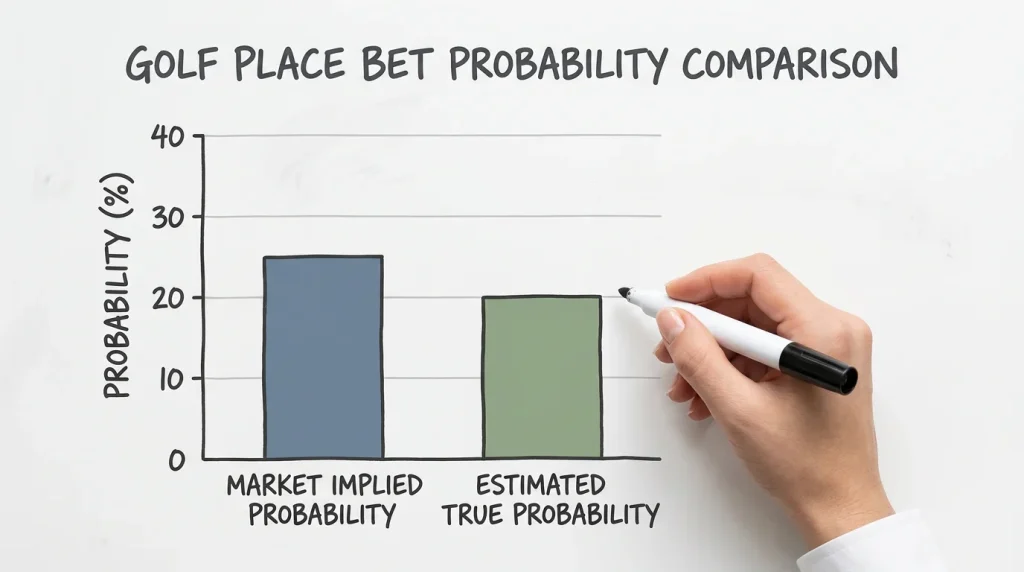
The discipline required to build those probability estimates is where most casual punters stop. But the inputs are not arcane or inaccessible. A player who has ranked consistently in the top 15 in the field for Strokes Gained: Approach over their last eight starts, who has a historically strong record on this specific type of course, and who has made every cut in their last five appearances, is not a 25/1 proposition based on their finishing probability alone. The market is pricing the outright winner probability — the place component is riding alongside it, frequently undervalued because the bookmaker’s margin is embedded more heavily in the win price.
Verified records from long-running tipster services demonstrate what this looks like in practice at scale. Consistent application of value-based each-way selection across thousands of bets produces long-term ROI figures in the range of 18% to 31% — well above the breakeven level and into territory that represents meaningful, sustainable advantage over the market. These are not exceptional outliers but the upper range of what rigorous, data-led each-way betting can achieve when applied with discipline over multi-year periods. The lower end of that range is more realistic for most recreational bettors, but even a 10% to 15% ROI maintained over a full golf season represents a significant return relative to the time invested in research.
One practical rule I apply consistently: at odds below 12/1, each-way betting rarely makes structural sense because the implied probability for the win part is already substantial enough that the place component adds relatively little expected value. The genuine each-way sweet spot is the 16/1 to 40/1 range, where the win probability is low enough that the place part genuinely adds expected value rather than simply diluting your exposure across two bets. Below that range, backing to win outright is often the sharper approach. Above 50/1 for most events, the each-way structure starts to look thin again unless you have unusually strong conviction grounded in a specific statistical edge that the market has not priced.
Avoiding Each-Way Traps: Dead Heats and Withdrawal Rules
The most expensive lesson I have ever taken from a golf bet involved a dead heat. I backed a player each-way, he tied for 5th place with two others in a five-place market, and my return was roughly a third of what I expected. I had heard the term “dead heat rules” before but treated it as a rare technicality I could safely ignore. I was wrong — in a 156-player field where the difference between 5th and 6th is a single shot across 72 holes, ties at the cut-off position occur far more regularly than most punters appreciate, and when they do, the impact on your return is severe.
A dead heat occurs when two or more players tie for a finishing position that falls within your place terms. The bookmaker’s response is to reduce the place stake proportionally among the tied players. In practice: if three players tie for 4th place in a five-place market, your effective place stake is reduced to one-third of its face value. The odds remain the same, but the stake applied to those odds is cut accordingly. On a £10 each-way bet, your place return is calculated as if you had staked approximately £1.67 on the place part, not the £5 you actually risked. That difference can turn a meaningful return into a near-breakeven result, and it catches experienced bettors off guard with regularity.
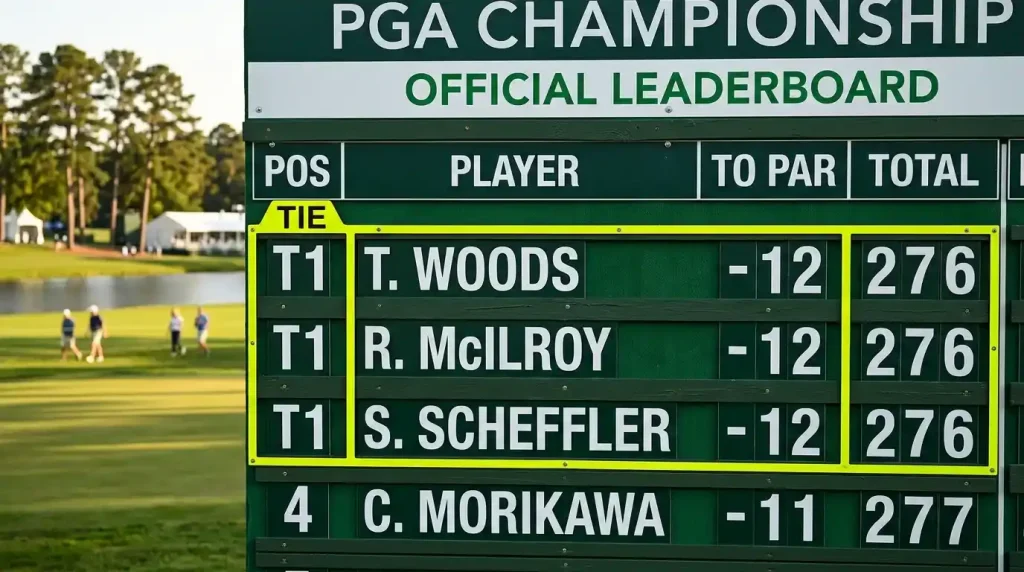
The full mechanics of dead heat calculation — including how they compound when several players tie, and how the rules differ between bookmakers — are covered in detail in the dead heat rules explainer. But the strategic implication for each-way betting is clear: when selecting players at prices where your return depends heavily on a clean finish at the boundary of the place terms, model the dead heat scenario explicitly. A player finishing in a three-way tie for 5th in a five-place market is not the same financial outcome as a clean 5th place finish, and treating them as equivalent will produce a systematic shortfall in your expected returns over time.
Withdrawal rules introduce a different but equally significant trap. If a player withdraws after your bet is placed, the place terms on your bet may be adjusted depending on when the withdrawal occurs and how many players remain in the field. Most bookmakers reduce the number of places paid when a withdrawal drops the field below a minimum threshold — typically below 12 runners in smaller events. This almost never affects the major PGA Tour events with 144 to 156 starters, but it is a real risk in DP World Tour events, particularly the smaller invitationals and co-sanctioned events where the starting field may already be at the minimum for full place terms.
Rule 4 deductions present a related issue. When a player withdraws before the tournament starts and their price was short enough to materially affect the remaining market, bookmakers apply a Rule 4 deduction — a percentage reduction applied to all win and place returns. This is most relevant at events with one or two dominant favourites at very short prices. The deduction percentage is determined by the withdrawn player’s starting odds, and on a bad week it can reduce your effective return by 15% to 25% on the win part. Always read the bookmaker’s Rule 4 policy before placing, particularly if you are backing in a field with a single heavy favourite.
The practical safeguard is straightforward and takes less than two minutes: read the specific terms of the market you are entering before placing, not after something goes wrong. Bookmakers publish their each-way rules, withdrawal policies and Rule 4 procedures clearly. The difference between a firm that guarantees its extended terms regardless of post-posting withdrawals and one that reserves the right to revert to standard terms is a material factor in which account you prioritise for any given bet. Treat it as part of your research, not an afterthought.
Frequently Asked Questions
How many places do bookmakers pay on each-way golf bets?
The standard across the industry is five places at one quarter (1/4) of the win odds. However, in 2026, leading UK bookmakers regularly offer six, eight or even ten places at one fifth (1/5) for PGA Tour events and the four Majors. The terms vary by event, field size and whether the offer is a guaranteed market or a promotional extension, so it is worth checking each bookmaker's specific terms before placing.
Is each-way betting always worth it in golf?
Not always — it depends on the odds, the terms and your assessment of the player's finishing probability. Each-way betting offers the most value in the 16/1 to 40/1 price range, where the place part carries genuine expected value. At shorter odds below 12/1, backing to win outright often makes more mathematical sense. The key is comparing the implied probability in the place odds against your own honest estimate of the player's realistic finishing position, based on form and course fit data.
What happens to my each-way bet if a player withdraws?
It depends on the bookmaker's rules and when the withdrawal occurs. If a player withdraws before the tournament starts and the bookmaker applies Rule 4 deductions, your effective return is reduced proportionally. For smaller events, a withdrawal that drops the field below the minimum threshold may also reduce the number of places paid. Major bookmakers publish their withdrawal rules clearly — always check them before placing, especially on DP World Tour events with smaller starting fields.
How do I calculate the return on an each-way golf bet?
Split the calculation into two parts. Win part: multiply your stake by the win odds and add your stake back. Place part: divide the win odds by the place fraction to get place odds (e.g. 20/1 at 1/5 = 4/1 place odds), then multiply your place stake by the place odds and add your stake back. If your player wins, both parts pay. If they only place, only the place calculation counts. Always remember an each-way bet is two separate bets, so your total outlay is double the quoted stake figure.
Articles
Golf Betting for Beginners UK
The first time I placed a golf bet, I picked a player because I'd heard his name on television, found…
Strokes Gained Golf Betting
Before Strokes Gained existed, golf analysis was essentially a collection of politely useless numbers. Putts per round. Greens in regulation.…
Golf Betting Exchange Tips UK
The first time I laid a player on a betting exchange and watched them make a quadruple bogey on the…
The Open Championship Betting Tips
Every year, The Open Championship delivers at least one moment that makes casual observers think it's unpredictable. Every year, the…
