
Golf Betting for Beginners UK: The Foundations Before Your First Bet
 Available in US
The first time I placed a golf bet, I picked a player because I’d heard his name on television, found his price, backed him without any further thought, and watched him finish 47th. Not a disaster, but not a great introduction either. What I didn’t know at that point — and what I wish someone had explained before I started — is that golf betting has more structural complexity than almost any other sport, and understanding even the basics of how the markets work dramatically improves your experience from day one. This is the guide I should have read first.
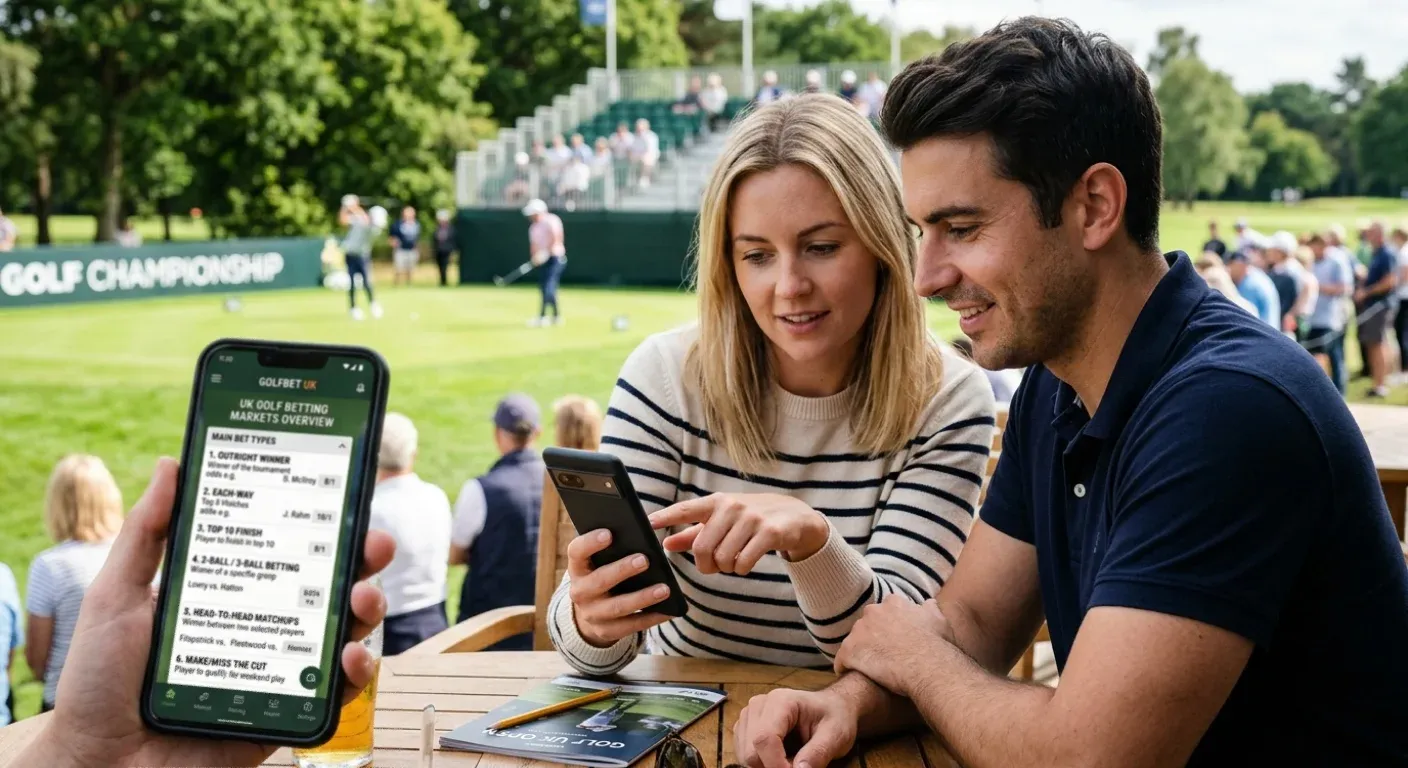
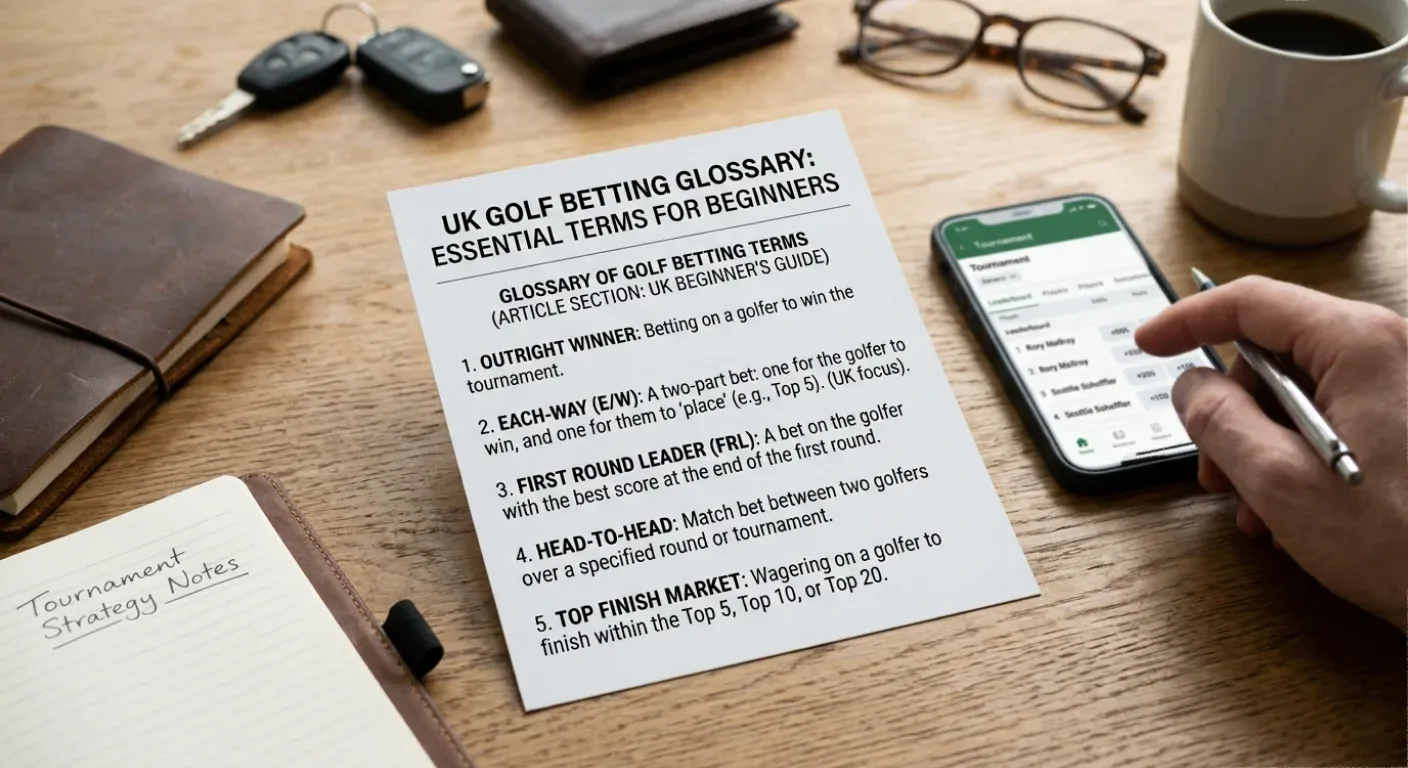
The Six Most Common Golf Betting Markets
Golf offers more distinct market types than almost any sport you can name. Here are the six you’ll encounter most often and what each one actually involves.
The outright winner market is the most straightforward: you pick the player you think will win the tournament. Simple in concept, challenging in practice because you’re competing against 155 other players. Odds range from around 5/1 for a strong favourite to 500/1 or beyond for no-hopers at the back of the field. The large field size means even well-researched selections lose far more often than they win.
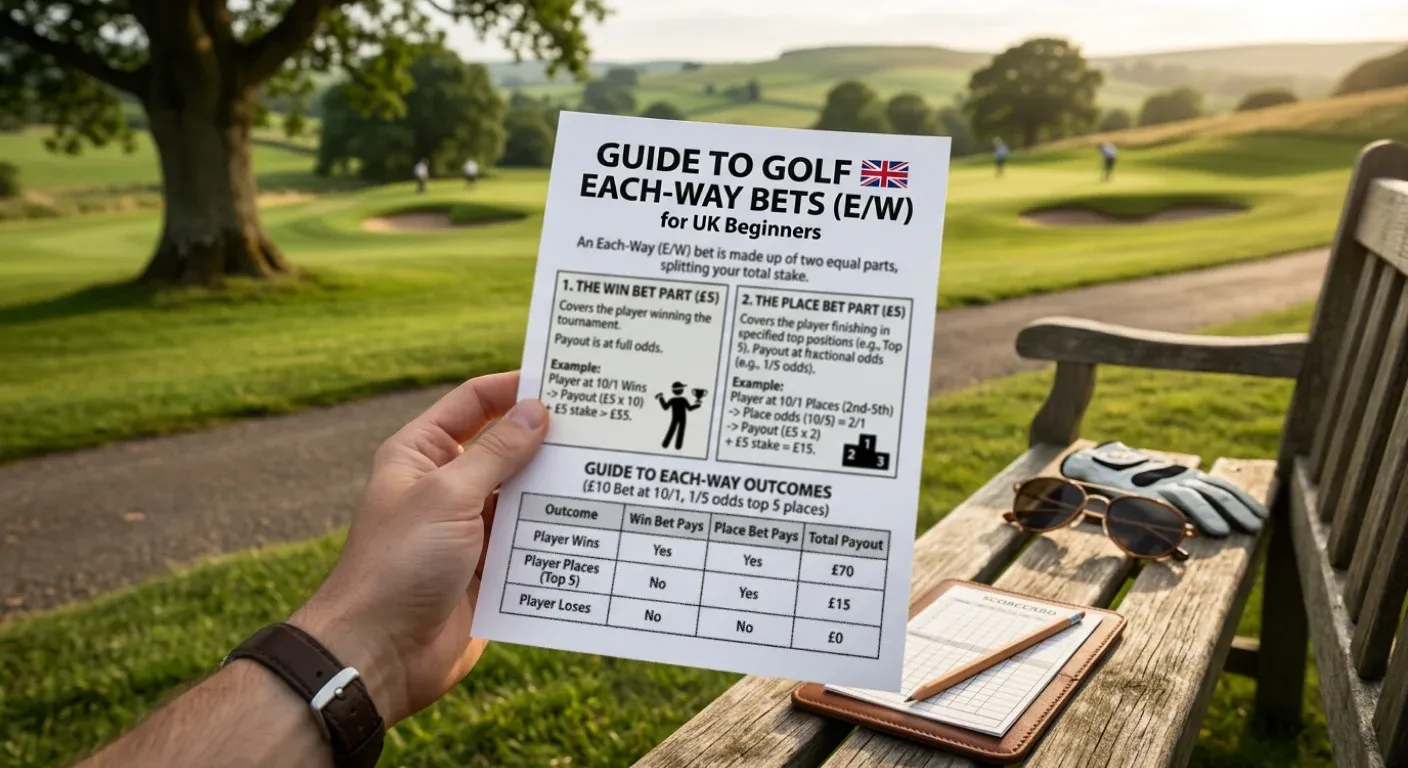
Each-way betting is the modification most widely used by recreational golf bettors. You’re making two bets: win and place. If your player wins, both parts pay. If they finish in the top five (standard terms) or more places (expanded terms), only the place part pays. The place return is a fraction of the win price — typically one-quarter. Each-way betting reduces variance and extends the range of results that pay something.
First Round Leader (FRL) is exactly what it sounds like: which player will lead the field after Thursday’s round one? The market typically pays to two or three places and settles on Thursday evening. It’s a single-round market, so the time horizon is much shorter than an outright bet, and the result is known within 24 hours of placing.
Head-to-head matchup betting pits two named players against each other across 72 holes. You’re picking who will outscore whom regardless of their overall tournament finishing position. This reduces a 156-player prediction problem to a binary choice — much more accessible odds and probability.
Three-ball betting involves predicting which of three grouped players will score lowest in a specific round or rounds. More players than a head-to-head, but still dramatically simpler than the full outright market.
Top-10 or top-20 finish markets are place markets that settle when the tournament ends. Back a player to finish in the top 10; if they do, you win. Odds are shorter than outright (because the required outcome is less precise) but still long enough to be interesting, typically 2/1 to 12/1 for most touring professionals.
How to Place Your First Golf Bet Step by Step
43% of UK sports bettors now place their wagers through mobile phones, and the process is nearly identical across all major licensed operators. Here’s what placing a simple each-way outright bet looks like from start to finish.
Choose a UKGC-licensed operator and complete the sign-up process including identity verification. Depositing money before completing verification is possible at some operators, but withdrawals are blocked until verification is complete — finish verification first.
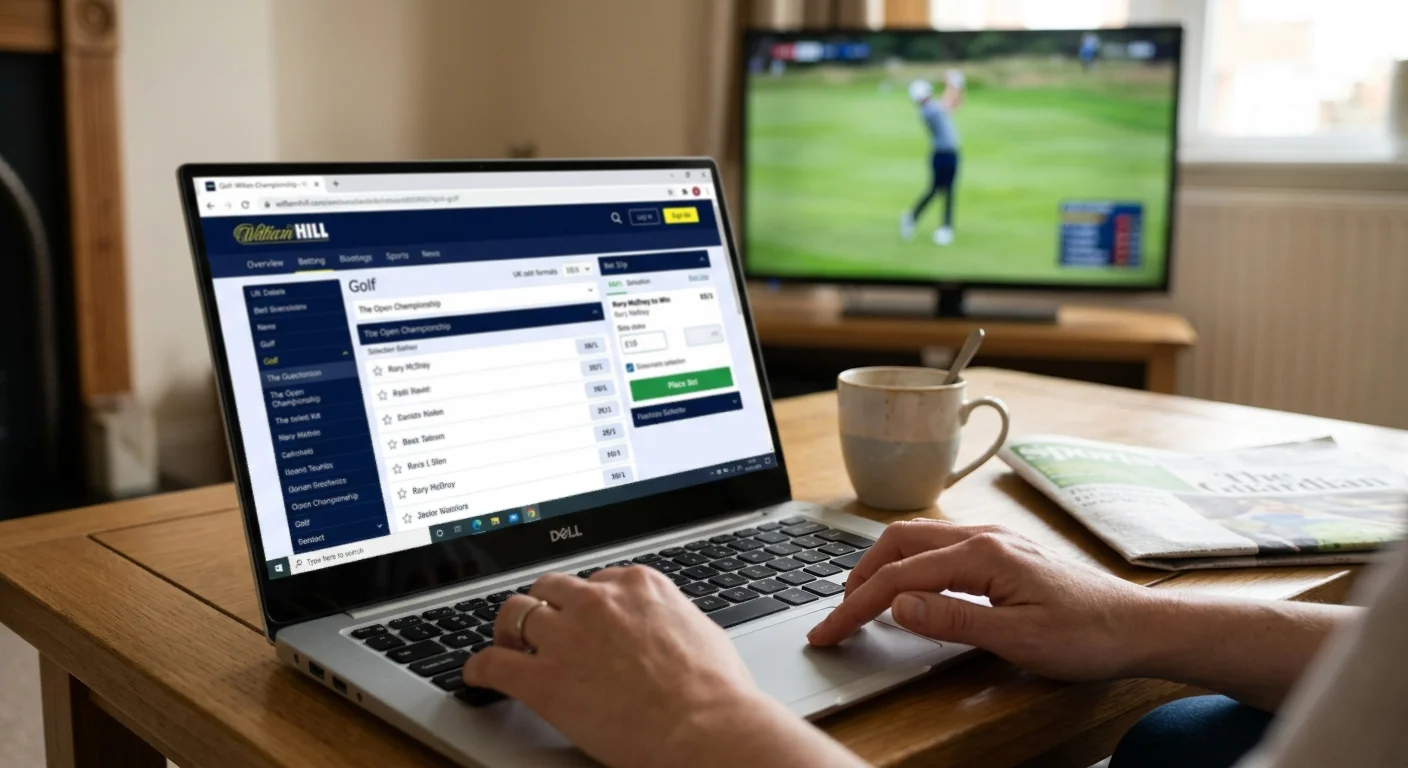
Navigate to the golf section, usually found under Sports. Select the relevant tournament — it’ll typically appear under PGA Tour, DP World Tour, or the Major’s name if one is active. Open the outright market.
Find the player you want to back. Click or tap their name to open the betting options. Select each-way (EW) rather than win-only. Enter your stake in the stake field — the amount you want to put on each half of the each-way bet. So a £10 each-way stake means £10 on the win and £10 on the place, costing £20 in total.
Check the each-way terms before confirming. The terms will show something like “5 places, 1/4 odds.” Five places means the top five finishing positions pay the place component. 1/4 odds means your place return is at one-quarter of the win price. At 20/1, the place price is 5/1. Confirm the bet. Done — you’ve placed your first golf bet.
Golf Betting Terminology: 20 Terms You Need
Outright: bet on the overall tournament winner. Each-way (EW): two-part bet combining win and place. Place: finishing within a specified number of positions. Places: the number of finishing positions that pay the place component. Fraction: the proportion of win odds paid on the place component (1/4, 1/5). FRL: First Round Leader. H2H: head-to-head matchup market. Three-ball: best score among three grouped players. SG: Strokes Gained — performance metric measuring each phase of play relative to tour average. SG:APP: Strokes Gained approach to the green. Cut: the score threshold after round two that determines which players continue. Making the cut: finishing inside the cut line and progressing to rounds three and four.
Dead heat: when two or more players tie for the same finishing position, triggering a proportional reduction in returns. Rule 4: deduction applied to returns when a player withdraws from a tournament. Void: a bet that is cancelled and the stake returned, typically because a key condition of the bet cannot be resolved. Overround: the bookmaker’s built-in margin, representing the percentage by which the sum of all implied probabilities exceeds 100%. Early price (EP): odds taken before the market tightens closer to the event. Closing price: the final odds available before the first ball is struck — the sharpest estimate of probability in the market. Accumulator (acca): a bet combining multiple selections whose individual returns multiply together. In-play: betting on an event after it has started, with odds changing in real time.
Common Beginner Mistakes and How to Avoid Them
The biggest mistake I see beginners make is backing well-known names at short prices without checking whether the price offers value. Tiger Woods’ name creates enormous betting interest regardless of his current form. A famous player priced at 8/1 might genuinely have a 12% chance of winning — in which case 8/1 is actually good value. But if that same 8/1 reflects only a 6% winning probability, you’re paying a “celebrity premium” with no edge.
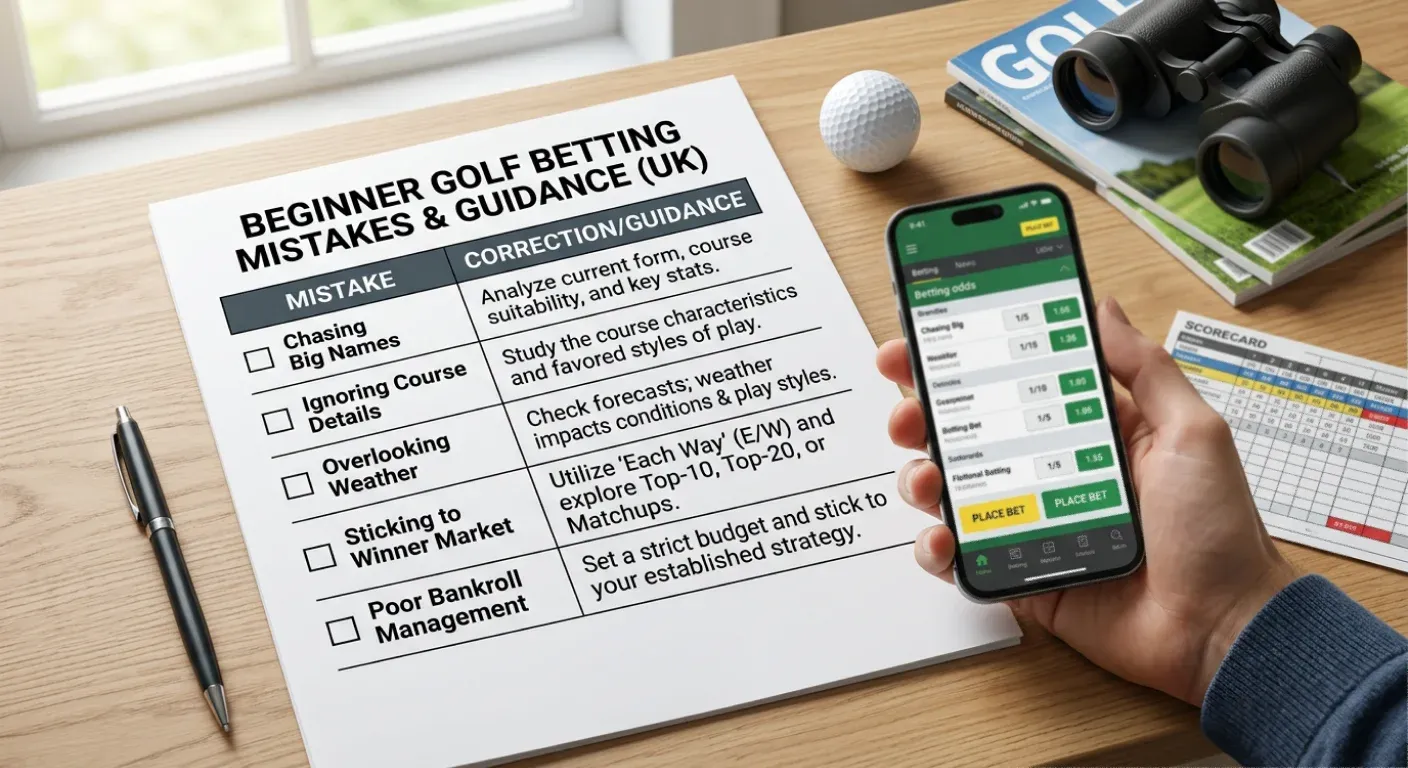
The second common mistake is misunderstanding each-way terms. A £10 each-way stake is a £20 outlay. Many beginners stake £10 thinking their maximum exposure is £10, then are surprised when £20 has been deducted. Always read each-way as two separate bets of the stated amount.
Placing too many bets is the third. A beginner backing eight players at £5 each-way across a weekend has £80 committed in a way that makes tracking results confusing and learning from outcomes almost impossible. Start with one or two selections per tournament, understand the results, and build complexity gradually as your analytical framework develops.
Not comparing odds across operators is an easily avoided costly habit. The difference between 28/1 and 33/1 on the same player is significant over the long run. Taking two minutes to check prices at two or three licensed bookmakers before placing routinely produces better prices on most selections. The complete terminology and market mechanics glossary — including every term mentioned above with full definitions — is available in the comprehensive golf betting odds explained guide.
Frequently Asked Questions
What is the simplest golf bet for a complete beginner?
A head-to-head matchup bet is the simplest starting point. You're choosing between two named players — whoever scores lower over the tournament wins your bet. Odds are typically close to evens for each player, the concept is easy to grasp, and you only need to assess two players rather than 156. Once comfortable with that, move to each-way outright betting on individual tournaments.
Do I need a large budget to start golf betting?
No. Most UK licensed bookmakers accept minimum stakes of £1 on golf markets. A starting bank of £50 to £100 is sufficient to place meaningful each-way bets at £5 to £10 each and experience a realistic cross-section of golf betting outcomes without serious financial risk. Never bet money you can't afford to lose — set a specific entertainment budget for golf betting and treat it as such.
How is golf betting different from football betting?
Golf betting involves far larger fields (up to 156 players) and much longer odds than football. Even the tournament favourite typically has only an 8-15% chance of winning — much lower than a football team's winning probability in most matches. Golf also involves four-day events rather than 90 minutes, creating more variance and more opportunity for form to reverse. The each-way structure is central to golf betting in a way that doesn't exist in the same form in football.
Articles
Golf Betting Unlicensed Sites
Someone in a golf betting forum I follow shared their "secret" for getting better odds: they'd found an offshore site…
Weather Conditions and Golf Betting
I've been studying golf betting for long enough to have sat through dozens of major events where the weather turned…
Golf Betting Exchange Tips UK
The first time I laid a player on a betting exchange and watched them make a quadruple bogey on the…
Golf In-Play Betting Tips
Saturday afternoon, final round of a DP World Tour event, and the lead changes hands five times between the 12th…
