
Golf In-Play Betting Tips: How to Use Live Markets to Your Advantage
 Available in US
Saturday afternoon, final round of a DP World Tour event, and the lead changes hands five times between the 12th and 18th holes. For someone watching with a passive interest, that’s drama. For someone with a systematic in-play approach and a live stats feed open, that’s a sequence of pricing opportunities. Golf in-play betting is a specific discipline, completely different from pre-event placement, and it rewards the punters who treat it as such rather than reactive punting driven by the emotions of watching sport unfold.
Why Golf In-Play Is Different from Other Sports
Football in-play betting is continuous — the game flows, the odds shift in real time, and markets update every few seconds. Golf in-play is episodic. Odds shift when a shot result is reported, when a score changes on the leaderboard, and when a player moves to a new hole with a different difficulty profile. Between shots, the market is relatively static.
That episodic nature creates a structural opportunity that doesn’t exist in continuous sports. When a player makes a bogey on a difficult par-three, their outright price lengthens. When they birdie an easier par-five, it shortens. These adjustments are based purely on stroke count — they don’t always fully account for where the player is now positioned on the course relative to the remaining holes, the difficulty of what’s ahead, or the comparative positions of their main rivals.
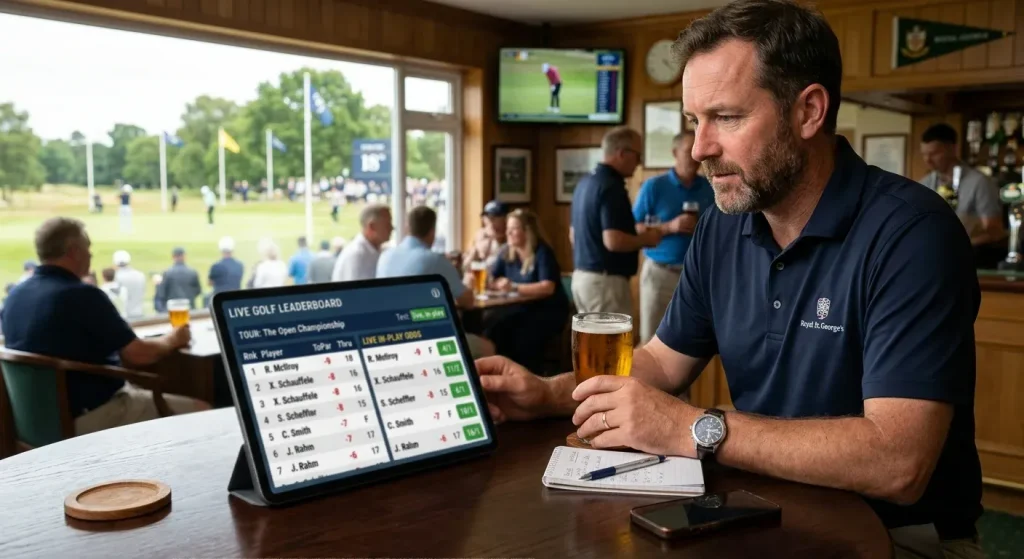
43% of UK bettors now place wagers through mobile devices — and 95% of all online betting activity happens from home. Golf’s episodic in-play structure is particularly well-suited to mobile engagement: you can monitor a live leaderboard, assess a position, and place without needing to be glued to a screen for 90 continuous minutes. Most of the time, you’re waiting for your moment. When it comes, you need to be ready to act within a tight window before the market adjusts.
The UK’s roughly 290 million monthly online bets on real events include a fast-growing in-play component. Bookmakers invest heavily in in-play pricing models, but those models are necessarily backward-looking — they’re adjusting based on what has happened, not what is about to happen on the course.
Key Moments to Back In-Play
Not all in-play moments are equally interesting. I’ve developed a shortlist of specific scenarios where the market consistently under-adjusts, creating windows of genuine value that close quickly.
The first is the “bounce-back” scenario. A player who’s just made a double bogey on a difficult hole — particularly an early-round hole where the rest of the field hasn’t played yet — will see their price lengthen substantially. If that player is in strong form, hitting the ball well, and the double bogey was a clear variance event (a lip-out, a bad lie in a bunker they normally handle), the lengthened price may well overshoot the appropriate adjustment. Back the bounce-back where the form evidence supports it.
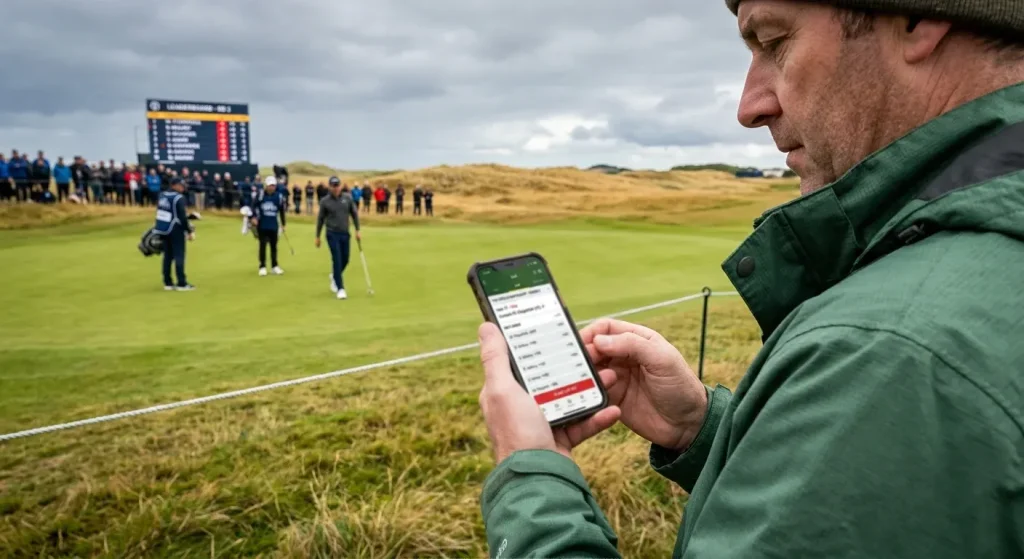
The second is the finishing-stretch opportunity. With six holes remaining, a player sitting one shot off the lead who has a strong record on the specific holes ahead of them — particularly if the remaining stretch historically favours their game type — may be underpriced relative to the leader who’s entering holes where they’ve historically struggled. Hole-by-hole scoring averages are publicly available on the PGA Tour website and several analytics platforms. This is granular enough that most in-play markets don’t price it correctly.
The third scenario is weather-split markets. When half the field has played in benign conditions and the other half is about to tee off into a wind event, the pre-event market hasn’t fully repriced. Backing players guaranteed to be in the favourable wave before they’ve started — or betting against players in the deteriorating conditions — can offer value if the bookmaker hasn’t updated the live prices to reflect the emerging conditions differential.
Reading Live Leaderboard for In-Play Value
The leaderboard is your primary data input for in-play betting, but reading it intelligently requires understanding what it doesn’t show as well as what it does. A player sitting T2 at eight under par looks impressive. What the leaderboard doesn’t tell you is that they’ve played 12 holes and have a run of birdieable holes ahead, that the leader is on the 16th green and likely to finish strongly, or that the co-leader in third has been making everything from outside 20 feet on unusually hot putting day.
Cross-referencing the leaderboard with live hole-by-hole scoring data — which is available through the PGA Tour’s ShotLink feed and various data aggregators — transforms your live reading. You can see which players are gaining or losing strokes on the current round relative to field average, which holes have been playing above or below par today specifically, and where the scoring opportunities and threats are on the remaining stretch.
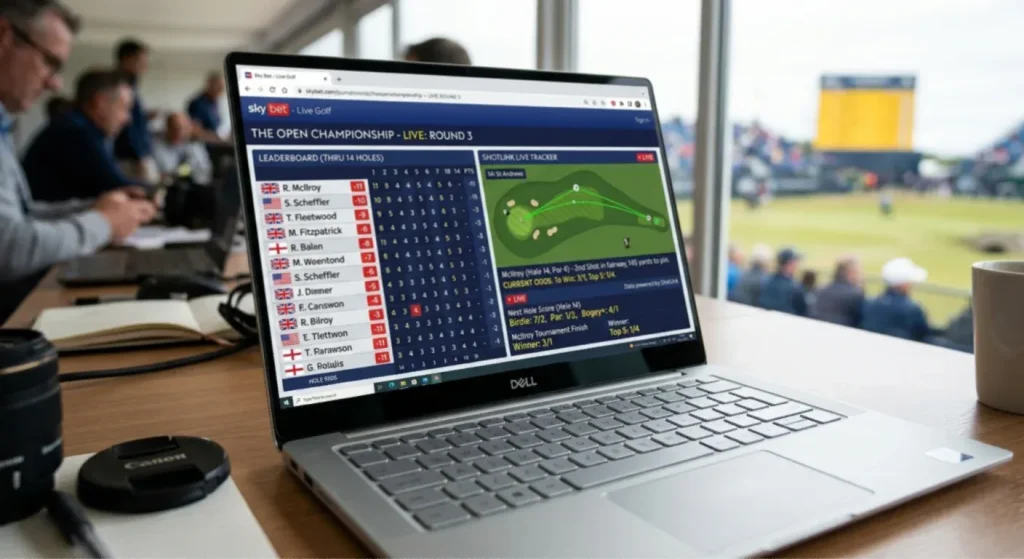
The “course position” concept is central to sophisticated in-play reading. A player on the 10th tee at -8 in a field where the average scoring for holes 10-18 is -1.2 relative to par has a very different expected finishing position to a player on the 16th tee at the same score. In-play markets don’t always adjust fully for this positional element, particularly on courses where the back nine is dramatically harder or easier than the front.
Mobile Betting: Tools for Live Golf Markets
The practical reality of golf in-play betting is that it happens on your phone, in real time, while monitoring multiple information sources simultaneously. Having the right setup before the round starts makes the difference between executing a well-reasoned bet in a 90-second window and fumbling through an app while the odds move.

My standard tournament-day setup involves three simultaneous windows: the live leaderboard from the tour’s official scoring platform (faster and more reliable than any bookmaker’s leaderboard), the bookmaker’s in-play market, and a live weather feed for the venue. On a good day, those three inputs are all I need to identify whether an in-play situation presents genuine value or just the appearance of it.
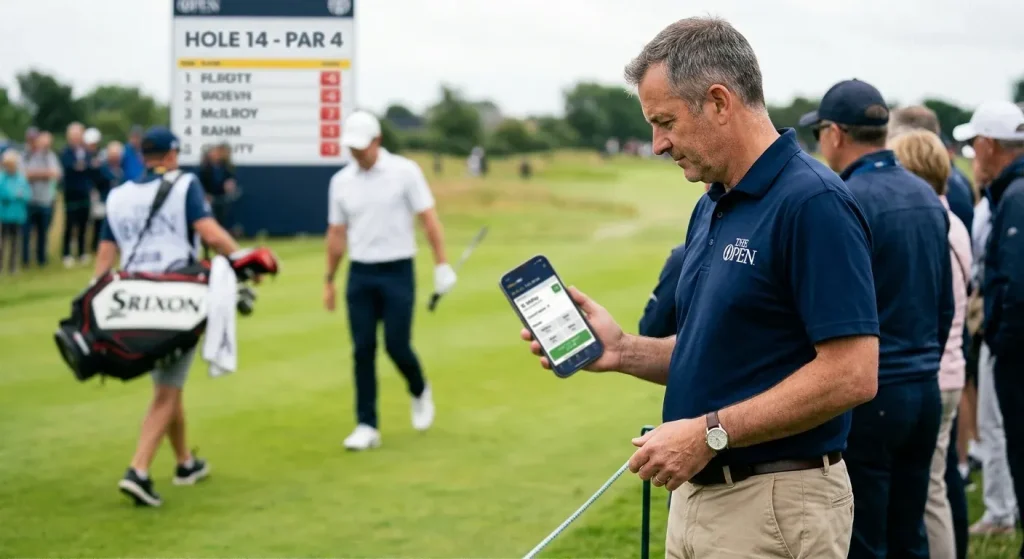
Cash-out on in-play positions is a tool worth understanding before you use it emotionally. If you’ve backed a player to win who’s now leading with four holes to play, the cash-out offer represents the bookmaker’s estimate of the current probability of winning adjusted for their margin. Accepting cash-out is sensible when you have information that suggests the market has overpriced your player — if you know they’ve been leaking oil on their putting all day and three of the final four holes are long, tricky putts. Refusing cash-out because you “feel good about it” is not a strategy. The dynamics of in-play betting connect closely with the broader picture of live event coverage, which you can explore in the guide to DP World Tour betting tips where the in-play market structure is particularly favourable to prepared punters.
Frequently Asked Questions
Which bookmakers have the best in-play golf markets?
Coverage depth, speed of price updates, and cash-out availability vary significantly between UK licensed operators. The major operators tend to offer the most comprehensive in-play golf coverage, including live-streaming for some events. For DP World Tour events specifically, coverage depth is narrower at some bookmakers than for PGA Tour events. Use multiple accounts to access the full range of in-play options.
Can you use live stats to gain an edge in golf in-play betting?
Yes — live SG data, hole-by-hole scoring averages, and current round Strokes Gained relative to field are all legitimately available through PGA Tour platforms and data aggregators. This information isn't secret, but it requires effort to access and interpret quickly. Most in-play bettors don't use it systematically, which is precisely why it creates an edge for those who do.
Does cash-out work differently in golf compared to football?
Golf cash-out offers are calculated on the same principle as other sports: the bookmaker's current probability estimate for your bet, minus their margin. The key difference is that golf cash-out values can shift dramatically between holes — a single shot changes the entire picture in a way that a football goal might not. Cash-out figures in golf are often less generous than in football due to the higher variance and the bookmaker's need to account for the remaining scoring potential on the course.
Articles
Golf Betting Bankroll Management
The most painful lesson I've learned in golf betting has nothing to do with picking winners. I once had a…
Dead Heat Rules in Golf Betting
The first time a dead heat cost me real money, I had no idea what had happened. My player finished…
Golf Betting Exchange Tips UK
The first time I laid a player on a betting exchange and watched them make a quadruple bogey on the…
Ryder Cup Betting Tips
The Ryder Cup is the event where everything I know about individual player form becomes significantly less useful than my…
