
Weather Conditions and Golf Betting: How Wind and Rain Shift the Markets
 Available in US
I’ve been studying golf betting for long enough to have sat through dozens of major events where the weather turned the entire betting narrative on its head. The most dramatic example I can give you: a player who was warm favourite going into the final round at a coastal links event, drawing the afternoon wave on a day when the wind shifted from 12mph to 28mph between the morning and afternoon tee times. By the time the leaders were playing their final holes, the morning wave scores were untouchable. Weather didn’t just influence the result — it determined it. If you haven’t built weather analysis into your golf betting process, you’re missing one of the most powerful predictive variables available.
Why Weather Matters More in Golf Than Any Other Sport
Football, tennis, cricket — all outdoor sports are affected by weather. But golf is uniquely vulnerable because the impact of conditions is simultaneously universal (every player must deal with the same course) and asymmetric (the order of play means different players experience dramatically different conditions at different points in their rounds, and even in the same round depending on tee time).
In cricket, rain delays the game for everyone equally. In tennis, wind is a factor but the court dimensions are fixed and both players experience the same conditions simultaneously. In golf, Player A might tee off at 7:30am in calm conditions and card a 65. Player B tees off at 1:30pm in 25mph crosswinds and shoots 72. Both have played the same course, in the same tournament, on the same day. Their results are not comparable — but the outright odds going into the day treated them as if they were in equivalent circumstances.

The international golf tourism market attracts close to a million spectators annually across the major events — The Open Championship, PGA Tour, and Ryder Cup combined. Spectators experience the drama of weather variance visually. Bettors who understand the data behind it can translate that drama into analytical advantage.
Wind: Reading Direction, Speed and Market Impact
Wind speed and direction are both relevant, but they’re not equally important for all courses. Understanding which factor matters more for a specific venue is the first step in weather-informed betting.
Wind direction determines whether a hole plays as a headwind, tailwind, or crosswind. For a course with a clockwise routing — holes running broadly north, east, south, west — a northerly wind creates headwinds on north-facing holes and tailwinds on south-facing holes. The par-five in the first section might go from a reachable two-iron approach to a three-wood approach simply because the wind has shifted 45 degrees. Course maps and wind direction combined tell you which holes will play harder or easier on any given day.
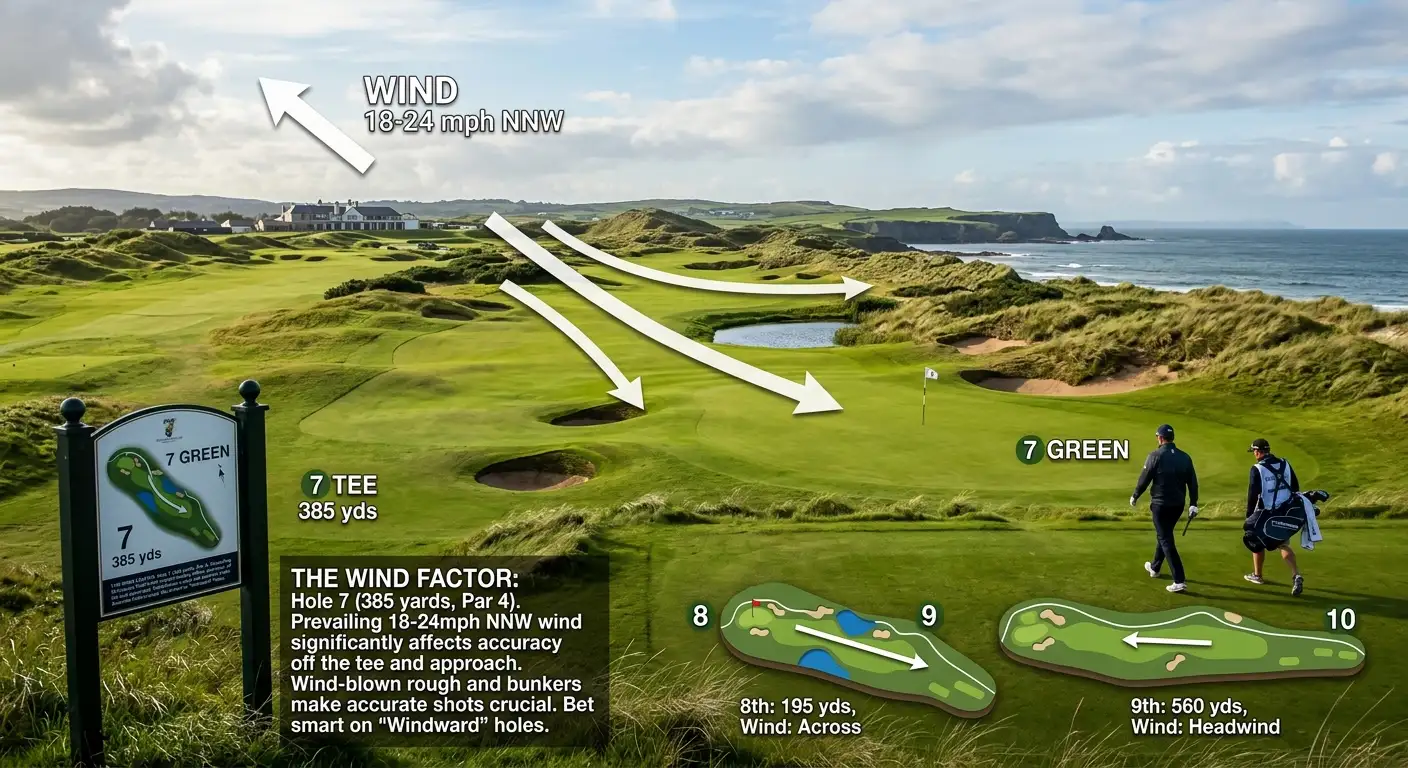
Wind speed matters most in a threshold sense. Below 15mph, most professionals can play near their normal shot-making envelope. Between 15mph and 25mph, scoring averages rise noticeably, and the premium on accuracy off the tee increases. Above 25mph on a links course, scoring averages can rise by four to six shots across the field compared to calm conditions. The players who perform best in those conditions — not just those ranked highest — are the betting selections that make sense.
DataGolf’s database contains over 2.1 million records. The subset of that data corresponding to round-by-round scoring in conditions above 20mph wind speed reveals specific patterns: certain player archetypes consistently outperform in wind, particularly those with low ball flight, strong punch-shot games, and patience to accept bogeys without tilting. Low-ball hitters generally outperform high-ball trajectory players in significant wind. This is not a universal rule, but it’s a reliable enough pattern to incorporate into selection for exposed, wind-affected courses.

Market impact: pre-event odds don’t fully account for upcoming weather because the forecast when the market opens (typically Monday or Tuesday) has more uncertainty than the forecast on Thursday morning. Odds that looked accurate on Tuesday may look wrong by Thursday morning once the weather picture clarifies. This window — Tuesday-to-Thursday morning price movements — is often the most productive period for weather-informed betting.
Soft vs Firm Conditions: How Scoring Changes
The wind dimension is dramatic and visible. The soft-versus-firm question is subtler but equally important for player selection.
Firm, fast conditions favour approach players with the ability to land the ball short of the target and let it run to the hole. Bump-and-run shot-making becomes viable. Greens become receptive from the front rather than requiring aerial approaches directly at the flag. Players with creative ground-game skills — typically those who’ve played on links courses extensively — have a structural advantage.
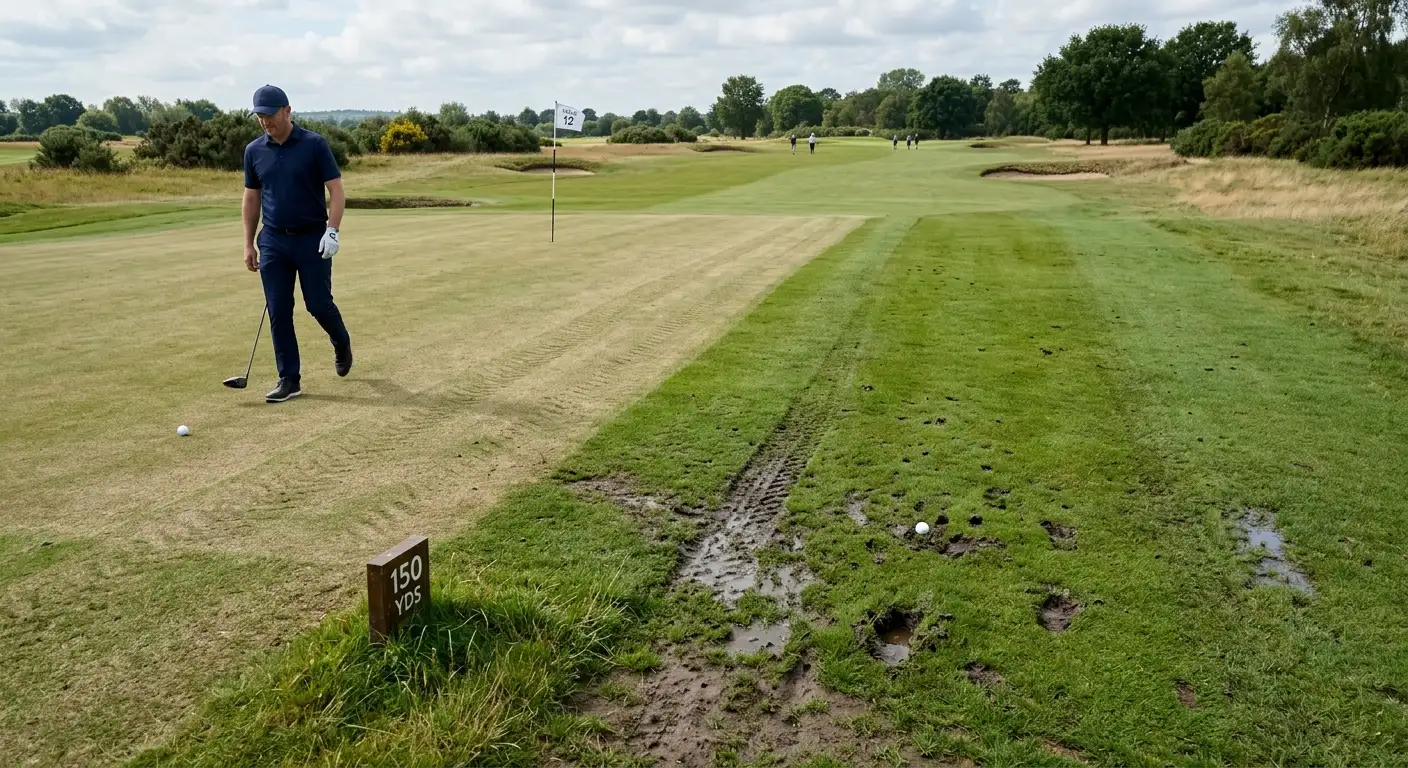
Soft, wet conditions favour the aerial game. Greens become receptive to high-stopping approaches. Long hitters gain advantage because the fairways don’t run out — distance off the tee equals position near the green rather than plugged lies in the rough. Players who rely on controlled release rather than aerial stopping are at a disadvantage.
After significant rain, the course rating can effectively drop by one to two strokes because fairways are softer, ball sits up rather than plugging, and approach shots hold greens more easily. Low scoring is more achievable, which changes the population of players who can contend. Lower-ranked players can post competitive numbers on soft courses that they couldn’t post in typical conditions because their limitations — shorter driving, less precise approach irons — are less penalised by soft landing conditions.
In the context of FRL betting, firm morning conditions where the dew has burned off by 10am and approaches are releasing create a very different scoring environment to soft morning conditions after overnight rain. Factor the recent rainfall history at the venue — available via weather archives and tournament preview sites — into your course condition assessment.
Using Weather Forecasts in Your Betting Research
The practical application requires access to reliable, granular forecasts for the specific venue — not just the nearest major city. Many golf courses are in coastal or rural locations where local conditions diverge significantly from regional weather patterns. A course 15 miles from a city can experience wind speeds 40% higher due to topography. Use the nearest weather station or a specialist golf weather service rather than general regional forecasts.
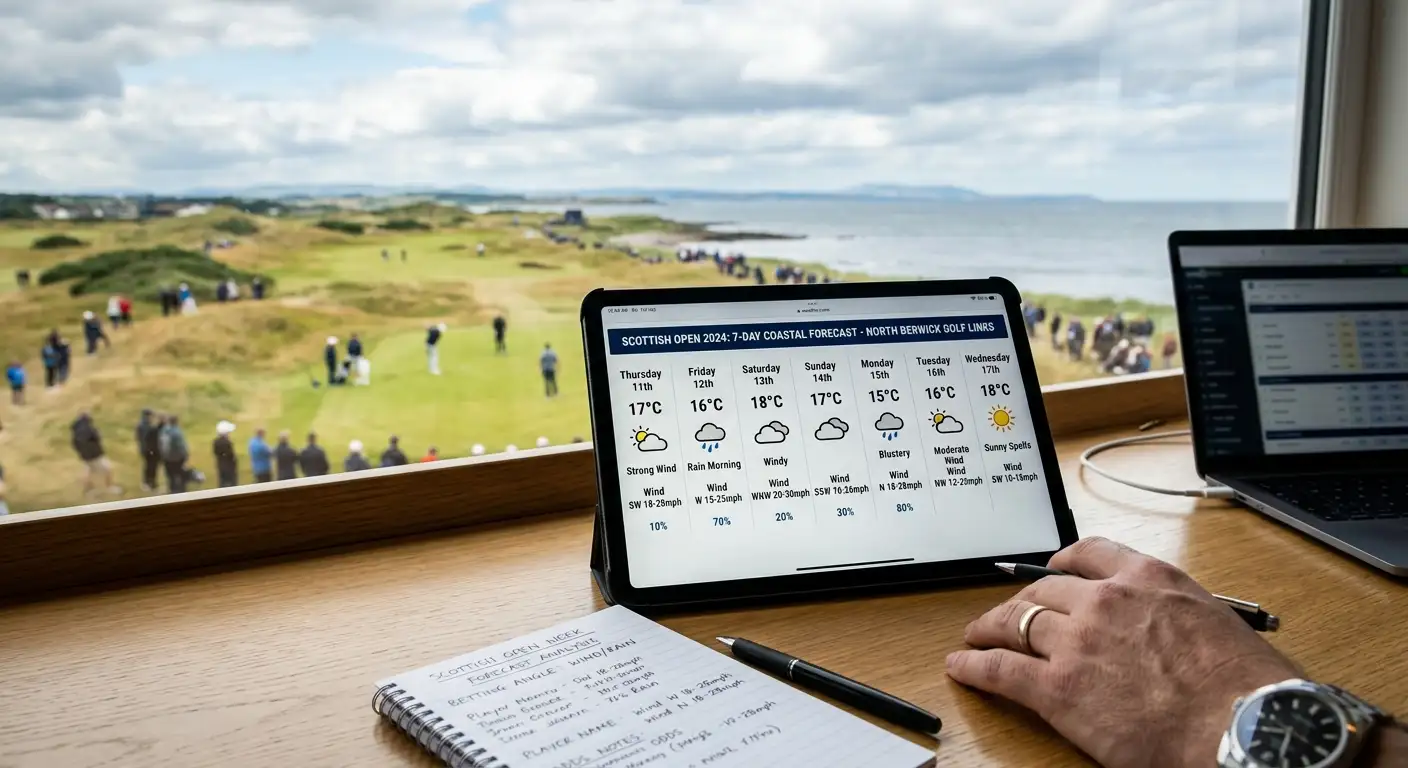
Tournament preview services aggregated for international golf tourism events — over 980,000 spectators visited The Open Championship, PGA Tour, and Ryder Cup combined in 2023 — often include venue-specific weather analysis in the week of an event. These are worth monitoring as Thursday approaches because they consolidate information that would otherwise require building your own weather monitoring setup.
Build a simple weather-scoring analysis into your pre-event routine: check the forecast Tuesday, check it again Thursday morning, and flag any events where the forecast has shifted significantly. Price changes in that window that correlate with weather updates are often efficient responses to new information — but they’re not always fully accurate, and the 30 minutes between a weather update and a bookmaker price adjustment is sometimes enough for a sharper punter to get on first. For a complete framework of pre-event tournament research — including how weather integrates with course fit and form analysis — the guide to golf course form covers the full process in detail.
Frequently Asked Questions
How much does wind actually affect golf betting odds?
On links and coastal courses, wind above 20mph can shift scoring averages by four to six shots across the field compared to calm conditions. Pre-event odds reflect expected conditions based on the forecast when the market opens. If wind significantly increases between market open and tee time, prices may not fully adjust. This creates windows where backing players known to excel in wind offers genuine value over the prevailing odds.
Which type of golfer performs best in wet, soft conditions?
Players with high ball flight and the ability to stop approaches aerially benefit most from soft conditions. Long hitters gain more advantage when fairways are soft because drives don't run into rough. Players who rely on ground-game techniques or bump-and-run approaches are relatively disadvantaged. Look for players with strong approach play statistics in rain-affected rounds specifically, which is available in granular form on analytics platforms.
Where do I find reliable weather forecasts for golf tournaments?
Use venue-specific forecasts rather than regional city forecasts. The nearest weather station to the course is the most reliable source. Specialist golf weather services provide course-specific data including wind speed by hour and precipitation probability. For links courses particularly, the difference between the general regional forecast and the specific coastal forecast can be several wind-speed categories. Always check both.
Articles
Golf In-Play Betting Tips
Saturday afternoon, final round of a DP World Tour event, and the lead changes hands five times between the 12th…
Golf Accumulator Tips UK
I've built some genuinely satisfying golf accumulators over the years — and I've also watched them die on the third…
Golf First Round Leader Tips
The FRL market is one of the most interesting bets in golf — and one of the most frequently misunderstood.…
Dead Heat Rules in Golf Betting
The first time a dead heat cost me real money, I had no idea what had happened. My player finished…
