
Dead Heat Rules in Golf Betting: Exactly How Your Return Is Calculated
 Available in US
The first time a dead heat cost me real money, I had no idea what had happened. My player finished fifth — exactly where I needed him to finish for a healthy each-way return — but the bookmaker paid me roughly half of what I expected. The settling note mentioned “dead heat rules applied” and I stared at it for a full minute before admitting I needed to actually learn what this meant. If you’ve ever been confused by the same thing, here’s the complete explanation you should have had years ago.
What a Dead Heat Is and When It Happens
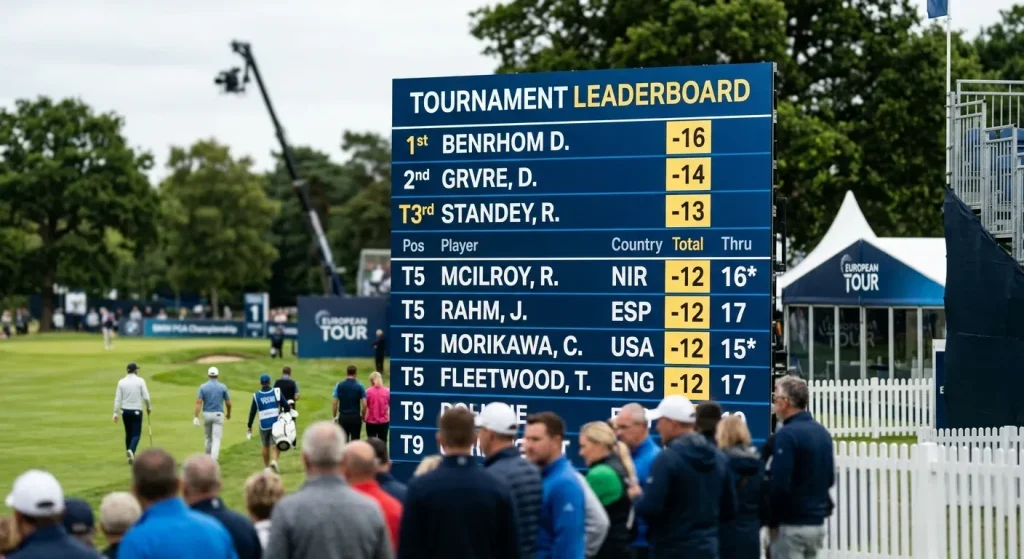
A dead heat occurs when two or more players tie for the same finishing position. In golf, this happens constantly — far more often than in most sports. Unlike a 100-metre sprint where photofinish technology separates athletes by thousandths of a second, golf uses cumulative stroke counts over 72 holes, and identical scores are routine. A standard-sized PGA Tour event pays each-way to five places under typical terms. If three players tie for fourth place, that’s a dead heat. Standard bookmaker terms pay five places, but now sixth through seventh must also be accounted for — and the dead heat rule is how the arithmetic gets resolved.
The standard each-way offering in UK golf markets covers five places at one-quarter the win odds. The best bookmakers in 2026 have expanded this to eight, ten, or even twelve places for major events — meaning the chances of a dead heat affecting your return are higher than ever, because more finishing positions are in play. Dead heats also apply to other markets: first round leader, top-ten finish, head-to-head matchups where both players card the same score. Any market where the same outcome can be shared between two or more selections is subject to these rules.
How the Dead Heat Return Formula Works
The formula looks intimidating on first encounter, but once you’ve worked through it once, it becomes second nature. The core principle is simple: you’re only entitled to a proportional share of the place payout, reflecting the share of the finishing position your player actually holds.
Let’s build this from scratch. You back a player each-way at 20/1, paying five places at one-fifth the win odds. Your stake is £10 each-way — £10 win, £10 place, total outlay £20. Your player finishes tied for fifth with one other player. Two players are sharing one available place (fifth), so the dead heat fraction is 1/2.
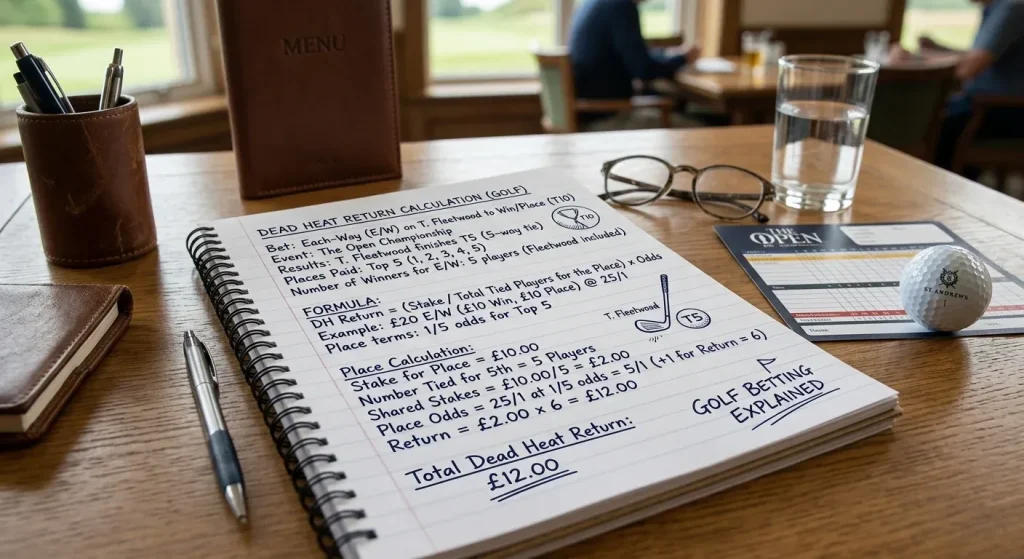
Under normal circumstances — sole occupancy of fifth — your place return would be: £10 x (20/1 x 1/5) x (1/1) plus your stake back. That’s £10 x 4/1 plus £10, giving £50 total place return.
With a dead heat at 1/2 fraction applied: £10 x 4/1 x 1/2 equals £20 profit on the place portion, plus half your stake back (£5). Total place return: £25. Your win bet loses, so your total return is £25 against a £20 outlay. You’ve still made £5 profit, but it’s significantly less than the £30 profit you’d have collected from an uncontested fifth.
If three players share the fifth place in a five-place market, the fraction becomes 1/3. Using the same example: £10 x 4/1 x 1/3 gives £13.33 profit on the place portion, plus one-third of your stake back (£3.33). Total place return: approximately £16.66. The more players sharing the position, the harder dead heat rules bite.
Dead Heat in Each-Way Bets: The Combined Calculation
Here’s where it gets slightly more complex, because each-way bets have two components and both can be affected by dead heats — though usually only the place portion is impacted unless your player is tied for the outright win.
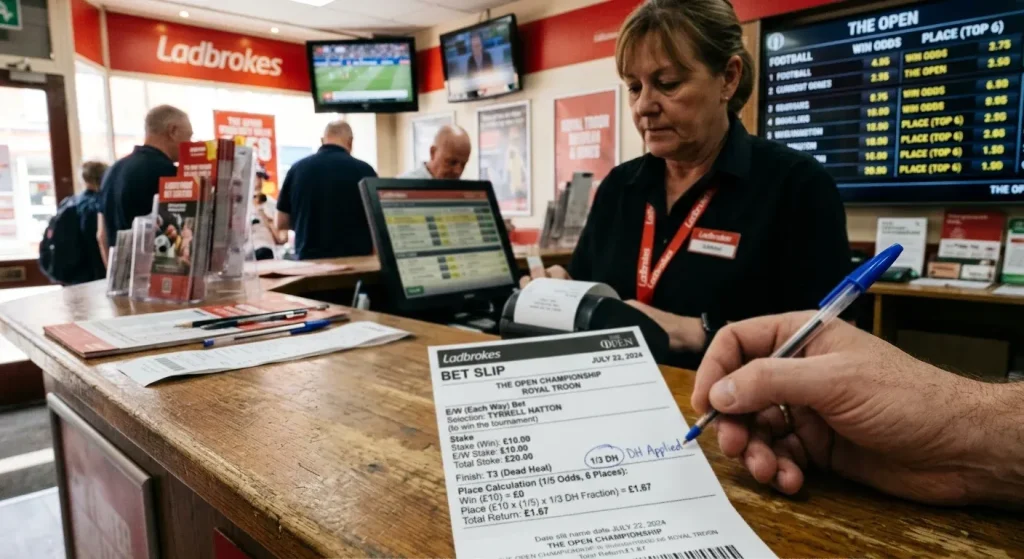
Consider a scenario where your player is one of three tied for fifth in a market paying five places at one-fifth odds. The win part of your each-way bet simply loses — there’s no dead heat calculation to apply there. The place part is where the formula above applies in full.
Now consider the rarer scenario where your player ties for first. Bookmakers settle outrights on the official result after any playoff — if there is one. If the tournament ends without a playoff (some smaller events settle on stroke count only), the dead heat fraction applies to the win portion too. In that case both your win and place components are fractionally paid. This is genuinely rare on the major tours but worth knowing about for smaller events or non-playoff formats.
Standard bookmaker terms pay the full each-way return where a player finishes inside the place positions outright. The dead heat rule only activates where two or more players share a finishing position that sits on or spans the place boundary. If your player finishes tied for third in a five-place market, that’s clean — you’re inside the places regardless of how many others are tied at third. If your player is tied for fifth out of five paid places and one other player shares that position with them, dead heat rules apply to the place portion.
Real-World Examples: What You Actually Get Back
Let me work through three scenarios that cover the most common situations you’ll encounter.
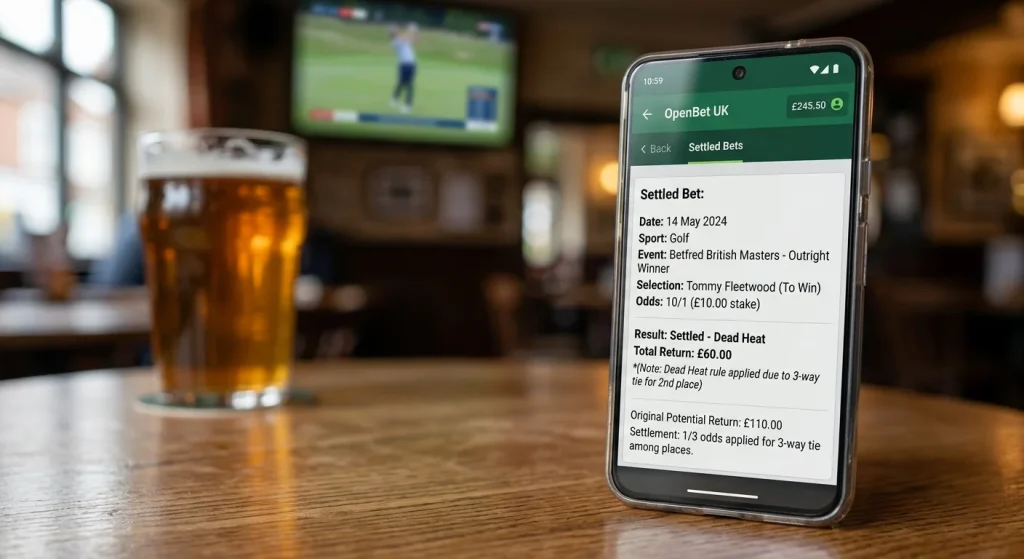
Scenario one: player finishes tied for sixth in a market paying six places at one-fifth odds, tied with one other player. You backed at 40/1, £5 each-way. Dead heat fraction: 1/2. Place odds: 40/1 x 1/5 = 8/1. Dead heat adjusted: 8/1 x 1/2 = 4/1. Place return: (£5 x 4) plus half stake back (£2.50) = £22.50 total. Win bet loses. Net profit: £2.50 on a £10 outlay.
Scenario two: player finishes tied for eighth in a market paying eight places at one-fifth odds, tied with two others. You backed at 66/1, £5 each-way. Dead heat fraction: 1/3. Place odds: 66/1 x 1/5 = 13.2/1. Dead heat adjusted: 13.2/1 x 1/3 = 4.4/1. Place return: (£5 x 4.4) plus one-third stake back (£1.67) = £23.67 total. Win bet loses. Net profit: £13.67 on a £10 outlay.
Scenario three: player finishes tied for the win, tournament has no playoff. You backed at 25/1, £10 each-way, five places at one-quarter odds. Tied with one other player. Dead heat fraction: 1/2. Win return: (£10 x 25/1 x 1/2) plus half stake (£5) = £130. Place return: (£10 x 25/1 x 1/4 x 1/2) plus half stake (£5) = £36.25. Total return: £166.25 on a £20 outlay. Without dead heat: win return £260 plus place return £72.50, total £332.50. The difference is significant — but you’ve still landed a substantial winner.
Understanding how returns interact with finishing positions connects directly to the broader question of each-way market selection, which you can explore in detail through the complete guide to each-way golf betting tips.
Frequently Asked Questions
How does a dead heat affect my each-way golf bet?
A dead heat applies a proportional reduction to your place return. If two players tie for a place position, you receive half the place payout plus half your place stake back. If three players share the position, you receive one-third. The win portion of your each-way bet is unaffected unless your player ties for the outright win in a non-playoff format.
Do all bookmakers apply dead heat rules the same way?
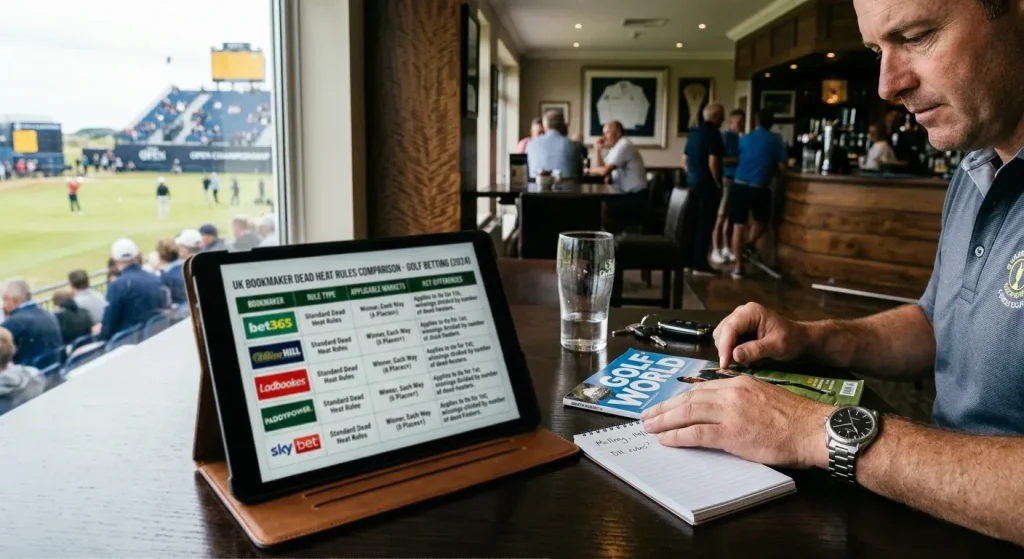
The fundamental calculation is standardised across UK licensed bookmakers, but there are subtle differences in how partial stake refunds are handled and how they deal with ties that span across place boundaries. Always check the specific rules section for golf markets before placing, particularly for each-way bets in events where large ties are likely.
Can there be a dead heat on the outright winner market in golf?
Yes, though it's uncommon on the major tours because playoffs are used to determine a sole winner. However, some smaller DP World Tour and Challenge Tour events settle on stroke count without a playoff, in which case dead heat rules apply to the outright win market. Check the settlement rules for any event you're considering before placing.
Articles
Golf Betting Value Bets Explained
The word "value" gets thrown around in betting circles so often it's almost lost meaning. Every tipster claims to find…
LIV Golf Betting Tips
LIV Golf has been running long enough now that the novelty argument for ignoring it in betting terms has expired.…
Golf Tournament Formats and Betting
When I first started betting on the DP World Tour seriously, I backed a player in a tournament I thought…
Golf In-Play Betting Tips
Saturday afternoon, final round of a DP World Tour event, and the lead changes hands five times between the 12th…
