
Responsible Gambling for Golf Bettors: Tools, Limits and When to Step Back
 Available in US
I include a section on responsible gambling in almost everything I write about betting — not because I’m required to, but because I’ve seen firsthand what happens when the enjoyment of the game tips into something more compulsive. Betting on golf is supposed to be an extension of your interest in the sport. When it stops being that and becomes a source of anxiety, secrecy, or financial stress, the tools described in this article are what exist to help. There’s no shame in using them — they were built specifically for this purpose.
Understanding Problem Gambling in the UK: The Numbers
The picture from the Gambling Survey for Great Britain — the most rigorous and comprehensive survey of gambling behaviour ever conducted in the UK — is sobering when examined honestly. The survey has become a key building block of the evidence base helping government, industry, and other partners understand gambling behaviour and its potential consequences, as the UK Gambling Commission’s chief executive described it.
2.7% of UK adults score eight or more on the Problem Gambling Severity Index (PGSI) — the threshold that indicates problem gambling. That’s not a tiny fraction when applied to the UK adult population: it represents hundreds of thousands of people experiencing genuine harm from gambling behaviour. The same survey data shows that problem gambling is not concentrated exclusively among stereotyped demographics — it appears across income levels, ages, and backgrounds, though with clear patterns suggesting higher risk among younger adults and those experiencing financial stress.

30% of British teenagers aged 11-17 spent their own money on gambling activities in the previous 12 months — a figure that rose from 27% in 2024. This increase in young people’s engagement with gambling is a genuine concern, and it’s part of why the regulatory framework is tightening on precisely the tools and presentation formats that are most accessible to young people.
Understanding these figures isn’t about stigma — it’s about accurately perceiving the statistical context of recreational gambling. The large majority of people who bet on golf do so without developing problematic patterns. But the 2.7% PGSI figure means that if you’ve been betting on golf for years, you almost certainly know someone who has experienced harm from gambling, whether they’ve spoken about it or not.
Tools Every UK Bettor Should Know
Every UKGC-licensed bookmaker is required to offer a standardised set of responsible gambling tools. These are not soft suggestions — operators are mandated to make them available and accessible, and their absence from an operator’s platform would be a serious licence condition breach.

Deposit limits are the most practically useful tool for active bettors. Set a daily, weekly, or monthly maximum deposit in your account settings. The limit takes effect immediately when set and cannot be increased without a minimum delay period — this delay is deliberate, providing a cooling-off window before a higher limit comes into force. Set your deposit limit to match your intended betting budget, not your maximum financial capacity.
Session time limits and reality checks prompt you after a set period to confirm you want to continue. These are more relevant for casino products than sports betting, but the option to set an active session reminder is available at all licensed operators and some bettors find it a useful anchor.

Cooling-off periods — typically between 24 hours and 30 days — suspend your ability to bet for the chosen period. These can be applied immediately from your account settings without the more permanent implications of self-exclusion. They’re useful when you recognise you’re chasing losses, betting when tired or stressed, or simply want to take a break from the routine.
Loss limits cap how much you can lose in a day, week, or month. Unlike deposit limits, which cap money in, loss limits cap money out. Set a loss limit that represents the maximum you’re genuinely comfortable losing in that period — not a theoretical maximum, but an actual comfort level.
Warning Signs for Golf Bettors Specifically
Golf betting has characteristics that create specific risk patterns distinct from casino gambling or football betting. Understanding the warning signs specific to this context helps you recognise them before they’ve taken significant hold.
Betting to recover losses from a previous event — “chasing” — is the most common warning sign in sports betting generally and golf specifically. Golf lends itself to this because results are fortnightly or weekly and the temptation to “make it back” on the next tournament is persistent. If you find yourself placing larger bets specifically because you lost the previous week, that’s a warning flag regardless of how rational the individual selection feels.
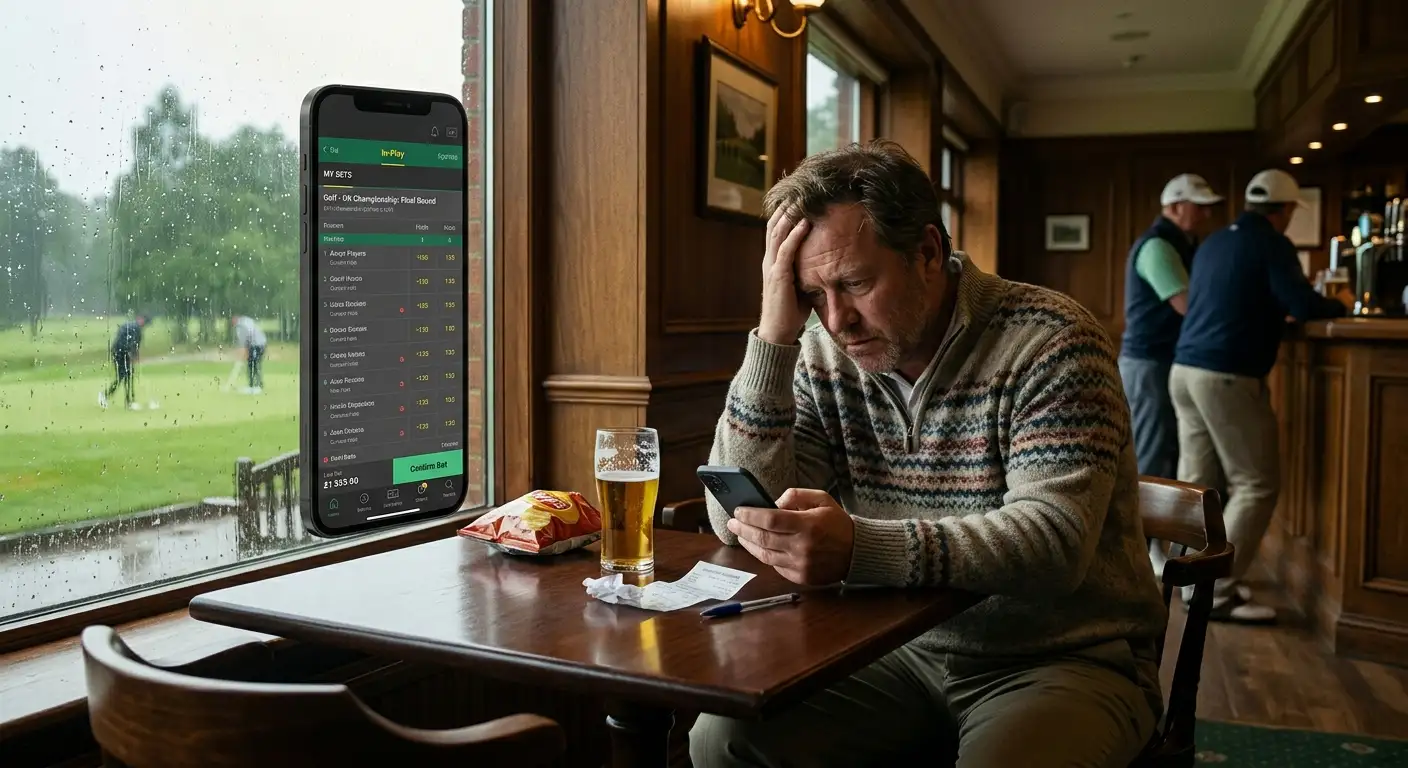
Betting when you said you wouldn’t. Setting a limit — “I’ll only bet on Majors this year” or “I’ll only stake £20 per week” — and then overriding it on a specific week because of a particularly compelling opportunity is not the same as making a considered revision to a strategy. If your pre-committed rules are routinely overridden by in-the-moment impulse, the rules aren’t serving their function.
Preoccupation with results in contexts where it interferes with other activities — watching live leaderboards during family time, being unable to enjoy an event’s golf without a bet on, feeling genuine distress rather than mild disappointment at a losing result — these are qualitative warning signs that the betting activity has become more significant to your wellbeing than is healthy.
Secrecy about the scale of betting activity is a common marker. If you’re hiding bet sizes from a partner, keeping a separate bank account for betting activity, or reluctant to discuss your gambling honestly with anyone close to you, the secrecy itself is worth reflecting on. Recreational betting doesn’t typically require concealment.
Getting Help: UK Resources
GamStop is the national self-exclusion scheme that applies simultaneously across all UKGC-licensed operators. Registration at gamstop.co.uk excludes you from all UK online gambling platforms for a minimum of six months, with one-year and five-year options. It’s comprehensive and effective — it cannot be reversed during the exclusion period, which is precisely the feature that makes it a genuine intervention rather than a soft barrier.

GamCare operates the National Gambling Helpline at 0808 8020 133, available 24 hours a day, seven days a week. The helpline provides confidential support, information, and referrals for anyone concerned about their own or someone else’s gambling. The service is free and entirely confidential.
BeGambleAware (begambleaware.org) provides self-help resources, a chat service, and an extensive library of information about recognising problematic gambling patterns and finding appropriate support. Gordon Moody offers residential rehabilitation services for those with severe gambling disorder. NHS services for gambling harm are now available through specialist NHS clinics in several regions.
The consistent thread across all responsible gambling tools — whether self-imposed limits or professional support — is that they work best when used proactively rather than after harm has accumulated. The framework for keeping golf betting within healthy bounds connects directly to the bankroll management practices covered in the guide to golf betting bankroll management, which treats responsible limits as a structural part of the betting strategy rather than an afterthought.
Frequently Asked Questions
What is GamStop and how does it work for online golf betting?
GamStop is the national self-exclusion register for UK online gambling. Registering at gamstop.co.uk excludes you from all UKGC-licensed online operators for a minimum of six months. The exclusion is comprehensive — it applies across all licensed platforms, not just the ones you register with individually. It cannot be reversed during the exclusion period. It does not affect betting with unlicensed operators, which is one of the reasons using licensed operators is essential.
What is the PGSI score and what does it indicate?
The Problem Gambling Severity Index (PGSI) is a standardised questionnaire used to assess gambling harm. A score of eight or more indicates problem gambling. 2.7% of UK adults reach this threshold. Scores between three and seven indicate moderate-risk gambling. Scores of one or two indicate low-risk gambling. The Gambling Commission's Gambling Survey for Great Britain uses PGSI as a key measurement of harm in the UK population.
Can I set deposit limits on all UK licensed betting sites?
Yes. All UKGC-licensed operators are required to offer deposit limit functionality. Limits can be set in account settings and take immediate effect. Requests to increase a limit are subject to a mandatory delay period — typically 24 to 72 hours — before the higher limit becomes active. This delay is a regulatory requirement designed to prevent impulsive increases. You can always decrease a limit immediately.
Articles
Golf In-Play Betting Tips
Saturday afternoon, final round of a DP World Tour event, and the lead changes hands five times between the 12th…
Mobile Golf Betting in the UK
The shift to mobile-first golf betting happened quietly but completely. I remember when placing a golf bet on your phone…
US Open Golf Betting Tips
The US Open is the only Major where the tournament organisers are explicitly trying to make it hard to score…
Golf Betting Unlicensed Sites
Someone in a golf betting forum I follow shared their "secret" for getting better odds: they'd found an offshore site…
