
Best Golf Tipsters UK 2026: Verified Records and What They Actually Mean
 Available in US
I’ve wasted money on tipster services that looked impressive until I asked one simple question: where’s the verified proof? The golf betting tipster space is full of people who’ve had a hot run over six weeks and built a subscription service around it. After nine years tracking picks in this niche, I can tell you the difference between a genuine long-term edge and someone who got lucky in a soft field. That difference comes down entirely to verified, independent records — and most services don’t have them.
Why Verification Matters More Than Win Rate
Let me start with the number that catches most punters out: win rate. A golf tipster boasting a 40% win rate sounds impressive until you realise that backing 30/1 shots at even a 20% clip produces a far better long-term return. Win rate without context is almost meaningless. What actually matters is ROI — return on investment across a statistically significant sample — and whether a third party can vouch for every single bet.
The difference between self-reported results and independently verified ones is enormous. Self-reported records can be backdated, selectively edited, or simply invented. Verification platforms — the legitimate ones — timestamp every tip at the point of submission, before the event starts. There’s no going back.

Here’s the benchmark I use when evaluating any service: a minimum of 500 bets before I take the numbers seriously. At that sample size, variance starts to settle. Below 500, even a bad system can look profitable and even a genuinely skilled tipster can look mediocre. One service I’ve followed over the long haul has logged over 2,000 bets since 2018, which gives you the kind of evidence base that actually means something. That’s the standard worth holding others to.
How to Read a Tipster’s Track Record
The first time I sat down with a tipster’s full results sheet, I made the mistake almost everyone makes: I looked at the headline profit number and stopped there. That’s like judging a restaurant by the photo on the menu. What you actually need to dig into tells a very different story.
Average odds matter because they tell you whether the ROI figure is being driven by a handful of big-priced winners or by consistent outperformance. A tipster hitting 15% ROI at average odds of 8/1 is operating in a very different space to one hitting 15% ROI at 5/2. The former involves higher variance and you’ll need a larger bank to survive the inevitable cold runs.

Strike rate in context matters too. If someone is tipping at average odds of 25/1, a 6% strike rate is entirely sustainable. If they’re averaging 6/1 and still hitting only 6%, the maths is working against them over time.
Drawdown is perhaps the most underappreciated figure in any track record. What’s the longest losing run? What’s the maximum drawdown as a percentage of the starting bank? A tipster who shows 200 points profit over three years but has a 90-point drawdown mid-journey requires a specific kind of psychological resilience — and a bank large enough to absorb it. Services that don’t publish their maximum drawdown are, in my experience, hiding something uncomfortable.
One service with over seven years of verified results has accumulated more than 2,000 points of profit at a 30% ROI. That’s an extraordinary long-term figure that holds up to scrutiny precisely because the sample size makes variance an insufficient explanation. Compare that to a newer service with an 18% ROI but only 300 bets — interesting, worth monitoring, but not yet something I’d stake serious money on.
The Numbers Behind Top UK Golf Tipsters
I’ll give you the honest picture of what the verified data actually looks like across the services I’ve tracked over the years, because the numbers reveal something important about the realistic ceiling of this game.
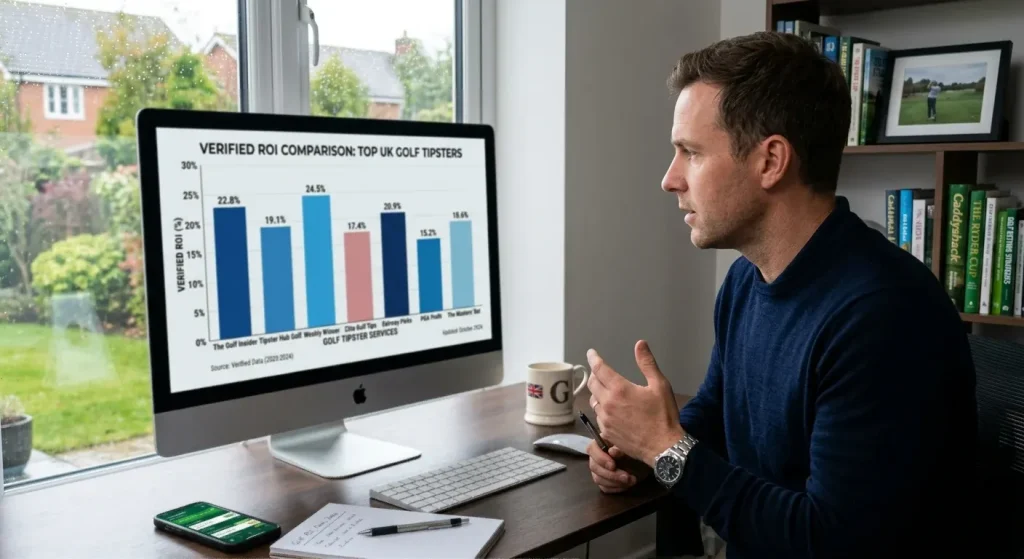
The standout figure in recent UK golf tipster data is a verified ROI of 31.5% across over 2,100 bets dating back to 2018. Short-term performance within that same service hit 230% ROI in a single year — which sounds extraordinary until you understand that a few big-priced winners in a small sample can produce that kind of spike. The long-term figure is what tells the real story.
At a more modest but entirely credible level, services sitting around 18% ROI with verified platforms like Betting Gods represent a realistic expectation for what a skilled, disciplined operator can achieve. That’s not glamorous. But compounding 18% ROI over a multi-year period with sensible staking is genuinely life-changing if you approach it as a business rather than a hobby.
One figure I find particularly illuminating: a service that generated £3,947 profit in a single year with an average stake of £9.80 across 625 bets. That’s roughly 12 tips per week — a high-volume approach with modest individual stakes. The annual profit is real money, but it required consistent, disciplined staking across every single week of the golf calendar, including the dull summer events nobody watches.
The pattern across all legitimate long-term services is consistent: moderate ROI figures (15-35%), large sample sizes, and none of the explosive short-term claims that attract the most subscribers.
Red Flags: When to Walk Away from a Tipster
The red flags are easy to spot once you’ve been burned a few times. The first is any service that leads with percentage returns without context — “up 340% this year!” means nothing without knowing the stake size, number of bets, and odds range.
The second is the absence of a starting bank figure. Without a defined starting point, percentage returns are invented numbers. Ask any tipster you’re considering: what bank do your percentages assume? If the answer is vague, walk away.

The third — and this one catches people repeatedly — is the trial period performance. Many services run a genuinely excellent trial, often because they’re cherry-picking the tips they’d have shared anyway. I’ve seen multiple services deliver 40-point profits in a four-week trial and then haemorrhage 60 points in the following two months. Insist on seeing at least six months of live, post-publication data before you hand over a subscription fee.
The fourth is the absence of independent verification. If the only evidence of performance is a screenshot on their own website, that’s not evidence — it’s marketing. Platforms that timestamp and publicly record every tip at the point of submission provide the only meaningful audit trail.

Finally, be deeply suspicious of services that never have a losing week. Every genuinely skilled golf tipster has cold runs. The nature of backing long-priced players means you will go weeks — sometimes months — without a significant winner. A service presenting a perfectly smooth upward equity curve hasn’t found the holy grail; they’ve curated their results.
Understanding what verified tipster data really looks like will transform how you approach golf betting bankroll management — because the two go hand in hand. Realistic ROI expectations directly dictate the staking strategy that will keep you in the game long enough for edge to express itself.
Frequently Asked Questions
How do I verify that a golf tipster's results are genuine?
Look for third-party verification platforms that timestamp tips before events start. Self-reported screenshots are not verification. Check the number of bets in the sample — under 500 is too small to draw reliable conclusions. Ask specifically about maximum drawdown and longest losing run.
What is a good long-term ROI for a golf tipster service?
Anything between 15% and 35% ROI over a sample of 1,000 or more bets is genuinely strong performance. Be sceptical of figures above 40% sustained over large samples — the maths of the market makes that very difficult to sustain. Short-term spikes above 100% are possible but tell you almost nothing about long-term edge.
Is a high win rate more important than ROI for golf tips?
ROI is far more important. A tipster with a 15% win rate at average odds of 20/1 is producing a better long-term return than one with a 30% win rate at average odds of 3/1. Always evaluate ROI across a meaningful sample — win rate in isolation is a marketing number, not a performance metric.
Articles
LIV Golf Betting Tips
LIV Golf has been running long enough now that the novelty argument for ignoring it in betting terms has expired.…
Golf Betting Bankroll Management
The most painful lesson I've learned in golf betting has nothing to do with picking winners. I once had a…
US Open Golf Betting Tips
The US Open is the only Major where the tournament organisers are explicitly trying to make it hard to score…
Golf Tournament Formats and Betting
When I first started betting on the DP World Tour seriously, I backed a player in a tournament I thought…
