
Golf Betting Bankroll Management: The Framework That Protects Your Edge
 Available in US
There is a sobering thought experiment I share whenever someone asks me whether golf betting can be consistently profitable. Imagine a verified tipster with a documented ROI of 31.5% across 2,111 bets placed over eight years. That is an extraordinary record — the kind of long-term edge that most bettors never achieve. Now suppose that tipster has a punter following their selections, but the punter stakes 10% of their remaining bankroll on each tip because they want to maximise their returns from such a strong track record. After a losing streak of seven consecutive bets — which happens to any tipster no matter how skilled — the punter’s bankroll is reduced to roughly 48% of its starting value. A winning streak cannot fully recover that hole without taking further risk. The tipster’s edge is real. The punter’s bankroll management is destroying it.
Bankroll management is not a supplementary topic in golf betting. It is the foundational discipline that determines whether a genuine edge in picking translates to actual long-term profit, or whether it is consumed by the inevitable variance that characterises a sport where a 25/1 shot wins perhaps 3% to 4% of the time. The maths of compounding losses is unforgiving, and golf’s natural variance — driven by large fields, four-round formats and the high randomness inherent in any outdoor sport — makes the swings longer and deeper than in most betting markets.
Why Golf Betting Requires a Different Bankroll Approach
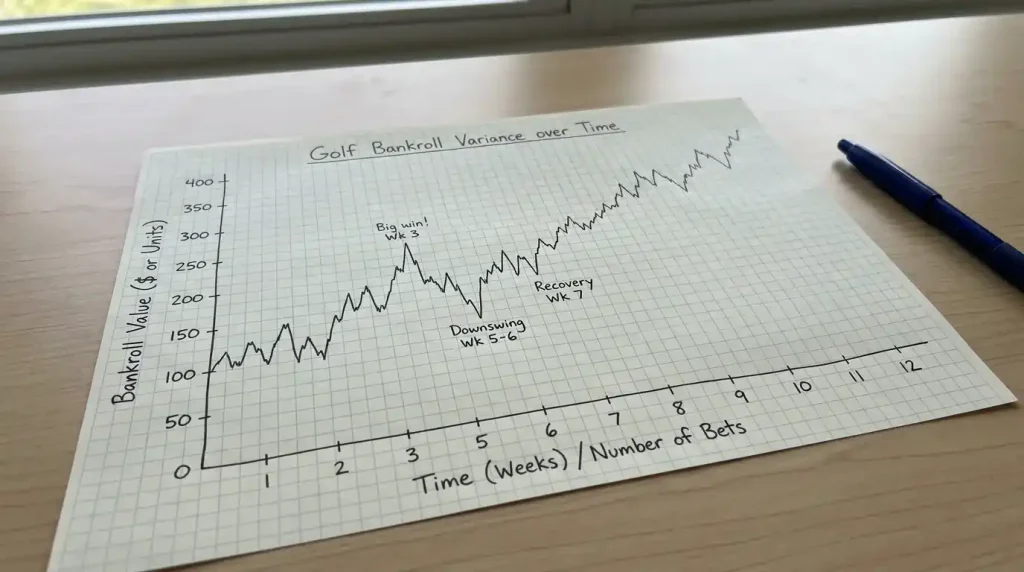
The first time I lost eight consecutive each-way selections was in a run of three consecutive weeks. All eight players I had backed had performed exactly as their statistical profiles suggested they might — four of them made the top 15, two more finished inside the top 25. But none placed within the terms of their each-way market, and my bankroll took the full loss on every selection. This is not a story about bad picks. It is a story about the inherent variance structure of a betting market where even correct analysis produces a “loss” 80% to 85% of the time on outright selections.
This is the fundamental feature of golf betting that makes a standard “stakes as you feel it” approach so dangerous. In football betting, a run of eight losing bets is unusual and alarming — it typically signals something is wrong with your selection method. In golf each-way betting, a run of eight consecutive losing selections in which every player you backed performed well and just missed the place terms is entirely plausible and statistically unremarkable. If your staking is calibrated based on football’s loss frequency expectations, you will massively over-stake relative to what golf’s variance structure can sustain without catastrophic drawdown.

The demographic context reinforces why this matters. Around 15% of UK men regularly bet on sport — a substantial population making real financial decisions under the influence of cognitive biases that are particularly severe in high-variance markets. The urge to increase stakes to “catch up” after a losing run, to double down on a player you have strong conviction about, or to stake more heavily on Majors because they “feel more important” are all impulses that good bankroll management explicitly neutralises. Managing against these impulses is not a moral exercise — it is a performance-optimisation process that directly affects your financial outcomes.
Staking Plans: Flat, Percentage and Kelly Criterion
Three main staking methodologies apply to golf betting, and the right choice depends on your experience level, the consistency of your selection process, and whether you are primarily using your own picks or following a verified tipster service. Each has meaningful tradeoffs that are worth understanding before you adopt one.
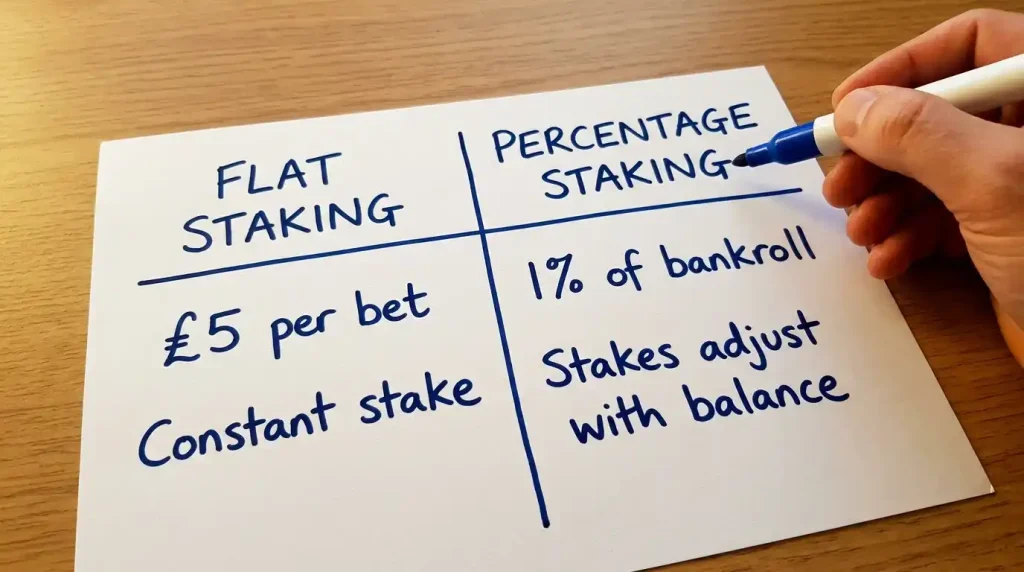
Flat staking is the simplest and, for most recreational bettors, the most appropriate starting point. You decide on a fixed monetary stake — typically 1% to 2% of your total starting bankroll — and apply it to every bet regardless of your level of conviction. On a £500 bankroll, this means staking £5 to £10 per selection. The immediate objection is that this feels insufficiently sensitive to situations where you have high conviction versus low conviction. The counter-argument is that conviction is unreliable in golf betting because the variance involved means that even your highest-conviction picks fail the place test most of the time. Flat staking removes the temptation to calibrate stakes based on emotional confidence, which is the most corrosive source of bankroll destruction for most punters.
Percentage staking applies a fixed fraction of your current bankroll — most commonly 1% to 2% — to each bet, adjusted upward as your bankroll grows and downward as it shrinks. This has a natural protective mechanism: your absolute stakes reduce automatically during losing periods, limiting the depth of drawdown. The drawback is that recovering from a losing period takes longer because your stakes also reduce when your bankroll is lower. For a bettor with a genuine long-term edge, percentage staking is mathematically superior to flat staking over extended periods. For a bettor who is not yet confident they have a verified edge, it produces the same risk management benefit as flat staking with a smoother long-term bankroll trajectory.
The Kelly Criterion is the mathematically optimal staking formula, calculated as: stake percentage = (edge / odds) where edge is your estimated probability advantage over the market’s implied probability. Applied correctly to a genuinely positive expected value bet, Kelly maximises the growth of your bankroll over time. The problem in practice is that Kelly requires accurate probability estimates that most bettors — and most tipster services — cannot produce reliably. Even a small systematic overestimation of your edge produces what is called “overbetting” under Kelly, which generates more severe drawdowns than flat staking despite the theoretical optimality. The standard solution is “fractional Kelly” — typically one quarter to one half of the full Kelly stake — which provides most of the long-term growth benefit while dramatically reducing variance. For golf betting, where even verified tipsters with strong records operate with selection uncertainty at the individual bet level, half-Kelly or quarter-Kelly is the appropriate implementation if you choose to use the formula at all.
The practical recommendation for most UK golf bettors: start with flat staking at 1% to 2% of your bankroll per selection. After at least 100 to 200 bets, evaluate your actual results against your expected results and consider whether percentage staking or fractional Kelly is appropriate for your verified track record. Do not apply sophisticated staking methodology to an unverified edge — the formula will faithfully amplify whatever noise or genuine signal exists in your picking, and amplifying noise is exactly what you want to avoid.
One final point on staking plans that is consistently underappreciated: your staking plan should remain constant regardless of your current results. The plan you designed when your bankroll was at £500 should apply just as rigorously when it has grown to £700 or fallen to £350. Many bettors unconsciously tighten stakes when winning (to “protect” profits) and loosen them when losing (to “catch up”). Both behaviours contradict the mathematical logic that makes your staking plan work in the first place. Consistent application is the entire point.
Tracking Your P&L: The Template Golf Bettors Actually Use
I have had this conversation at some point with nearly every punter I know who eventually became consistently profitable: there was a period when they did not track their bets properly, they felt like they were “roughly breaking even or better,” and when they finally sat down and calculated their actual P&L for the past three months, the number was significantly worse than their impression. This is almost universal in betting, and it is not a character flaw — human memory is systematically biased towards remembering the winners and underweighting the losers. A tracking spreadsheet exists to override this bias with arithmetic.
The minimum fields you need to record for each bet are: date, tournament name, player backed, bet type (outright win, each-way, FRL, matchup), odds at time of placing, stake, whether the bet was each-way (recording win stake and place stake separately if applicable), result (win / place / loss), return, and running P&L. These ten fields take approximately 90 seconds to fill in after placing a bet and approximately 60 seconds to update after the result. The investment is trivial relative to the analytical value it provides.

Additional fields that significantly improve the analytical usefulness of your records include: which bookmaker the bet was placed with, the each-way terms at time of placing (number of places and fraction), any SG or form basis for the selection, and a brief “post-mortem” note after each result (e.g. “player made the cut comfortably, finished T22 — solid result just outside place terms” versus “player shot 75 in round one, form analysis was wrong”). These fields let you retrospectively analyse where your selections are performing relative to expectation and identify systematic errors in your research methodology.
The verified records of successful tipster services illustrate what a meaningful track record actually looks like in terms of sample size and timescale. The Golf Insider service, for example, built its credibility over more than seven years and more than 2,000 recorded tips before the record was large enough to distinguish genuine skill from variance. At a rate of roughly 3 to 5 tips per week, it takes approximately two to three years of consistent tracking before your own sample is large enough to say anything statistically robust about whether your selection approach has a genuine positive edge. This is not discouraging — it is the correct expectation, and knowing it prevents you from making premature conclusions about whether your method is working.
Psychological Traps: Chasing, Tilt and the Weekend Effect
The single most expensive thing I have ever done in golf betting has nothing to do with a research failure. It was a Friday afternoon when two of my selections missed the cut, I was down for the week, and I decided to add two extra selections for the weekend that were not in my original research. Both lost. The four original planned selections produced a combined profit for the week. The two unplanned, emotionally motivated additions turned a profitable week into a losing one.
This pattern — often called “tilt” in poker circles but equally applicable to sports betting — is the most common source of bankroll destruction for punters with genuinely sound research processes. It occurs when a losing period activates an emotional response that overrides the analytical framework you built when you were thinking clearly. The response is not always dramatic. Sometimes it is as subtle as bumping a stake from 1.5% to 3% on a Saturday selection because you “really like this one” after a frustrating Thursday-Friday. Sometimes it is adding a lower-quality selection to increase your exposure for the weekend. These are the invisible bankroll leaks that do not show up in your “research quality” but consistently prevent profitable periods from translating to positive annual returns.
Chasing losses is the acute version of the same impulse. After several losing weeks in succession — which, as discussed, is statistically normal in golf betting — the temptation to increase stakes to “recover” the loss is powerful. It is also mathematically irrational: the expected value of a bet does not improve because you have lost recently. The bet’s expected value is determined entirely by the odds, your probability assessment and the stake. Increasing the stake when your bankroll is already depleted simply means that when the inevitable further losing run occurs, you have less cushion to absorb it from.

The UK’s own gambling research provides sobering context here. The Gambling Survey for Great Britain found that 2.7% of UK adults score at or above the problem gambling threshold on the Problem Gambling Severity Index. That figure represents several hundred thousand individuals in a country where 8% of adults place online sports bets. The causes of problem gambling are multifaceted, but loss-chasing and stake escalation during losing periods are identified consistently as behavioural markers that precede the development of genuine gambling disorder. As Grainne Hurst at the Betting and Gaming Council described, the protection of consumers is not simply an industry issue but a genuine public health concern — one that responsible bettors should take seriously in their own behaviour management before it becomes a structural problem.
The most reliable psychological protection I have found is a pre-committed betting plan: selections identified by Wednesday, stakes calculated as a percentage of current bankroll, recorded in the tracker before the first round begins. Once the week’s bets are placed and logged, that is the final exposure for the week. No adding. No escalating. If the results are bad, the methodology is reviewed at the end of the week, not during it. This structure does not eliminate the emotional discomfort of losing — nothing does — but it prevents that discomfort from generating additional losses.
The “weekend effect” is a related and equally costly trap. Many punters bet their largest weekly stakes on Saturday and Sunday events — particularly during Major weeks — because those rounds feel more significant and emotionally charged. The problem is that Saturdays and Sundays are also when the market is tightest and most efficient, because every punter on the circuit has had all week to arrive at the same conclusions you have. The odds available on Saturday morning for a player who has led through two rounds are significantly sharper than the odds available on the Tuesday before the tournament, when value is most available. If you find yourself regularly staking more at weekends than at the start of the week, you are likely systematically betting at your worst prices and your highest emotional activation level simultaneously.
Setting Win Targets and Loss Limits
One of the most useful reframings I can offer on golf betting profitability is this: the question is not “can I make money this week?” but “what return can I realistically expect over a 200-bet sample at my current level of edge?” The answer to the second question is grounded in data rather than optimism, and it changes how you relate to the inevitable weekly variance.
Realistic ROI targets for verified golf tipster services run in the range of 10% to 30% over long periods, with the higher end reserved for services with unusually strong data-driven methodology and lower average stake levels. A verified tipster with a documented 31.5% ROI across 2,111 bets represents the upper range of what sustained, disciplined golf betting produces — and that record was built over eight years with consistent methodology, not a lucky run. At the lower end, a punter achieving 8% to 12% ROI over a 200-bet sample is performing well above the market average and should feel confident their approach has genuine merit. A 5% ROI is plausible as a floor for a disciplined punter who applies consistent research without a specific edge in course fit or SG analysis.
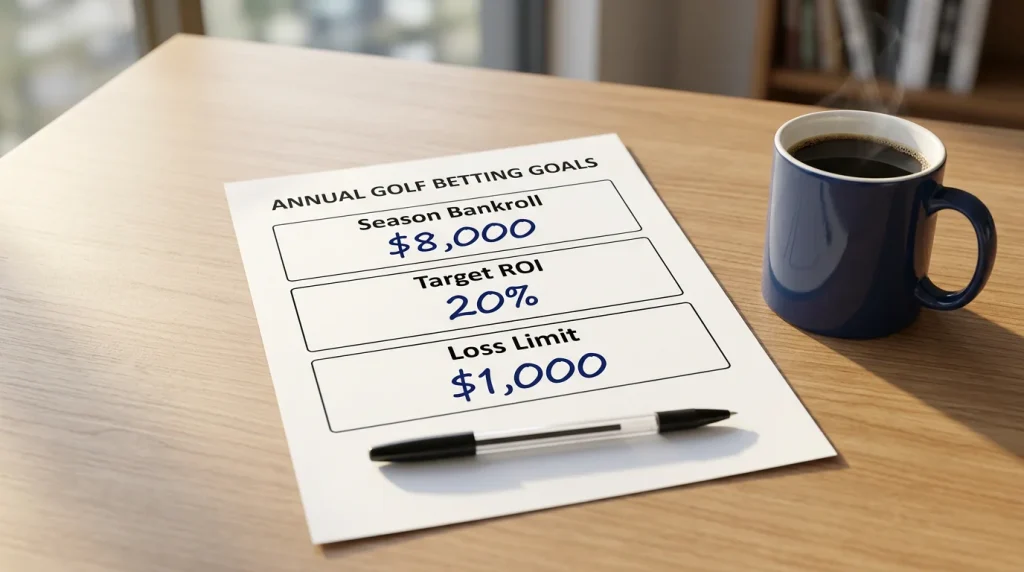
Setting a seasonal loss limit is as important as setting a profit target. Before the golf season starts, decide the maximum you are willing to lose across the full season and treat it as the absolute floor for continuing to bet at the current level. If your bankroll drops to that level, reduce stakes by 50% rather than stopping entirely — stopping cold is as psychologically counterproductive as chasing. If it drops to 50% of the original loss limit at the reduced stake level, stop entirely for the season and use the time to review your research process. This is not defeatism — it is the professional trader’s approach to managing maximum drawdown, and it prevents the scenario where a bad first half of the season generates desperate, high-variance betting in the second half to try to recover. For a comprehensive companion guide to the selection and verification of tipster services that can anchor your staking targets, the best golf tipsters guide covers how to evaluate long-term records and identify genuine versus manufactured performance claims.
Frequently Asked Questions
What percentage of my bankroll should I stake on each golf bet?
For most recreational bettors, 1% to 2% of your total bankroll per bet is the appropriate starting range. This means a £500 bankroll generates stakes of £5 to £10 per selection. At 1%, a losing run of 20 consecutive bets — which is statistically possible in golf each-way betting — reduces your bankroll by approximately 18%, which is recoverable. At 5%, the same run reduces your bankroll by approximately 64%, which is potentially catastrophic. Start at 1% and only increase once you have verified your edge over at least 100 bets.
How long does it take to know if a staking plan is working?
A minimum of 100 bets is required before drawing any conclusions, and 200 bets is the more statistically robust threshold. At the typical rate of 3 to 5 golf selections per week during the active season, that represents approximately one to two full seasons of recorded betting. Before that sample is accumulated, what looks like a positive or negative result could easily be variance rather than a genuine reflection of the quality of your selection methodology.
Is Kelly Criterion suitable for golf betting?
Fractional Kelly — specifically one quarter to one half of the full calculated Kelly stake — is suitable for bettors who can produce reliable edge estimates from their research. Full Kelly is too aggressive for golf betting because the high variance of outcomes means that even small errors in edge estimation lead to overbetting and severe drawdowns. If you are not confident in the accuracy of your probability estimates, flat staking at 1% to 2% produces better practical outcomes than full Kelly despite being theoretically suboptimal.
What is a realistic long-term ROI target for golf betting?
A realistic long-term ROI target for a disciplined recreational punter is 5% to 15% over a 200+ bet sample. The verified records of the most successful UK golf tipster services show long-term ROI in the 18% to 31% range across thousands of bets, but these represent the upper range of what consistent, data-led golf betting produces. Any service or individual claiming sustained ROI above 35% without a very large verified sample should be treated with significant scepticism.
Articles
PGA Tour Free Picks
The paid tipster subscription industry exists because most people don't believe they can do this analysis themselves. Some of that…
Golf Course Form Guide
Monday morning, the tour schedule updates, and you have until Thursday morning to build a credible analytical case for the…
Golf Betting Unlicensed Sites
Someone in a golf betting forum I follow shared their "secret" for getting better odds: they'd found an offshore site…
Golf Betting Value Bets Explained
The word "value" gets thrown around in betting circles so often it's almost lost meaning. Every tipster claims to find…
