
PGA Tour Free Picks: How to Research Weekly Events Without Paid Services
 Available in US
The paid tipster subscription industry exists because most people don’t believe they can do this analysis themselves. Some of that belief is justified — genuinely skilled tipsters with verified long-term records do provide something of value. But a significant portion of it is a gap in confidence rather than a gap in ability. The tools available for free in 2026 are sophisticated enough that any punter willing to spend 45 minutes on a Tuesday can build a defensible set of weekly picks for PGA Tour events. Here’s exactly how I approach it, from scratch, every week.
Free Data Sources Every PGA Tour Bettor Should Know
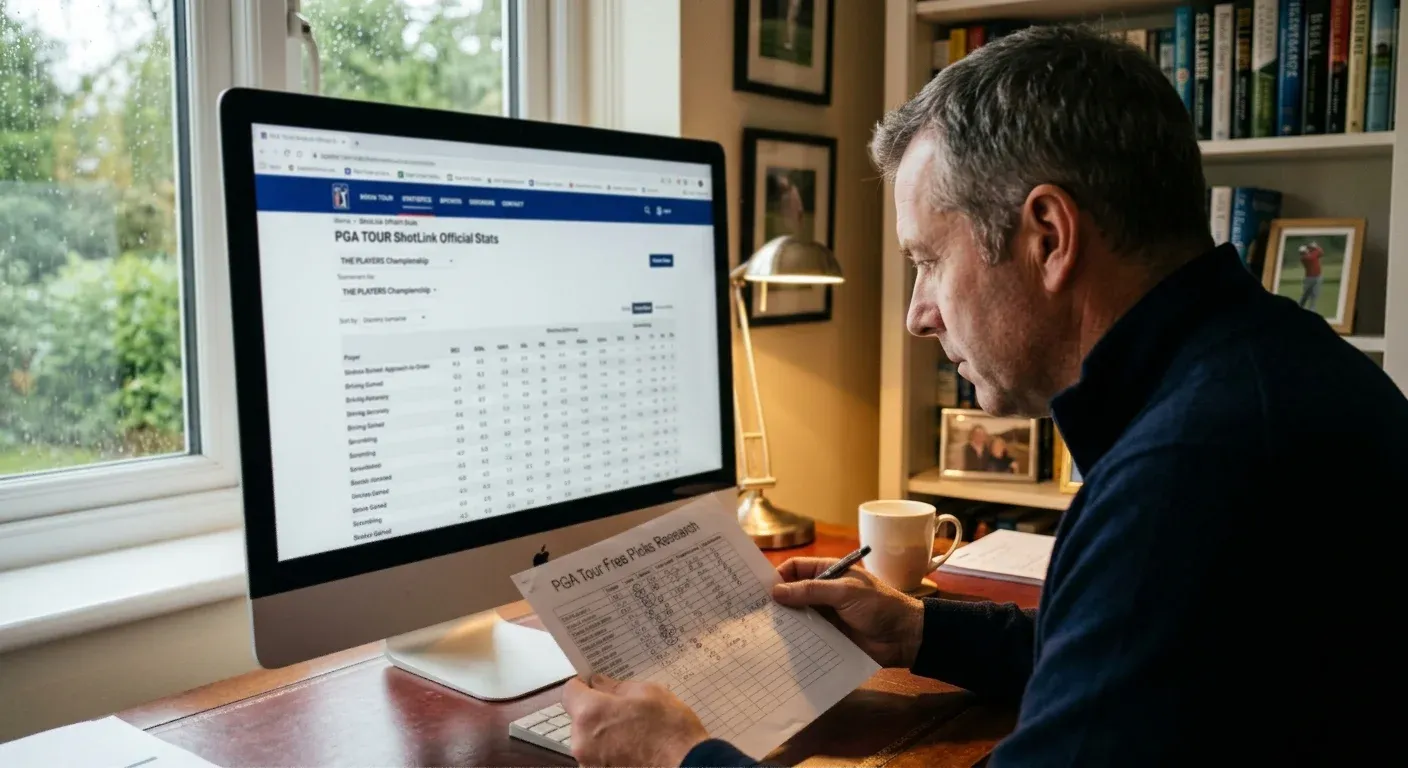
The PGA Tour’s decision to make extensive statistical data publicly available has quietly transformed what a self-directed bettor can access. The official PGA Tour website publishes full season and rolling-average statistics for every active player on tour, including traditional stats and Strokes Gained categories broken down by time period.
DataGolf is the most powerful free tool available for golf bettors and it carries over 2.1 million records across professional golf globally. The free tier provides access to player rankings based on SG-weighted performance models, course-specific fit ratings, and recent form summaries. The premium tier adds more granular filters and additional predictive models, but the free layer alone is more analytically useful than anything most punters were using five years ago.

The PGA Tour market was valued at $2.5 billion in 2024, projected to reach $3.8 billion by 2032 — that scale of commercial activity has driven the data infrastructure to become increasingly public-facing. More data means a more efficient market, which is the trade-off: better information is available, but your competitors have access to the same information, so the analytical edge increasingly comes from how you interpret and apply the data rather than from simply having access to it.
For free sources specifically: PGA Tour official stats (pgatour.com/stats), DataGolf’s free player ranking and form pages, Fantasy National for simplified SG overviews, the DP World Tour’s official stats portal for European coverage, and ShotLink data summaries published periodically by analytics journalists. Between these, you have everything needed for a sound pre-event framework without spending a penny on subscriptions.
Building a Weekly Research Routine in Under an Hour
The most common objection to doing your own research is time. “I don’t have time to analyse every player in the field.” You don’t need to. The goal is to narrow a 156-player field to a shortlist of six to eight genuinely interesting candidates, and that process takes less time than most people assume when you have a clear framework.
Monday: identify the tournament venue and course profile. Five minutes maximum. What type of course is it — driving course, accuracy course, bermudagrass greens, bentgrass, coastal, inland? This one classification determines which SG categories you’ll prioritise in your filtering. Write it down before you look at a single player.

Tuesday morning: open DataGolf and filter the field by the SG category relevant to the course profile. Take the top 30 players by that primary metric over the last 24 months. That’s your universe — you’re not going to find your selections outside it. This step takes ten minutes.
Tuesday afternoon: apply a form filter. Of those 30, which players have made the cut in at least four of their last six starts and have at least one top-15 finish in the same period? Cut the list to roughly 15 players. That’s another ten minutes.
Wednesday morning: cross-reference with the odds board. Of your 15 remaining candidates, which are priced at 20/1 or longer? Any player shorter than 20/1 is already significantly bet by the market and the value is harder to extract at those prices. From the remaining longer-priced candidates, check their specific course history — have they made the cut here before, or on similar course types? That’s fifteen minutes of targeted history checking.
Final selection: your shortlist should be four to six players. Assess the each-way terms available. If the bookmaker is paying eight or more places at favourable fractions, back your top three to four selections each-way at equal stakes. Total research time: around 45 minutes across two days. Total cost of data tools used: zero.
PGA Tour vs DP World Tour: Which Is Easier to Research
An honest comparison: PGA Tour is far better served by public data infrastructure than DP World Tour. ShotLink data, the foundation of SG calculations, is a PGA Tour proprietary system. The DP World Tour publishes fewer granular statistics, and the third-party analytics platforms have less comprehensive DP World Tour coverage than their PGA Tour equivalents.
The PGA Tour market being valued at $2.5 billion reflects the enormous commercial investment in data, broadcast, and analytics infrastructure. That infrastructure benefits bettors in the form of more available data — but it also means the market is more efficiently priced, because more smart money is flowing into PGA Tour markets than DP World Tour ones.

My practical assessment: PGA Tour research produces more reliable picks because the data is richer, but the odds you find are marginally tighter because the market is sharper. DP World Tour research is harder because the data is thinner, but the odds are marginally more generous because fewer analytical resources are deployed against the market. The two tour types complement each other well for a punter willing to work both.
Turning Research into Shortlisted Picks
The research process produces a ranked list. The final selection step — converting that list into actual bets — is where discipline matters most. The temptation is to back everything on your shortlist because “they all look good.” That’s how you end up with ten bets a week at small stakes and no coherent edge.

I limit myself to four bets per tournament as a hard rule. If I have more than four compelling candidates after running my framework, I take the four with the longest prices — because at that point, all four are in the same quality tier and the expected value calculation favours the longer prices. If I have fewer than four candidates that genuinely clear all my filters, I back only those that do and accept an under-deployed bank that week.
The weekly discipline of running the same framework, regardless of whether the previous week produced winners or losers, is what separates the systematic punter from the reactive one. A bad week is not a reason to widen the filters. A good week is not a reason to congratulate yourself on your genius. The process is what creates edge over time, and consistency in applying it is what lets the edge accumulate. For the complete SG-based analytical framework that underpins the research routine above, the full guide to Strokes Gained golf betting provides every component in depth.
Frequently Asked Questions
Where can I find free PGA Tour stats and form guides?
The PGA Tour official website (pgatour.com/stats) provides comprehensive Strokes Gained statistics and traditional stats for all active players. DataGolf's free tier offers SG-weighted player rankings and course fit analysis. Fantasy National provides simplified SG summaries. Between these three free sources, you have the core data infrastructure for meaningful weekly research.
How long does weekly golf betting research realistically take?
With a clear framework and familiarity with the tools, around 45 minutes to one hour spread across Tuesday and Wednesday mornings. The Monday step — identifying the course profile — takes five minutes. Tuesday filtering and form analysis takes 20 minutes. Wednesday odds-checking and final shortlisting takes another 20-25 minutes. The process gets faster as the tools become familiar.
Is it possible to beat bookmakers without a paid tipster service?
Yes, for punters willing to build and consistently apply a research framework using available free data. The key is process consistency — applying the same criteria every week regardless of recent results — and limiting bets to situations where the analysis generates clear positive expected value. Most self-directed bettors fail not from lack of information but from inconsistent application of their own stated criteria.
Articles
The Open Championship Betting Tips
Every year, The Open Championship delivers at least one moment that makes casual observers think it's unpredictable. Every year, the…
Dead Heat Rules in Golf Betting
The first time a dead heat cost me real money, I had no idea what had happened. My player finished…
Golf Betting Free Bets UK
Free bets are how UK bookmakers compete for new customers — and for good reason. A well-structured offer can genuinely…
Golf Betting Exchange Tips UK
The first time I laid a player on a betting exchange and watched them make a quadruple bogey on the…
