
Golf Betting Tips This Weekend: How to Find Value in 48 Hours or Less
 Available in US
It’s Wednesday afternoon and you’ve just remembered there’s a golf event on this week. The market has been open since Monday. The smart money has already moved the popular selections. You have 48 hours before Thursday’s first tee time. This scenario happens to every golf bettor — including me — more often than the disciplined Monday-morning approach would suggest. The good news: 48 hours is enough time to do meaningful research if you’re ruthlessly efficient about where you direct your attention.
Monday to Wednesday: The Ideal Research Timeline
Before getting into the compressed version, it’s worth understanding what the ideal timeline looks like — because even when you can’t execute it fully, knowing which steps matter most tells you where to focus when time is short.
The roughly 8% of UK adults who bet on sport online aren’t all researching methodically from Monday morning. A significant proportion are making their selections on Thursday morning, after the opening round prices have long since tightened from the early-week originals. Understanding this distribution matters because it tells you where the market is most likely to be soft: Tuesday morning, before public betting interest has sharpened prices, is the optimal window for informed early picks.

Monday is ideally used to identify the venue and classify the course profile. No player research yet — just understanding what the course demands. That single piece of information should take ten minutes and filters everything that follows. Tuesday is for statistical filtering: opening DataGolf or the PGA Tour stats page, applying the SG category relevant to the course profile, and building a longlist of 15-20 players to research further. Wednesday is for form confirmation, odds checking, and final selection. Total ideal timeline: 75-90 minutes across three days.
When 48 hours is all you have, you compress this into one sitting. The cost is usually some loss of early-week price — the best prices on popular selections are already gone by Wednesday. The benefit is that late-week information — weather forecasts, practice round form reports, confirmed absences — is now available and can genuinely improve selection quality.
The 48-Hour Research Framework
Here’s the compressed version of my research process for a Wednesday afternoon starting point. 43% of UK bettors use their phones to place wagers — the entire framework below can be executed on a phone in 45-60 minutes.
Step one: venue classification (5 minutes). What’s the course type? Is it a driving course, an approach-play venue, a links? Check the tournament name and venue — you’ll often have this in memory already from following the tour schedule. If not, a single search brings it up immediately.

Step two: top SG filter (10 minutes). Open DataGolf or the PGA Tour stats page. Filter by the primary SG category for the course type. Take the top 20 players in the field by that metric over the last 12-24 months. Write them down or screenshot.
Step three: form filter (10 minutes). Of your 20, mentally flag any who have been publicly struggling recently — missed cuts in three or more of the last five starts, or a known injury or form issue mentioned in tournament previews you’ve skimmed. You’re cutting obvious non-starters, not doing exhaustive analysis. Get to 12-14 candidates.
Step four: odds check (10 minutes). Open your bookmaker and check the prices of your remaining candidates. Remove anyone priced shorter than 16/1 — the value is harder to find at shorter prices when the market has been active for two days. Your remaining list should be six to eight players priced 16/1 or longer who pass the SG and form filters.
Step five: each-way terms check (5 minutes). How many places is your bookmaker paying? Are any enhanced terms available? This directly affects which of your shortlisted players makes the final cut — a player at 40/1 in an eight-place market is more attractive than the same player in a five-place market.
Step six: final weather check (5 minutes). What’s the Thursday and Friday forecast? If significant wind or rain is expected, does that favour any of your shortlisted players specifically? If yes, that player gets priority. If the weather is benign, stick with the SG ranking as your primary differentiator.
Final selections: back your top three to four each-way at equal stakes. Done. Total time: 45-50 minutes from a Wednesday afternoon starting point.
What to Skip When Time Is Short
Knowing what not to do when time is limited is as important as knowing what to prioritise. Several research steps that genuinely add value in a full research cycle become counterproductive when time is short because they’re time-consuming relative to the marginal information they add.
Skip deep-dive course history analysis. Checking whether a player has won at this specific venue previously is interesting context but rarely changes a selection when you’ve already confirmed their SG profile matches the course type. In a 48-hour window, SG plus current form is sufficient.

Skip reading tournament preview articles. Most preview articles are written to a deadline on Monday or Tuesday and contain recycled information about the same popular players. They’re useful for names you haven’t considered, but if you’ve run the SG filter properly, you’ve already identified anyone worth considering. Preview narratives tend to push you toward popular selections that are already fully priced.
Skip the “gut feel” selections entirely. When you’re in a compressed research window, the temptation to add a player you just “feel good about” is particularly strong because the rational analysis feels incomplete. Resist it. The gut-feel selection is the most likely to represent money thrown away when your process has been compressed.
Quick Market Check Before Placing
A final 10-minute step before placing protects against the most common mistake in compressed-timeline betting: backing a selection at a price that’s already moved significantly against you since Tuesday.
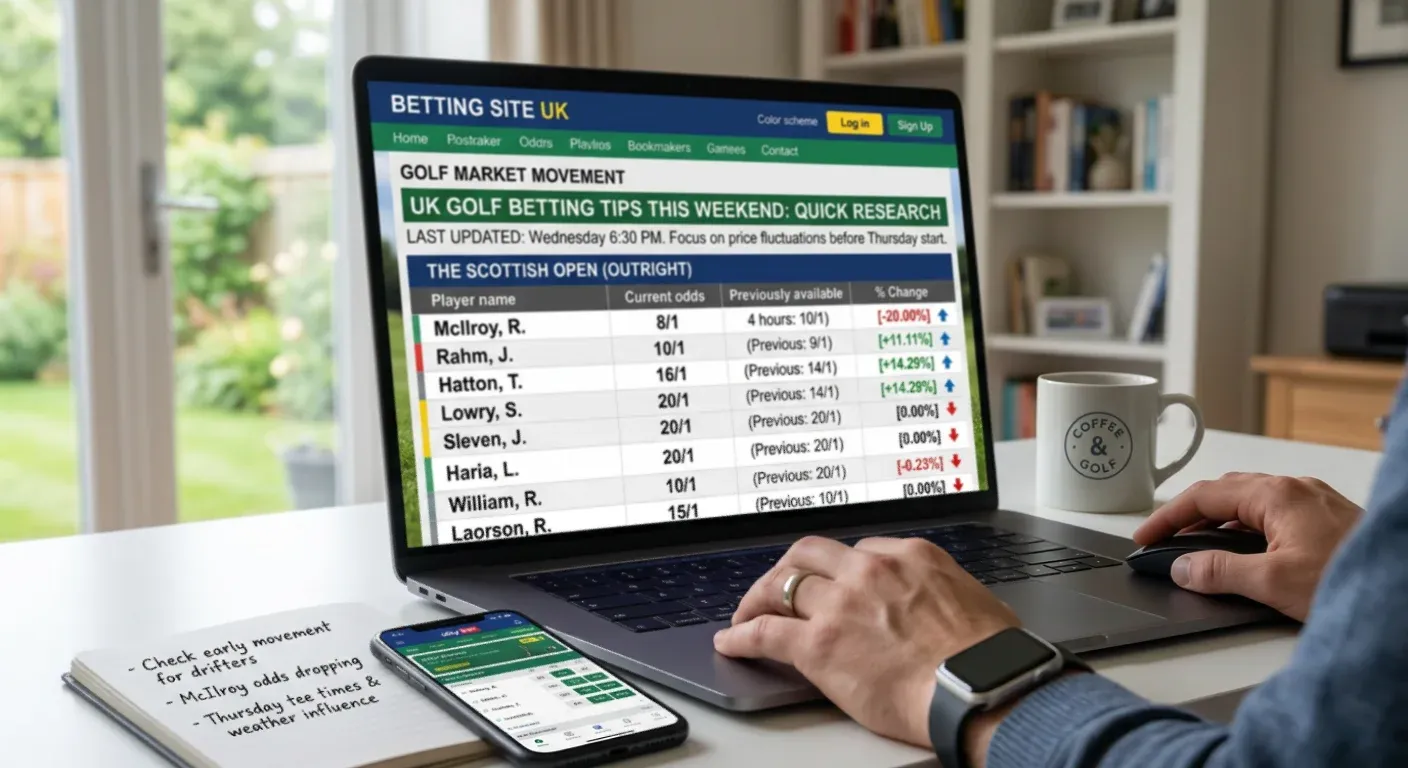
Open the market and compare your intended selections’ prices to what you’d have expected based on their ranking and form. If a player you wanted at 40/1 is now showing at 20/1, significant money has come for them — either smart money identifying the same edge you found, or news you haven’t caught. Either way, at 20/1 the expected value calculation has changed. Check quickly whether the odds movement is explained by any obvious news. If yes, adjust your view. If no explanation is visible, the shortened price simply reflects a market that’s moved against you on this selection — you can still back them, but with reduced stake or not at all if the value has evaporated.

Comparing across bookmakers for the best available price takes five minutes and routinely adds two to three points on at least one of your selections. At 40/1, three points extra is meaningful over the long run. This step is too often skipped under time pressure — don’t skip it. The core tournament research methodology that informs this quick framework is covered comprehensively in the guide to golf course form analysis.
Frequently Asked Questions
What are the most important things to check before a weekend golf bet?
Course type classification, the primary SG category for that venue, and current form over the last five or six starts. These three things — in that order — are the non-negotiable minimum. Weather forecast for Thursday and Friday is the fourth priority. Everything else adds value but can be skipped if time is genuinely short.
How early should I place my golf bets before a tournament?
Tuesday morning gives the longest early-week prices. But Wednesday afternoon placement isn't catastrophically late — the market has been sharpened by then, but late-week information (weather, confirmed absences) may partly compensate. Thursday morning placement is late: prices have tightened significantly and you're placing into a sharp market. Aim for Tuesday or Wednesday, with Wednesday as the practical minimum for informed selections.
Is it worth betting on both PGA Tour and DP World Tour in the same weekend?
Yes, if the research quality is maintained for both. The temptation when betting both is to do half the research on each and compensate with enthusiasm. Resist that. Apply the same framework to both — SG filter, form filter, odds check — and only bet where the selections genuinely clear all criteria. A strong three-event PGA Tour card and a single well-researched DP World Tour selection beats six half-researched picks spread across both.
Articles
Golf Betting Free Bets UK
Free bets are how UK bookmakers compete for new customers — and for good reason. A well-structured offer can genuinely…
Golf In-Play Betting Tips
Saturday afternoon, final round of a DP World Tour event, and the lead changes hands five times between the 12th…
Golf Outright Tips
Backing a tournament winner before a ball has been struck is the purest form of golf betting — and the…
Golf Betting Bankroll Management
The most painful lesson I've learned in golf betting has nothing to do with picking winners. I once had a…
