
Golf First Round Leader Tips: FRL Betting Strategy and Value Signals
 Available in US
The FRL market is one of the most interesting bets in golf — and one of the most frequently misunderstood. Most punters approach it as a shorter-odds outright, essentially backing their favourite player to have a good first round. That’s not entirely wrong, but it misses the structural edges that make FRL a genuinely beatable market when you approach it with the right framework. I’ve spent years breaking down first-round dynamics specifically, and there are repeatable patterns here that the standard golf preview completely ignores.
Why FRL Is One of Golf’s Most Beatable Markets
Most betting markets are priced by people with access to good information. The outright winner market on a major PGA Tour event is sharp — there are teams of analysts, quant models, and sharp professional bettors all competing to find inefficiencies. The FRL market is priced by those same bookmakers, but with a fraction of the betting volume and analytical attention. That asymmetry creates opportunities.
DataGolf’s database covers over 2.1 million match records and results across professional golf worldwide. A fraction of that data is directly applicable to first-round scoring — opening-round Strokes Gained, scoring averages in round one specifically, and how players perform when grouped with particular types of playing partners. Very few casual punters have accessed this level of granularity. That’s the edge.

First-round leader markets also benefit from a narrower time horizon than outright betting. You’re assessing a player’s likelihood of posting a low score over 18 holes, not their ability to sustain form across 72 holes in varying weather conditions. The variables you need to assess are more controllable: current form, tee time, course conditions for that specific wave, and recent ball-striking numbers.
Tee Time Advantage: Morning vs Afternoon Waves
I’ll tell you something that took me two seasons to truly internalise: tee time is not a secondary consideration. On certain course types and in certain weather windows, it is the primary variable — more predictive than recent form, more predictive than world ranking, more predictive than course history.
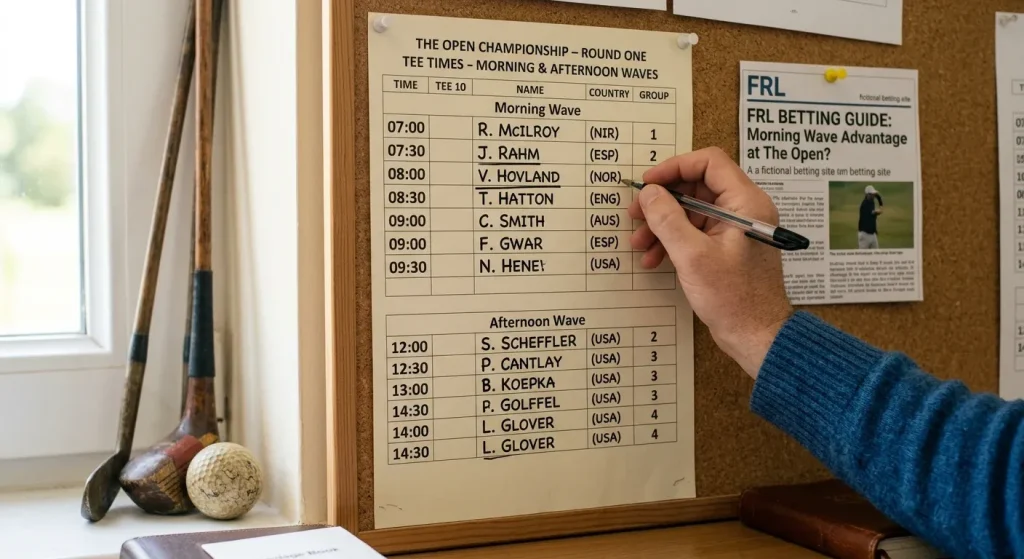
Links courses in particular are dramatically affected by wind. At a tournament like The Open Championship, or any coastal DP World Tour event, the morning wave might play in 8mph wind while the afternoon wave fights 25mph gusts. That’s not a minor scoring advantage — that’s a scoring differential of potentially four to six shots over a single round. When the morning wave consistently outscores the afternoon wave by that margin, the FRL winner is almost always coming from the earlier draw.
Parkland courses and stadium-style venues are more neutral, but softer morning conditions — when greens are still receptive from overnight dew and the course hasn’t been tightened by foot traffic — still offer a marginal advantage for approaches. The effect is less dramatic than on links, but it’s real and it’s consistent across the data.

The practical application: check the Tuesday/Wednesday weather forecast for tournament day. If the forecast shows building wind or deteriorating conditions through the day, weight your FRL selection heavily toward the morning draw. If conditions are stable all day, tee time becomes a secondary factor and you can prioritise form and SG metrics more confidently.
Approach play — SG:APP specifically — is the most predictive metric for many course types, as players who consistently gain strokes on approach shots create birdie opportunities that directly translate into low opening rounds. For Augusta-style courses, approach play is the dominant variable. For driving courses, SG:OTT takes primacy. Matching the dominant metric to the specific course profile is the core analytical work for FRL selection.
Form and Stats That Predict FRL Performance
Not all Strokes Gained categories are equally useful for FRL prediction. The four SG categories — off the tee, approach, around the green, and putting — each carry different predictive weight depending on the course type and the time horizon you’re forecasting. For a single round, putting variance is high enough that I discount recent putting statistics more heavily than I would for an outright pick. A player can putt brilliantly for 18 holes despite weak recent putting averages, or putt poorly despite being in excellent putting form. It’s the most volatile component in the short run.
What I prioritise for FRL is recent ball-striking form. SG:OTT and SG:APP over the previous four to six starts — specifically the rolling average, not the season total — tells you who is hitting it well right now. A player who’s been gaining 1.5 strokes per round on approach over their last four events is in striking (no pun intended) form for a low opening number.
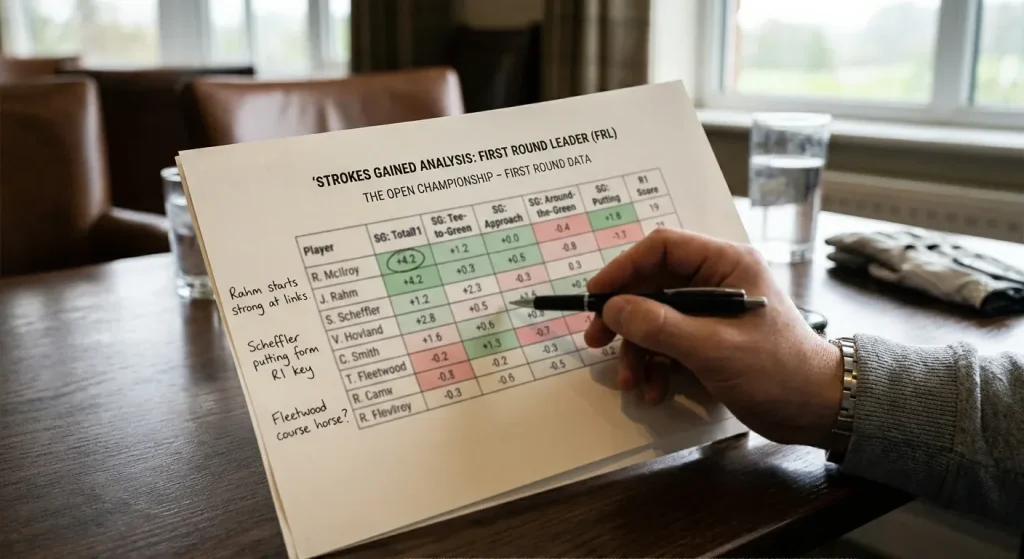
Opening-round scoring average is a legitimate standalone metric. Some players are demonstrably better in the first round than across all four rounds — possibly because they play more aggressively when the pressure is lower, or because their preparation routine peaks on Thursday. If a player shows a first-round scoring average that’s a full stroke better than their overall four-round average over a significant sample, that’s relevant information for FRL betting.
Cut-making rate is an indirect but useful filter. Players who regularly make the cut are, by definition, not having catastrophic opening rounds. A player with a 70% cut rate over 30 starts is consistently putting up scores that keep them in tournaments — exactly the profile that contributes to FRL contention. For deep-dive SG analysis that informs which metrics to prioritise for any given course profile, the guide to Strokes Gained golf betting covers the full methodology.
FRL Each-Way: Is It Worth the Extra Stake?
Most bookmakers offer each-way on FRL markets, typically paying two to three places at one-quarter the win odds. The question of whether to back win-only or each-way on FRL selections depends on the specific odds and your probability assessment — the same framework that applies to any each-way decision.

At shorter odds — say, a player priced at 8/1 for the FRL — backing each-way at two places gives you a place price of 2/1. If your probability assessment for a top-two finish is better than the 33% implied by 2/1, the each-way component has value. At longer prices — 25/1 or more — the each-way element becomes more attractive because the place fraction (6.25/1 at two places, 1/4 odds) offers genuine value on a top-two finish that’s relatively probable for a strong in-form player.
My general approach: at prices below 12/1 for FRL, I lean win-only unless the place terms are particularly generous. At 16/1 and above, the each-way structure often gives better long-term expected value because the place probability is meaningful at that price range. Track your FRL returns separately for win-only and each-way to understand which approach works better within your specific selection methodology.
Frequently Asked Questions
Does tee time really make a difference in FRL betting?
Yes — on links and coastal courses in particular, tee time can be the single most important variable. When morning conditions are significantly calmer than afternoon conditions, the FRL winner almost always comes from the earlier draw. Check the weather forecast for tournament day before finalising any FRL selection. On parkland courses, the tee time effect is smaller but still relevant.
Which stats are most predictive for first round leader picks?
Recent SG:APP and SG:OTT over the previous four to six starts are the most reliable short-term indicators. Opening-round scoring average relative to overall scoring average identifies players who perform especially well in round one. Minimise the weight you give to recent putting stats for FRL purposes — putting is too variable over 18 holes to be reliably predictive.
Is there an each-way option on the FRL market?
Yes, most UK bookmakers offer each-way on FRL markets, typically paying two to three places at one-quarter the win odds. Whether each-way adds value depends on the specific price and your probability assessment. At longer prices above 16/1, the each-way component usually offers better expected value than win-only. At shorter prices, win-only is often the more efficient stake.
Articles
LIV Golf Betting Tips
LIV Golf has been running long enough now that the novelty argument for ignoring it in betting terms has expired.…
Golf Betting Bankroll Management
The most painful lesson I've learned in golf betting has nothing to do with picking winners. I once had a…
Best Golf Tipsters UK 2026
I've wasted money on tipster services that looked impressive until I asked one simple question: where's the verified proof? The…
Golf Betting Value Bets Explained
The word "value" gets thrown around in betting circles so often it's almost lost meaning. Every tipster claims to find…
