
Masters Betting Tips: How Augusta National Rewards Specific Player Types
 Available in US
Augusta National is the most predictable Major venue in golf — if you’re looking at the right metrics. That sounds counterintuitive given that the Masters produces dramatic finishes and regular surprises, but the data behind who contends at Augusta is strikingly consistent. Multiple finalists from 2017 to 2025 shared a specific performance profile. Once you understand what Augusta actually demands from a champion, the betting analysis becomes more systematic and less dependent on the narrative noise that surrounds the tournament every April.
What Augusta National Demands from a Champion
Augusta is a par-72 course measuring around 7,500 yards in modern setup, but length alone doesn’t tell the story. The course is unusual in that its primary challenge comes not from the tee but from the approach. The greens at Augusta are notoriously difficult — elevated, sloped, with pin positions that punish anything above the hole. Getting approach shots below the hole is the tactical challenge that defines scoring at Augusta, and it directly explains why approach play — specifically SG:APP — is the single most predictive metric when assessing Masters contenders.
The patterns in the data are clear. Finalists and winners at Augusta from 2017 through 2025 consistently showed SG:APP numbers above +1.0 per round in the weeks and months leading into the tournament. Players gaining an average of one stroke per round on approach shots are creating birdie opportunities from below the hole — exactly the quality that Augusta’s sloped greens reward. Players losing strokes on approach, regardless of how impressive their driving statistics or world ranking, struggle consistently at Augusta.

Approach play is the most predictive metric because it directly creates birdie opportunities. Players who consistently gain strokes on approach tend to outperform over time, even if short-term results fluctuate due to putting variance. Augusta’s green complexes amplify this effect more than almost any other venue on tour — the difference between an approach that finishes 15 feet below the hole and one that finishes 15 feet above the hole is the difference between a makeable birdie putt and a genuinely terrifying par attempt.
SG:APP at Augusta: The Number That Matters Most
SG:APP — Strokes Gained: Approach to the Green — measures how a player performs on approach shots relative to the PGA Tour average. A player with +1.5 SG:APP is gaining 1.5 strokes per round on approach play compared to the average professional. That’s an enormous edge over 72 holes.
The reason SG:APP is specifically powerful at Augusta relates to the architecture of the course. Holes like the 10th, 11th, 12th, and 13th — Amen Corner — all feature approach shots that demand precise yardage control and trajectory management. Overshooting the green at the 12th leads to the back bank and almost certain bogey. The 11th green slopes aggressively front-to-back and rejects anything that doesn’t land in the correct section. The 15th requires an approach that stops on a sloping green rather than running through. Every one of these demands excellent approach play.
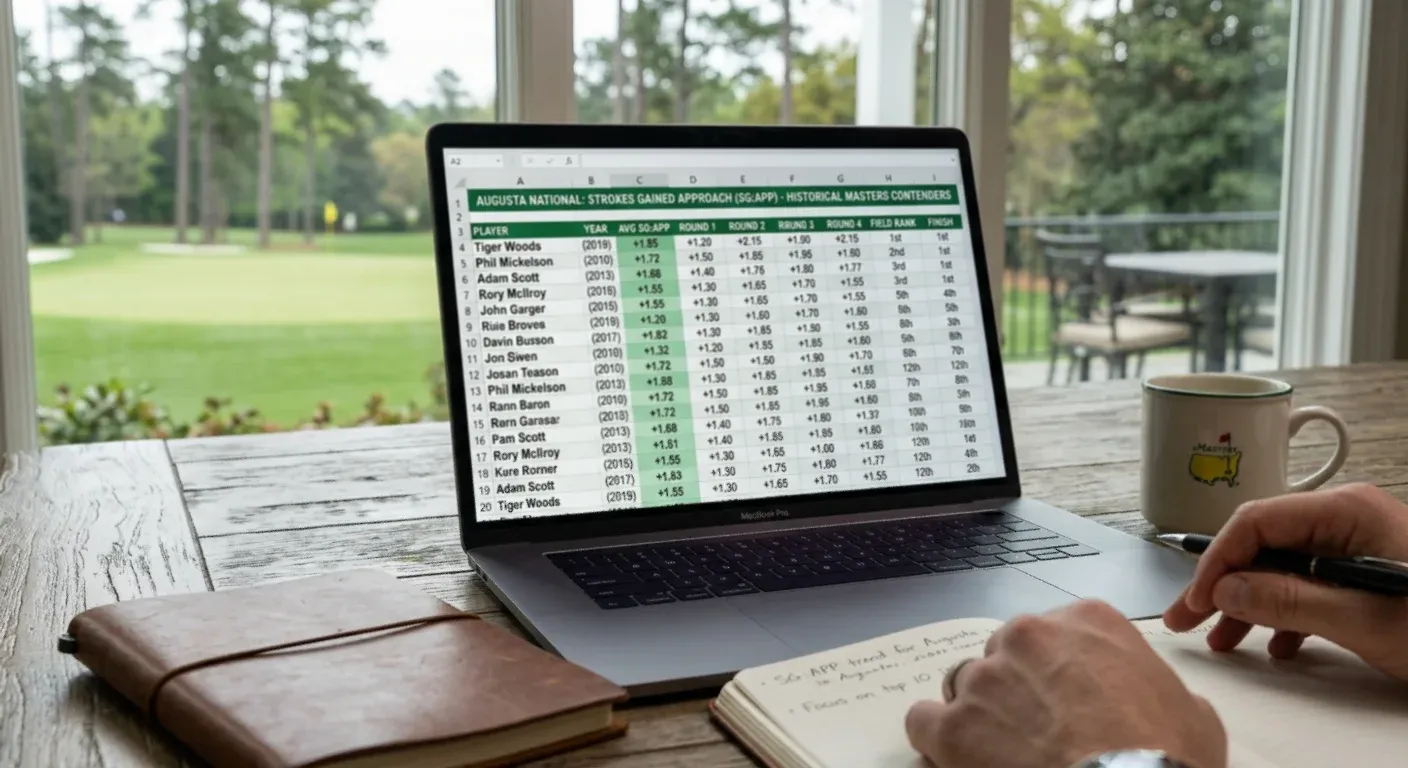
DataGolf’s database of over 2.1 million professional records allows you to isolate each player’s SG:APP performance not just overall but specifically on courses with similar green characteristics to Augusta — bermudagrass greens, elevated putting surfaces, significant slope. That’s the most predictive filter for Augusta contenders. A player with excellent SG:APP on bentgrass greens but poor numbers on bermudagrass is a weaker Masters pick than their overall SG:APP number suggests.
Rolling average SG:APP over the previous 12 months weighted toward the most recent starts is the calculation I use. Season-total numbers are useful as baseline context, but form right now matters more than what a player did in October. A player who’s been gaining 1.8 strokes per round on approach over the last six starts is more interesting than one who averaged 1.5 for the full year but has been drifting toward 0.8 recently.
Reading Masters Form: Recent Starts vs History
Augusta is one of the few venues on tour where course history carries genuine predictive weight. The course is private and rarely changes its fundamental character — the bermudagrass greens, the specific architectural challenges, the premium on approach accuracy — and players who’ve navigated it successfully before have demonstrated that their game profile is a match for Augusta’s demands.
But course history needs to be interpreted carefully rather than simply weighted by past results. A player who won or finished top five at Augusta six years ago and has subsequently seen their SG:APP decline from +1.8 to +0.4 is not a strong Masters pick based on that history. Their game profile may no longer match what Augusta requires. Conversely, a player who finished outside the top 20 at Augusta three years ago but has since dramatically improved their approach play — perhaps shifting from a strong driver/weak iron game to a more balanced attack profile — may be significantly underrated by a market that weights historical results too heavily.

Putting on fast bermudagrass greens is worth noting as a secondary variable. Augusta’s greens are genuinely different from most PGA Tour venues — faster, firmer, more sensitive to green-reading. Players who’ve demonstrated good putting numbers on bermudagrass over the previous season are better equipped than their overall putting statistics might suggest if those numbers are pulled down by poor bentgrass performance.
Each-Way Value at the Masters Market
The Masters market is one of the most competitive in golf betting. It attracts enormous attention, significant sharp money, and bookmaker resources dedicated to pricing it accurately. Finding genuine value in the outright market is harder at the Masters than at a routine weekly event — but it’s not impossible, and the each-way structure creates specific opportunities.
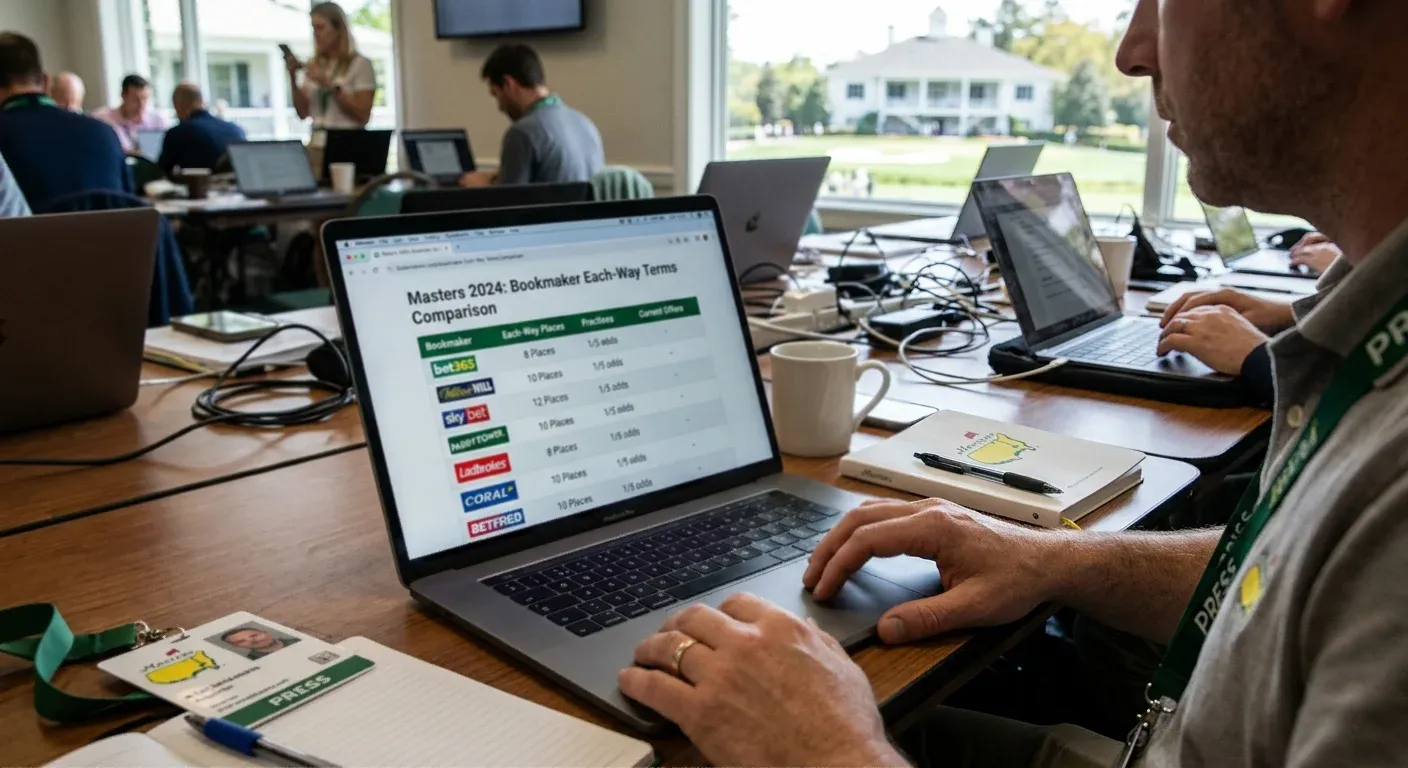
The Masters has a relatively small field — typically around 85 to 90 players — which changes the each-way mathematics compared to a 156-player PGA Tour event. Standard five-place each-way terms at a bookmaker paying one-quarter odds covers roughly the top 6% of the field, which is a meaningful proportion in a field this size. Expanded each-way terms — eight or ten places, which some bookmakers offer for major events — cover roughly the top 10% of an 88-player field. The implied probability for a top-eight finish is substantially different to the same target in a 156-player field.

The each-way strategy I’ve found most effective at the Masters is identifying players with strong SG:APP profiles and Augusta course history who are priced in the 40/1 to 80/1 range. At those prices, the place component of an each-way bet carries significant value if the player is genuinely a contender. A player priced at 60/1 with genuine Masters-profile credentials and an eight-place each-way market gives you a place price of 12/1 on what might be a realistic 15-18% chance of a top-eight finish. For a detailed breakdown of how Strokes Gained analysis underpins this kind of selection process, the full methodology guide is available at Strokes Gained golf betting.
Frequently Asked Questions
Which Strokes Gained category is most important at Augusta?
SG:APP — Strokes Gained: Approach to the Green — is the most predictive metric at Augusta National. The course's sloped, elevated greens reward approach accuracy above all other skills. Multiple Masters finalists from 2017 to 2025 showed SG:APP numbers above +1.0 per round. Filter specifically for bermudagrass SG:APP performance for the most relevant dataset.
How many places do bookmakers pay on the Masters each-way market?
Standard terms are five places at one-quarter the win odds. The best UK bookmakers expanded their each-way terms in 2025, with some offering eight or more places on major events including the Masters. The small field size of around 85-90 players means each place represents a higher percentage of the field than in a standard weekly event. Always compare available each-way terms across bookmakers before placing.
Does course experience at Augusta matter for betting purposes?
Yes, but it must be combined with current form data. Augusta experience matters because the course presents genuinely unique challenges — fast bermudagrass greens, specific approach angles, Amen Corner management — that benefit from previous exposure. However, a player whose SG:APP has declined significantly since their best Augusta results is not a strong pick simply because of past history. Weight both: current approach play form and Augusta-specific experience.
Articles
Golf Accumulator Tips UK
I've built some genuinely satisfying golf accumulators over the years — and I've also watched them die on the third…
PGA Tour Free Picks
The paid tipster subscription industry exists because most people don't believe they can do this analysis themselves. Some of that…
Golf Outright Tips
Backing a tournament winner before a ball has been struck is the purest form of golf betting — and the…
DP World Tour Betting Tips
The DP World Tour gets substantially less analytical attention per event than the PGA Tour, and that's precisely where the…
